My name is Tony, and I’m a new member of the MacroOps team. I wanted to take a moment to introduce myself, share what I do, and explain how I’ll be contributing around here. But first, a little backstory.
Not long ago, I was sitting where you are. This was back in 2020 when the world was reeling from Covid. During this period, I realized my work in markets had some considerable gaps that needed filling. As I’ll get to shortly, my focus has always been on the volatility complex, and as much as I felt comfortable with that side of markets, I knew there was more to learn. A lot more. Right around then, the X/Twitter algorithm dropped a thread from Alex in front of me that pinned me to my seat. This was the missing piece. Or pieces, as it turned out.
Just like you, I started with the free content. The Dirty Dozen became my north star. It complemented my work perfectly. It was high-level, big picture. Alex started with the macro and drilled into the micro. My work built up to the macro from the micro. His work cast a wide net, while I fished near the boat. But then something changed. I realized the information was incomplete without a process for identifying expressions of the trade ideas and the tools to size and manage the positions responsibly. That’s when I decided to invest and join the Collective.
That was 2021, and in the six years since joining the Collective, I’ve seen firsthand what makes the MO team and the Collective so special.
So, what is it?
About a year ago, Alex came to me and said he felt his work had some blind spots and one of those blind spots was the volatility complex. Humility and self-awareness are two of the defining characteristics of MacroOps operators, and here was the head operator acknowledging where he was vulnerable. Up until that point I knew how unique the MO approach to markets was, but this showed me how unique the MO culture was, established at the top, permeating throughout. Humility, integrity, and the endless pursuit of improvement.
As it turned out, it wasn’t just Alex. Brandon’s alignment with Alex was undeniable from the moment I joined. He brings an insatiable appetite for learning to every market session, and his enthusiasm and excitement shine through in every report he writes.
Mike G. and I were Collective members at the same time, and some of the early work he shared with the Collective shaped my trading forever. And now a week doesn’t go by that I’m not forced to hold a mirror up to myself because of his weekly essays on trading psychology and philosophy.
Dean and I are the newbies around here, but don’t let his short tenure at MacroOps fool you. He applies decades of market experience to building and honing some of the most powerful market regime tools I’ve seen. The synergies between his work, Brandon’s, and Alex’s are incredibly powerful.
So, how do I fit in this mix? Let’s start with what I do and why.
What I Do
My work at MacroOps is really twofold. First, and as noted above, I study the volatility complex intensely, and I share my takeaways with the Collective every week in my video series, Vol Street Journal. I primarily use the VIX complex, think VIX, VVIX, and VIX futures, but my work extends beyond that world. I also track individual stock volatility and correlations, as well as the volatility markets of other key marketplaces such as U.S. Treasuries. I built two models that incorporate everything I watch. Together, they paint a clear picture of what stressors are present in the market and whether the market can handle them.
Watching the volatility market so closely for so many years has helped me develop a feel for the broader market environment at any given time, which we then use to inform the MacroOps risk stance. If the volatility market is healthy and resilient, we’ll lean into “risk-on” positions, something that is playing out right now. This contributed to our decision to add to our long Nasdaq exposure this week.
Despite all the worries in the world today, market volatility is calm and resilient, creating a supportive environment for equities. How do I know it’s calm and resilient? For one, the VIX futures term structure is upward sloping from bottom left to top right, and VIX itself is below the entire curve. You can see this in the image below, which depicts the curve after market close on Monday, October 5.
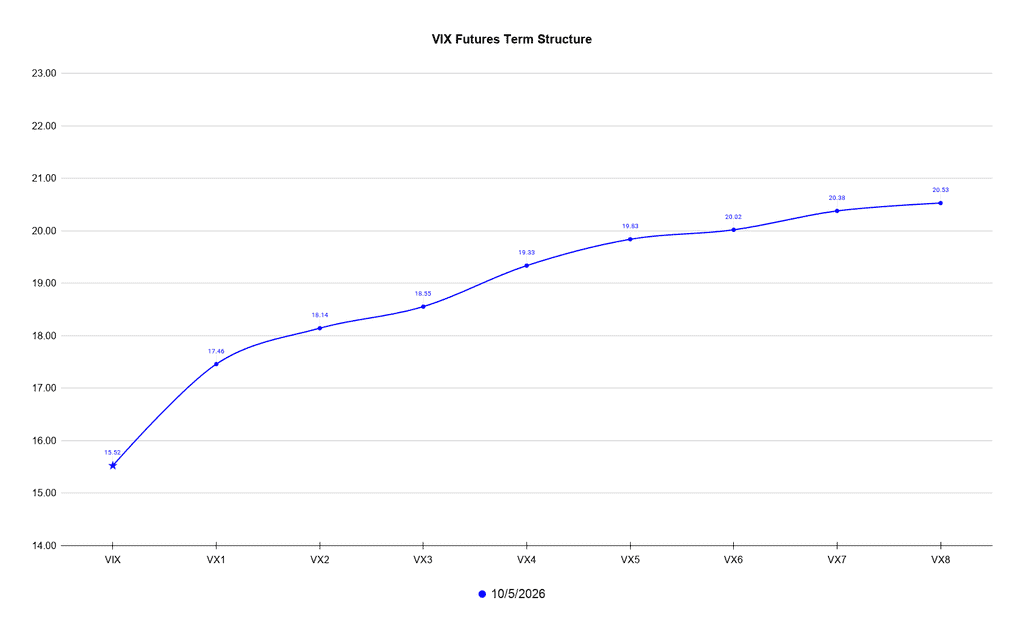
A snapshot of the curve is one thing. But studying the movements of the curve through a multitude of market regimes and deciphering the subtle messages the curve is sending is where my expertise comes in.
My second role at Macro Ops is running a mean reversion, positioning-based futures strategy that delivers uncorrelated returns to the other strategies in the book. But that’s not the focus of today’s note, so let’s get back to volatility.
Why the volatility complex?
In my time studying and trading markets, I’ve come to believe that the volatility market is one of the most insightful players in the room, so listening to what it’s saying is critical to grasping the true health of financial markets. If we can translate what the VIX complex is telling us about market stress, resilience, and regime shifts, we have a real edge in knowing when conditions are fragile versus when they’re healthy or simply noisy.
The VIX complex reacts to everything happening across all major markets, not just equities. During any given regime, the VIX complex will tell you what it cares about. In some regimes, it’s all about equities. In others, interest rates play a larger role. Sometimes energy markets have an outsize influence. Once you know what the VIX complex cares about, your understanding of equities markets improves greatly.
The VIX itself may be only a calculation, but the inputs that feed into the calculation reflect the hopes, fears, and positions of millions of market participants. The VIX is derived from S&P 500 options, the world’s largest and most liquid options market, used by institutions and individuals alike. The insights that can be gleaned from studying the VIX, the options market that underpins it, and the futures and futures options markets that are built around it are very powerful. Hence, why all of my market analysis begins there, and why my work is now part of the MacroOps suite.
Why now?
Macro Ops is evolving. With 10+ years under its belt, a fortified foundation built on humility, integrity, and performance, and a community of exceptional market operators, we’re stepping confidently into the future. The team is growing, the tools are improving, and new opportunities abound. If you want to be part of this evolution, enrollment in the Collective is open this week. Prices are set to double next year so if you’re sitting where I was back in 2020 considering making this investment in yourself, now is the time.
Lastly
As you may have heard or read, the MO team recently joined an established asset management firm to manage capital utilizing the MacroOps investment process. If you are interested in learning more about that opportunity, please review the requirements (here) and then reach out directly.