What happens when trading platforms evaporate, and all that remains is the prompt? This reality is so close I can see the whites of its eyes.
Today, right now, I have an intraday version of my breakout strategy running autonomously in a virtual environment. At the New York Session open, code screens for stocks that match my criteria, populates symbols into order tickets, determines trade levels and position sizing, and submits orders through my broker’s API. It manages positions that fill, closes working orders that don’t, and takes my account flat five minutes before session close.
When I want to alter anything about the strategy—screening criteria, risk levels, suppression rules, trade management—I never open a trading platform. Instead, I write a prompt.
This particular code contains my rules. But a stone’s throw into the future, anyone in the world will be able to direct their AI platform of choice to “trade Qullamaggie’s strategy in my personal brokerage account,” and an approximate replica—soup to nuts—will go to work.
All remaining friction between a human being and their ability to risk capital in financial markets is disintegrating. The technical execution layer of trading is compressing into an invisible layer humans simply speak to. As this occurs, where will edge remain?
The retail prompt trader of tomorrow may say, “I will just let the AI run and not touch it.” Just as traders across time have told themselves, “I will just leave my stop where it is and not move it.” Or, “I won’t double my position size when I feel I’m due for a win.” Or, “I won’t switch strategies when I hit an extended losing streak.“
But they will intervene. Alter size on hope. Strategy hop during panic. Instantaneously.
Naval Ravikant released a new podcast last week outlining his vision of our AI-saturated future. At the 37-minute mark, he states with stark directness what I have seen myself:
“If you have [an AI] trading bot out there, it’s going to be nullified or canceled out by every other trading bot until all the remaining gain will go to the person with the human edge.“
When execution earns nothing, what will your self-mastery yield?
Narratives Not Required
Our team has had a close eye on T-Notes. The 2-Year has been stabilizing above the long-term moving average for a year and half, with volatility compressing into an extremely tight range over the last six months.
Compressed volatility precedes expanded volatility. That expansion can move in either direction … but we’re leaning to the upside, and our Macro Ops Portfolio opened an anticipatory long position in late January.

2-Year T-Note Futures (ZT1!), 1D
In This Infinite Game two weeks ago, under “T-Notes on deck,” I featured a chart of the 5-Year T-Note, stating it “may have already tipped [bonds’] hand, breaking out of a five-month channel.”
This week, that breakout began to follow through.
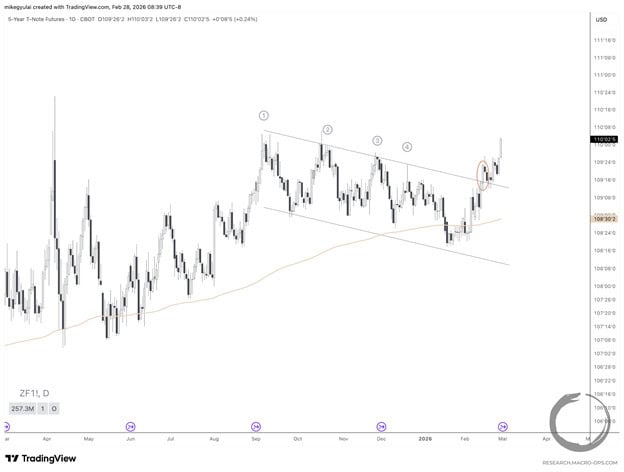
5-Year T-Note Futures (ZF1!), 1D
With regard to this potential move in bonds and its implication for rates, a member of our Macro Ops Collective raised the concern that he simply doesn’t see any existing narrative that would support such a move.
It’s a distinction that warrants discussion.
I am not a macro trader. But I have traded hundreds of technical pattern breakouts. And in my experience, “narratives” are a phenomenon of momentum. Narratives perpetuate a trend that has already taken hold.
In many—if not most cases—the initial breakout from a valid technical level is accompanied by no narrative at all.
A breakout may be accompanied by a discrete, moment-in-time “catalyst” such as a big earnings beat, or a change in policy stance, or geopolitical turmoil. But just as often there is absolutely no clear rationale for a breakout at the time that it takes place, and narratives take shape after the fact, once a clear trend has been established.
Perhaps the most vivid example of this phenomenon has been gold’s arc the last two years.
Gold broke out of a 12-and-a-half year base in March of 2024, and has gone on an astonishing 150% rise across 23 months.
Looking at the chart of gold today, our minds play a trick. They label the entire move explainable by a world of elevated geopolitical tension, policy unpredictability under Trump, and tariff shock.
But the truth is that this narrative formed deep into gold’s trend.
The “Liberation Day” tariffs, to cite the most clear-cut timestamp, were not announced until April 2, 2025, a full year after the initial breakout occurred.

SPDR Gold Shares (GLD), 1M
An honest look back to March 2024 will show the initial breakout framed as a “shock” or “head‑scratching” move: price ripping to new highs faster than the visible fundamentals seemed to justify. The commentary leaned on generic explanations like rate‑cut hopes, geopolitics and technical momentum.
Gold’s move has been absolutely historic. I would never expect something as dramatic in bonds. But if you are a trader who combines the macro with the technical, as we do at Macro Ops, don’t let your mind fool you into believing in revisionist history, and passing on excellent risk-to-reward trade profiles because a clean narrative for such a move has yet to reveal itself.
The Pauses That Refresh
We rang the register on CASY this week following what has been one of the most resilient trends of this recent regime.
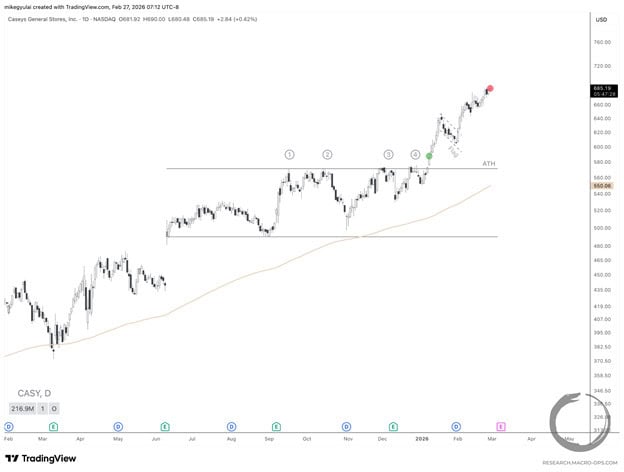
Caseys General Stores (CASY)
Many of the consolidations that had appeared in my screens for weeks have broken structure and been taken off my watch list until they set up again.
Here are the names I’ve seen hold structure as we move into next week:
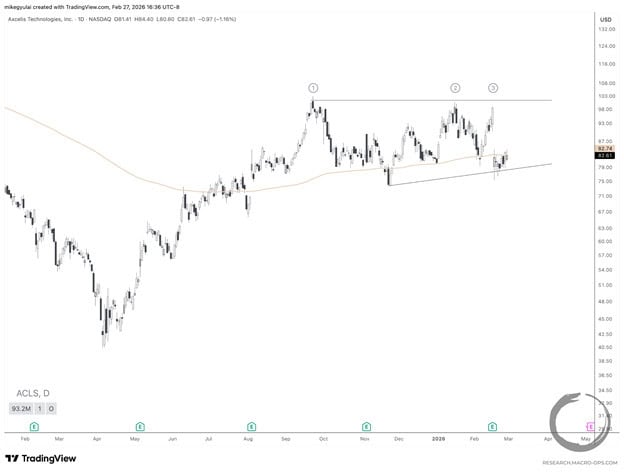
Axcelis Technologies (ACLS)
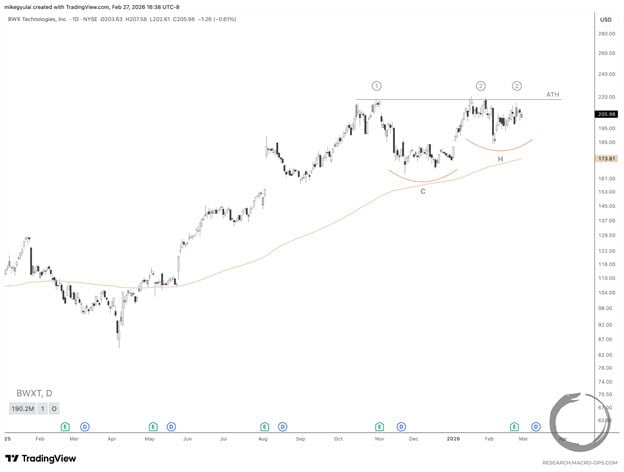
BWX Technologies (BWXT)
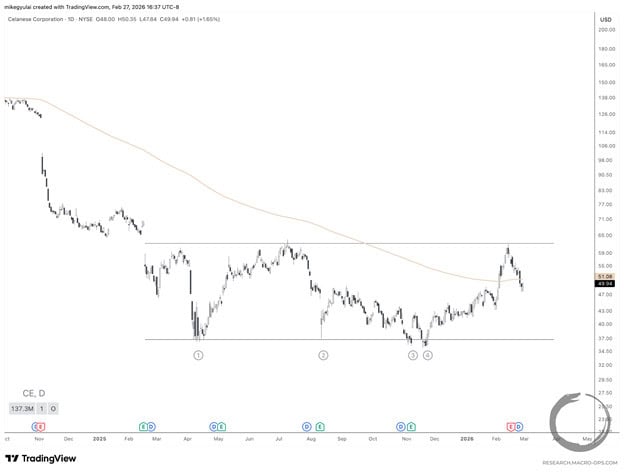
Celanese Corporation (CE)
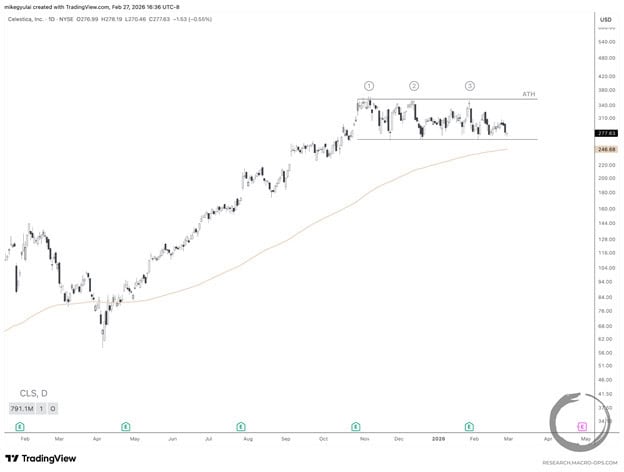
Celestica (CLS)
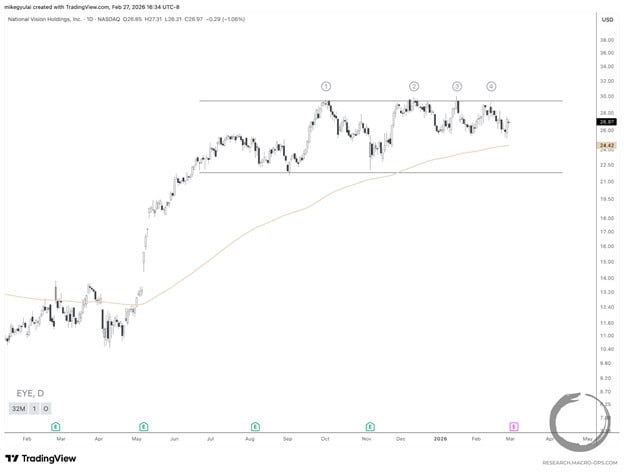
National Vision Holdings (EYE)
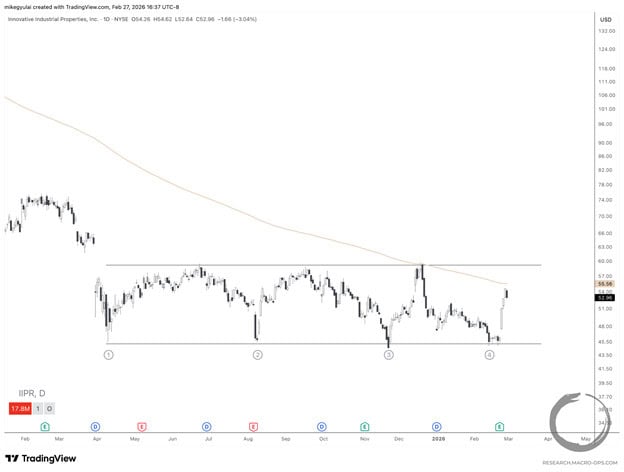
Innovative Industrial Properties (IIPR)

OneSpaWorld Holdings Limited (OSW)
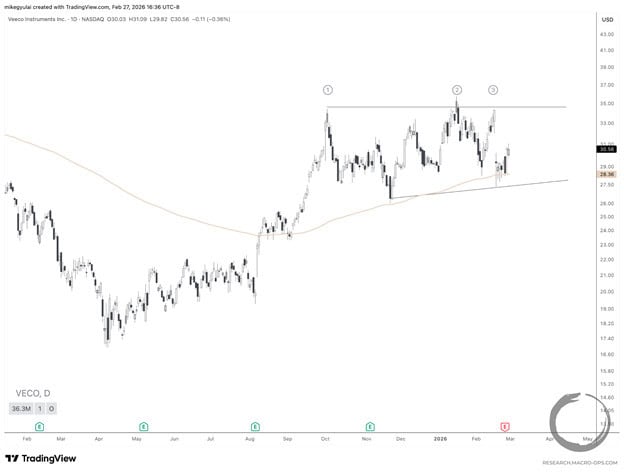
Veeco Instruments (VECO)
Best wishes in your trading, and see you in the next issue.