In a group of highly talented macro traders, I trade math. I screen for predictable, repeating price structures that offer asymmetric reward-to-risk. My setups frame a return four times my risk. I aim to turn over this edge as many times as possible.
One of Macro Ops’s favorite Market Wizards, Peter Brandt, also trades math—much better than me, I’ll add. He’s spoken openly about this focus being birthed out of the worst trading year and longest drawdown of his life.
“I almost quit trading. Really close to it. I had enough money to call it quits for life. Through the help of fellow trader friends, I became obsessed with the math and probability behind trading. Trading became a mathematical challenge, not just a matter of finding a new trade.“
Yet if Peter is obsessed with the numbers, why is he also adamant that human emotions are a trader’s biggest enemy? Shouldn’t that be a problem confined to discretionary traders?
Consider the foundational research of Kahneman and Tversky: losses are roughly twice as powerful psychologically as are gains. The reward-to-risk of my breakout setups may be 4:1. But the pleasure-to-pain ratio is 1:2.
So while the math says “great news!” After ten 1R losing trades and only three 4R winning trades, your account is up 2R in an adverse regime. The psychology says “not so fast!” Each of those 1R losses generated two units of pain. You’re running an eight-unit pleasure deficit.
Trading math looks one way: clean, elegant, rational. But it feels dramatically different. Which is why trading this way is simply intolerable without conscious inward investigation.
Peter’s Factor Report regularly opens with personal commentary. In the August 1, 2025 report, he wrote just two words: “Tough week!” In the next report: “Tough week!” And in the report after: “Tough week! AGAIN!“
This continued for twenty weeks, evolving from “Tough week” to “Tough markets” to “Tough Monday, Tuesday, Wednesday, Thursday, Friday.” When his Factor Service finally closed out 2025 and this four-month stretch ended, he shared his Rate of Return for the year: 70.7%.
“Tough year!”
A Launching Pad in Energy
Dominion Energy has been on my watchlist since late last year. It fit every criteria I look for in my breakout setups: 1) a continuation pattern, 2) multiple months in duration, 3) directionally supported by a long-term trend filter, 4) with three or more reactions to a clearly defined price level.
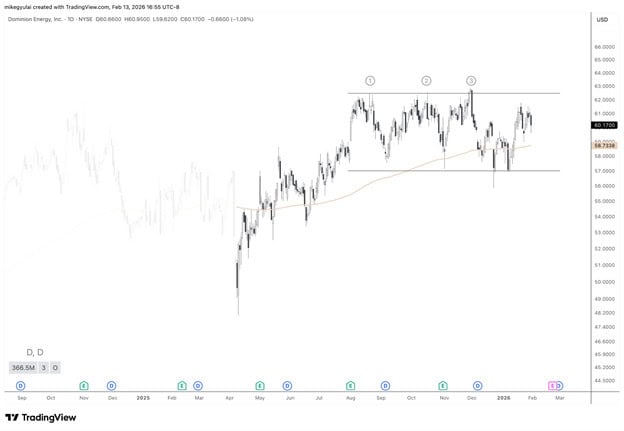
Dominion Energy (D), 1D, January 2026
But there was something unique about this particular Rectangle Continuation pattern … Zooming out, this pattern formed the Handle of a much larger, 15-month Cup & Handle Continuation—which fit all of my breakout criteria in its own right:
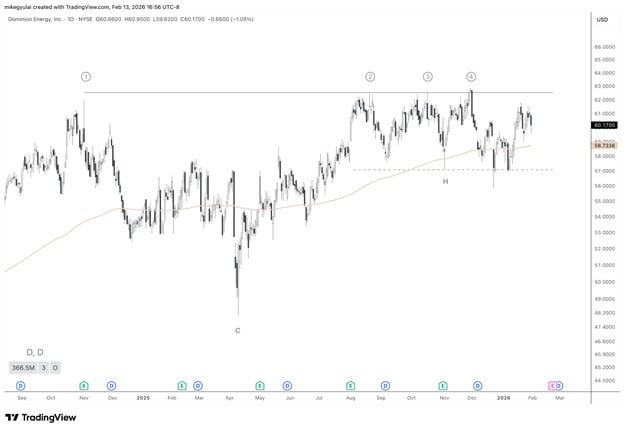
Dominion Energy (D), 1D, January 2026
When a smaller pattern appears nested within a larger pattern, and completion of the smaller pattern would also trigger completion of the larger, that smaller pattern can be referred to as a “Launching Pattern.”
The smaller pattern “launches” the larger.
Such patterns are some of my absolute favorite setups.
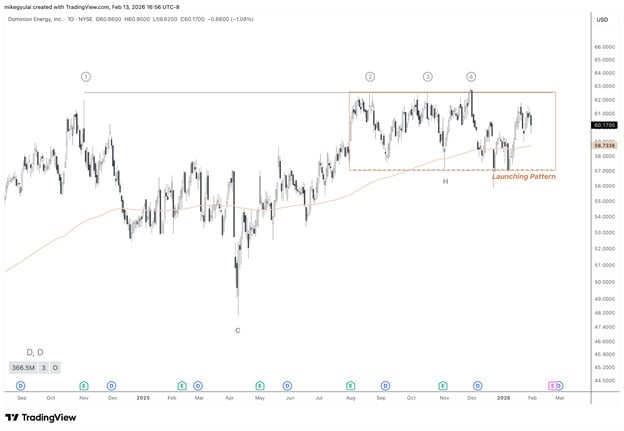
Dominion Energy (D), 1D, January 2026
Last week, I featured Dominion Energy in the active watchlist section of This Infinite Game.
This week, a breakout of the six-month Rectangle Continuation “launched” completion of the 15-month Cup & Handle.
Our Macro Ops portfolio opened a risk-defined position.
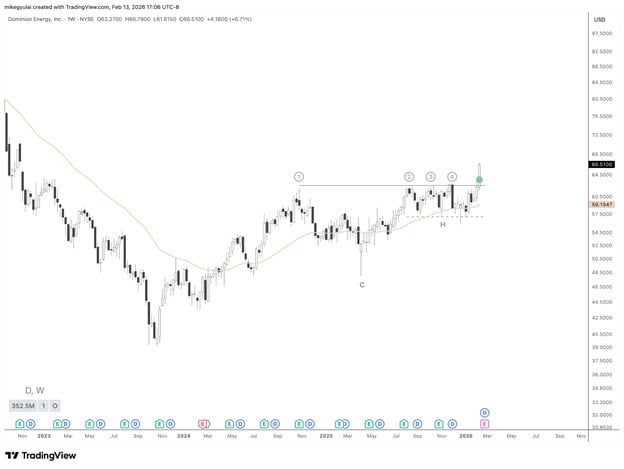
Dominion Energy (D), 1W
Outcomes are unknowable.
But I’ll take this trade 10 out of 10 times it appears.
T-Notes on Deck
There is a strikingly similar setup to Dominion Energy in 2-Year Note Futures:
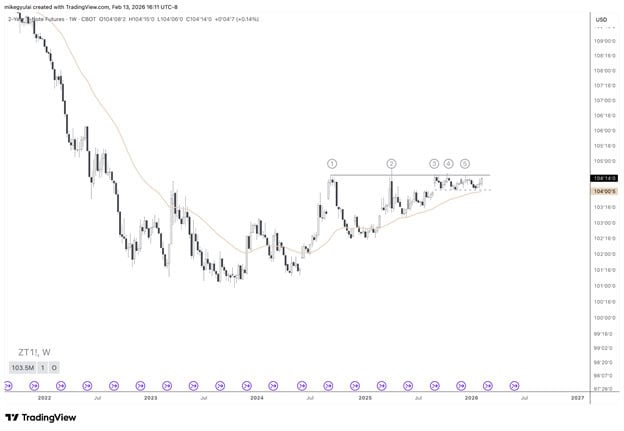
2-Year T-Note Futures, 1D
And 5-Year T-Note Futures may have already tipped their hand, breaking out of a five-month channel on Friday:
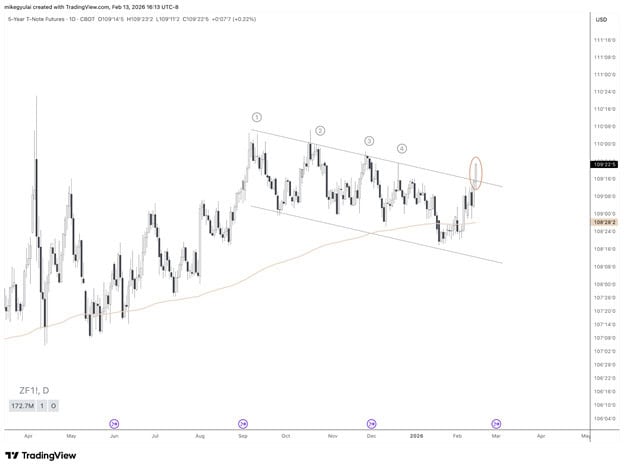
5-Year T-Note Futures, 1D
For an analog of how such channel breaks can play out, see Soybean Oil Futures:
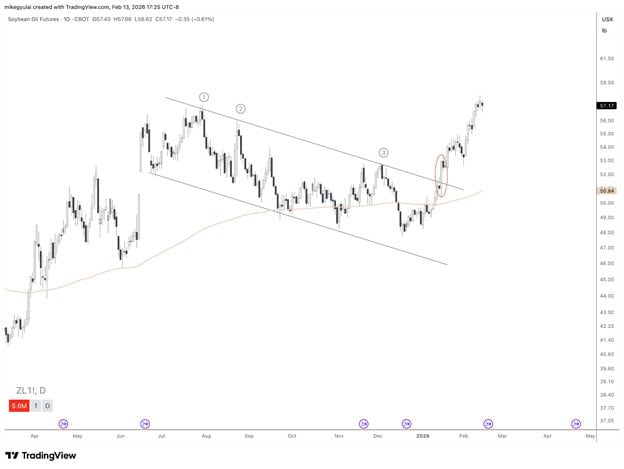
Soybean Oil Futures, 1D
Meanwhile, the NASDAQ 100 Equal Weight ETF looks absolutely atrocious: breaking down a seven-month support level while below the 200EMA trend filter.
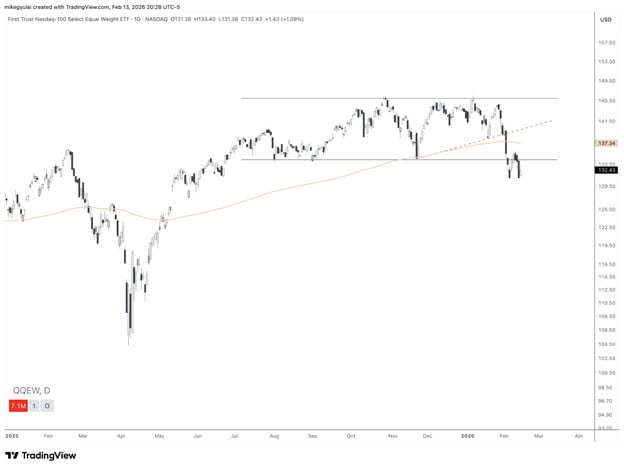
First Trust Nasdaq-100 Select Equal Weight ETF, QQEW, 1D
Tech stocks down, bonds up?
The Pauses That Refresh
As mentioned last week, the names on my active watchlist are narrowing. But there remain a number of high-quality setups pending breakout.
Long setups are currently tilted 2:1 defensive-to-cyclical, spanning financial services, healthcare and life sciences, and consumer and industrial distribution.
Here are the symbols that have my attention going into next week:
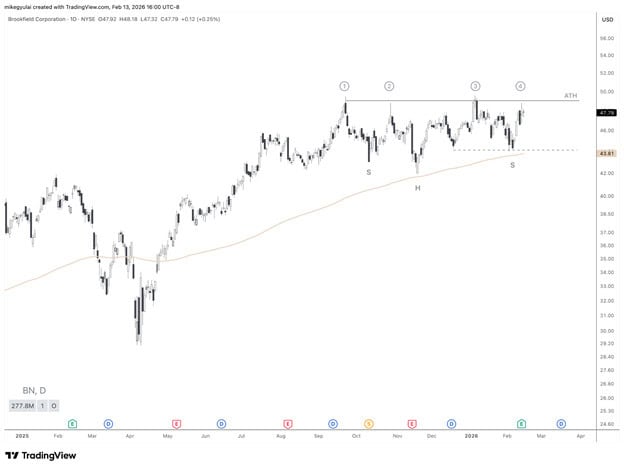
Brookfield Corporation (BN)
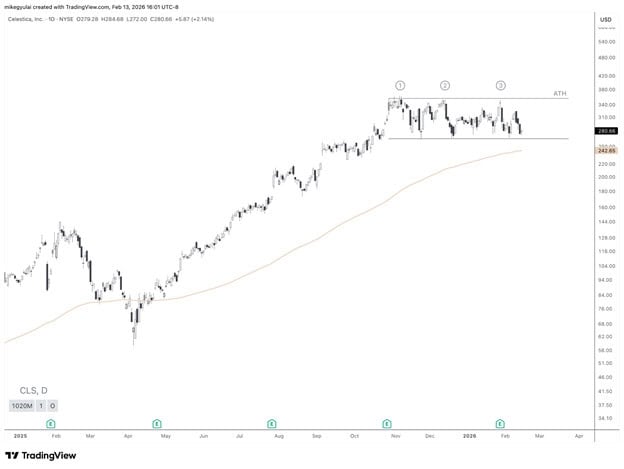
Celestica, Inc. (CLS)
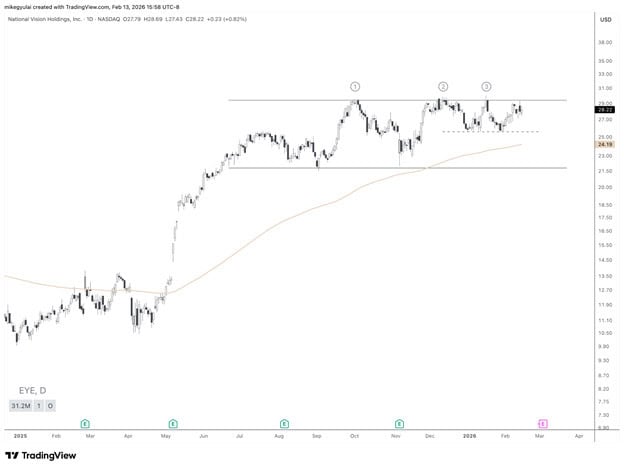
National Vision Holdings (EYE)
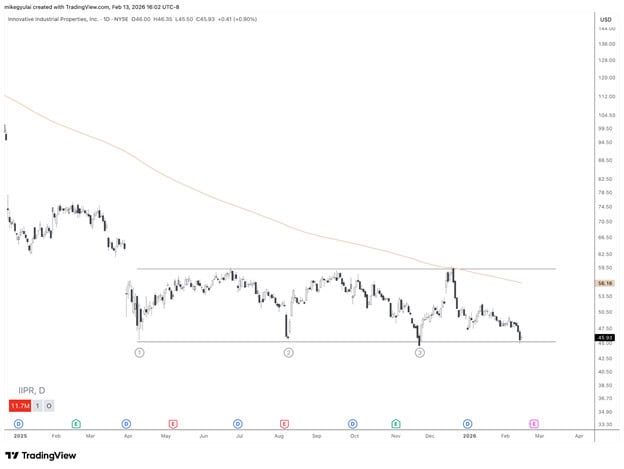
Innovative Industrial Properties (IIPR)
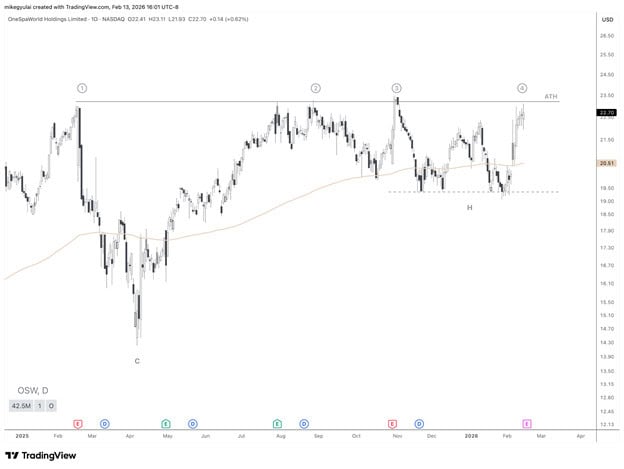
OneSpaWorld Holdings Limited (OSW)
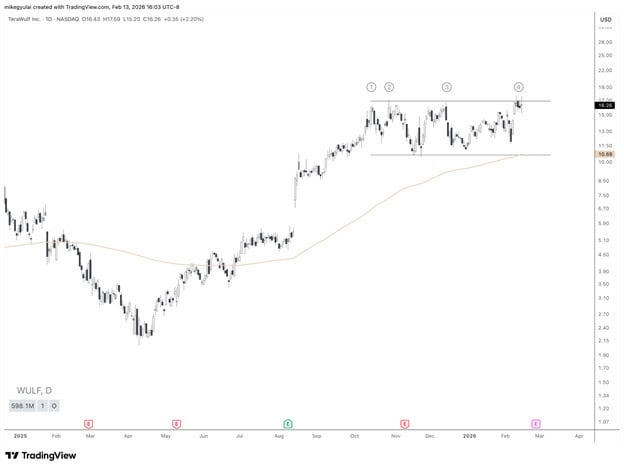
TeraWulf Inc. (WULF)
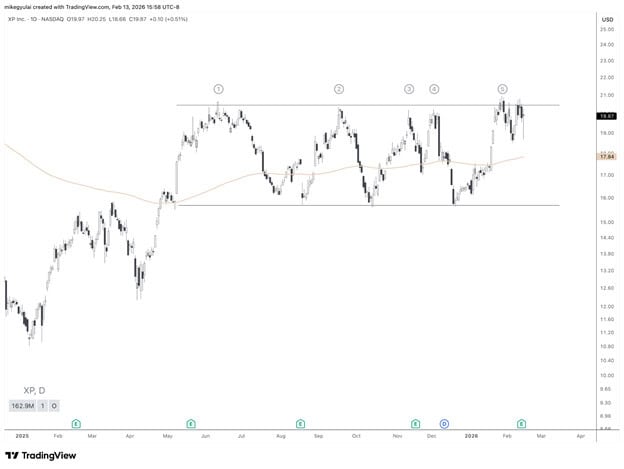
XP Inc. (XP)
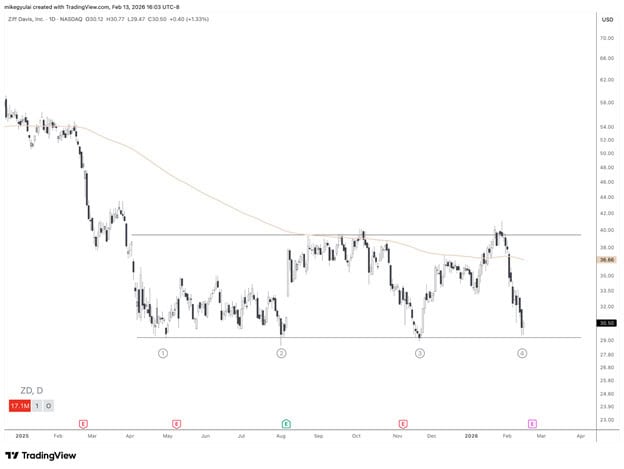
Ziff Davis (ZD)
Best wishes in your trading, and see you in the next issue.