Think about your last emotional trade.
Maybe it was buying after a big rally because it felt like the market would never stop going up. Maybe it was selling during a panic because it felt like the world was ending. Maybe it was sitting in cash for months, waiting for a pullback that never came.
However it played out, I’m guessing it cost you money.
Your brain is literally wired to do the opposite of what makes money in markets. We buy when we feel good, which is usually after prices have already run up. We sell when we feel scared, which is usually after prices have already collapsed. We chase. We panic. We second-guess.
The data is brutal. About 90% of retail traders lose money. Not because they’re stupid. Because they’re human.
Evolution optimized us for survival, not for trading. The same instincts that kept our ancestors alive, run from danger, follow the herd, those instincts destroy portfolios.
What if you could remove yourself from the equation entirely? What if you could let an algorithm make the decisions while you carry on with your life?
Introducing Trendlock
Trendlock is a momentum-based trading system that tells you exactly when to buy, when to sell, and when to sit in cash.
No complex charts to analyze. No news to interpret. No gut feelings to trust.
Just one clear signal every week.
Every Sunday at 6PM Eastern, you get an email. It tells you exactly what to do. You open your brokerage app, execute the trade, and you’re done until next week.
The whole process takes about 5 minutes.
Does It Actually Work?
Let me show you the data.
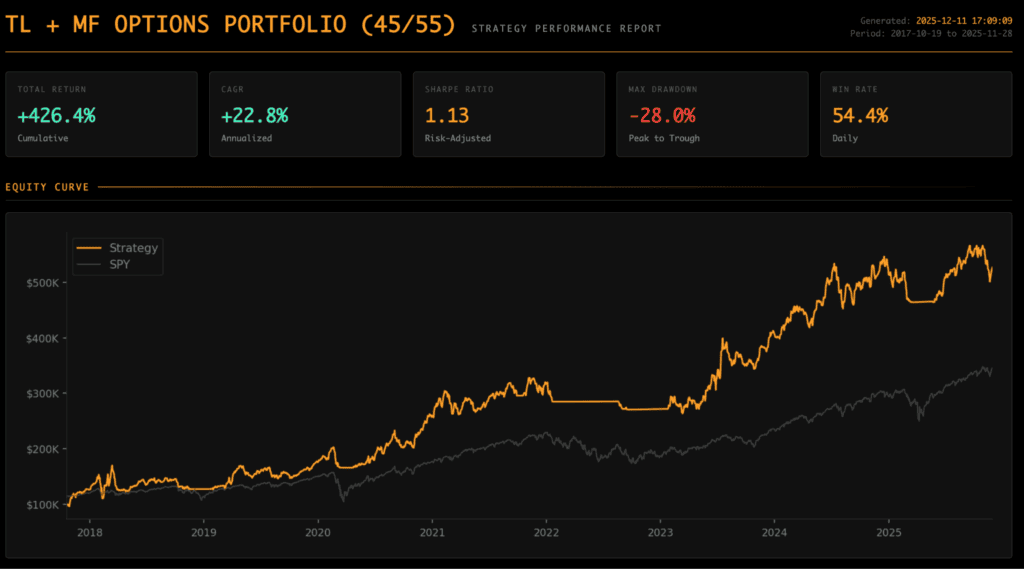
Since January 2020, Trendlock has delivered 29.4% annualized returns with a maximum drawdown of 23.1%.
The system has been running for 2,151 days. That’s nearly six years covering multiple market regimes. The COVID crash. The meme stock rally. The 2022 bear market. The AI boom. All of it.
Here’s the performance breakdown:
- CAGR: 29.4%
- Max Drawdown: 23.1%
- Sharpe Ratio: 0.9
- Sortino Ratio: 0.8
Compare that to buying and holding SPY through the same period. You’re getting significantly better risk-adjusted returns with substantially less pain during the rough stretches.
But the numbers that matter most are what happens during the chaos.
Built to Survive the Crashes
Anyone can make money when the market goes up. The question is what happens when it doesn’t.
Look at the performance across different market regimes:
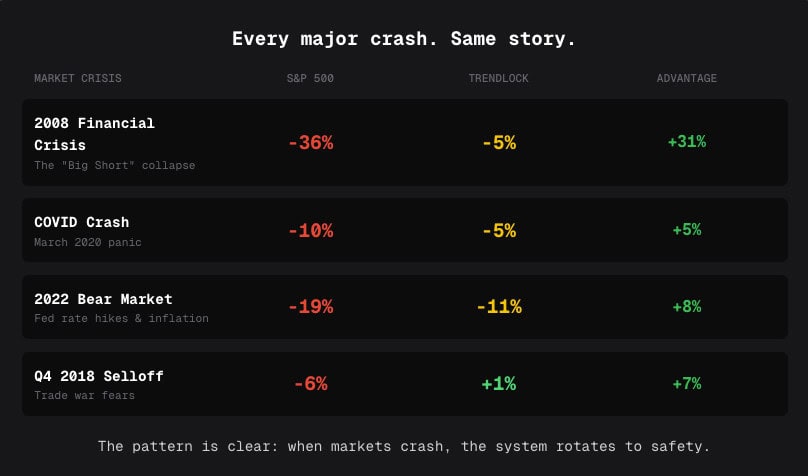
During the COVID-19 pandemic in March 2020, when markets dropped 34% in a matter of weeks and nobody knew if the world was ending, Trendlock navigated through it systematically. No panic selling. No emotional decisions.
Through the post-COVID run-up in 2020-2021, when the market was grinding higher in the face of constant bearish narratives, the system stayed in. It didn’t try to call the top. It rode the trend.
During meme season in 2021, when retail traders were piling into speculative garbage and the market was showing signs of froth, the system remained disciplined. It didn’t chase the hype.
When Russia invaded Ukraine in 2022 and the Fed started hiking rates aggressively, triggering a 25% bear market, the system managed risk appropriately. It didn’t ride positions down hoping for a recovery.
And during the AI boom from 2022 to present, when the market has been in that grinding Blended Bull regime I keep writing about, the system has captured the upside while managing the periodic sharp selloffs.
The system has been stress-tested across multiple market cycles. When conditions favor being aggressive, you’re in. When they don’t, you’re out. You’re not sitting there wondering what to do. You’re following a systematic process.
That’s the whole point.
How It Works
The algorithm analyzes price trends and momentum indicators to determine whether the market is in an uptrend, downtrend, or consolidation.
When conditions are strong, you’re in leveraged ETFs capturing the move. SSO for the S&P, QLD for the Nasdaq, UWM for small caps.
When momentum fades, you rotate to BIL, which is essentially cash.
The system doesn’t try to be in the market all the time. It waits for conditions that favor being aggressive, and it steps aside when they don’t. The current asset allocation is roughly 95% in equities and 5% in cash equivalents, but that changes based on market conditions.
Turnover is only 8%. That means the system isn’t constantly churning. It averages about one position change every ten days. Some weeks you do nothing. Other weeks you rebalance.
You’re not trying to predict anything. You’re not trying to time the market. You’re following a systematic process that tells you exactly what to do and when.
What You Actually Do
Sunday at 6PM Eastern, you check your email.
You see one of three instructions. Buy. Sell. Or hold your current position.
You open whatever brokerage you use. Fidelity, Schwab, Robinhood, whatever. You execute the trade as instructed.
Done.
Go live your life. The system watches the market so you don’t have to.
No staring at charts all day. No trying to interpret what the Fed is going to do. No reading X/Twitter threads trying to figure out if this is the crash or just a pullback…though you should read mine 🙂
One email. One decision. Five minutes per week.
The Reality Check
I’m not going to pretend this is a magic money printer.
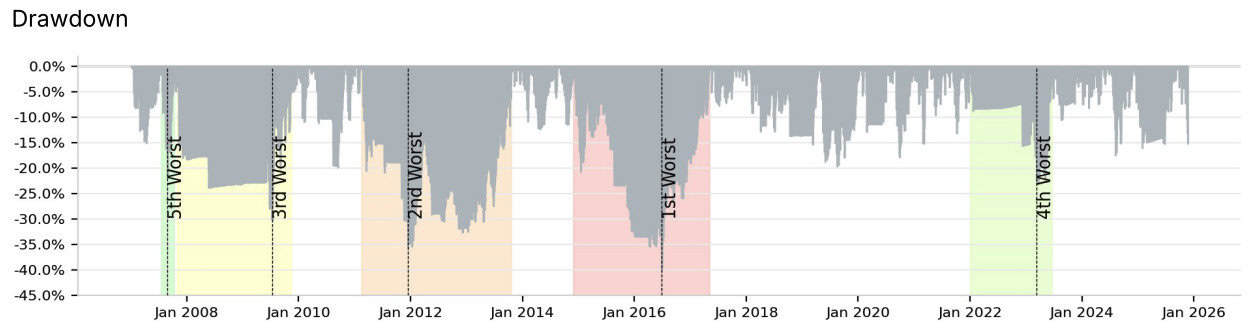
There will be drawdowns. The system experienced its maximum drawdown of 23.1% during the testing period.

Not every month is a winner. Not every year is a winner.
There will be periods where you’re buying and selling and stopping out, wondering what the system is doing. There will be times when the system exits a position and the market immediately rips higher without you. There will be times when the system gets back in and immediately takes a loss.
That’s trading. No system avoids that entirely.
But here’s what the system does avoid: it avoids you making emotional decisions when your brain is screaming at you to do the wrong thing.
Look at the alternative. Buy and hold investors ride every crash all the way down. They feel every percentage point of pain. Many of them sell at the worst possible moment and lock in those losses forever. They didn’t have a system telling them what to do. They were making emotional decisions in the middle of a panic.
Trendlock gives you a process. It removes you from making decisions when your emotions are running hot. It handles the hard choices so you don’t have to.
If you can’t handle stretches of underperformance, this isn’t for you. If you need to win every month, this isn’t for you. If you’re looking to 10x your account in six months, this isn’t for you.
But if you can stick with the process, if you can follow the signals even when they feel wrong, the math works in your favor over time.
A 29.4% CAGR compounds to life-changing returns if you can actually execute it consistently.
That means it’s 3.7X your initial investment in 10 years.
That’s +1217% return on investment in 10 years.
$100,000 becomes $1.317.000.00 in 10 years.
This is why compound returns matter so much. That consistent 29.4% annually turns into life-changing money over a decade if you can actually stick with the system through the drawdowns.
The Cost of Not Having a System
Think about your last emotional trade. The one where you bought too late or sold too early. The one where you panicked and locked in a loss. The one where you sat on the sidelines while the market ran without you.
How much did that cost you?
Now multiply that across years of trading. All the second-guessing. All the overtrading. All the times you knew what you should do but couldn’t pull the trigger.
That’s what a system solves. It takes you out of the equation.
You don’t have to be smarter than the market. You don’t have to predict the future. You just have to follow the signal.
Stop Guessing
Every week you spend making emotional decisions is another week of second-guessing, overtrading, and leaving money on the table.
The system will be available for first come first serve later this week.
The only question is whether you’re ready to stop trading with your gut and start following a process.
More details on how to get access coming soon.