Let me tell you what my Sunday looks like.
6pm: I open an email. It says “Hold SSO” or “Rotate to QLD” or “Move to BIL.”
6:02pm: I place the trade.
6:05pm: I’m done. I close my laptop and go watch a movie with my family.
That’s TrendLock. One email. One trade. Five minutes. Then I carry on with my life while the system does the heavy lifting.
No charts. No CNBC. No obsessing over what Powell said. No reading Twitter threads trying to figure out if this is the top or just a pullback.
The system compounds at 15.2% annually since 2015 (higher since 2020). Not by predicting the future, but by following momentum and rotating to safety when conditions deteriorate.
But here’s the part most people miss:
During the 2022 bear market, when SPY dropped 24%, TrendLock was down just 7%. During COVID’s crash, it outperformed by nearly 4%. It’s not about making money when everything’s going up, anyone can do that. It’s about not getting destroyed when everything falls apart.
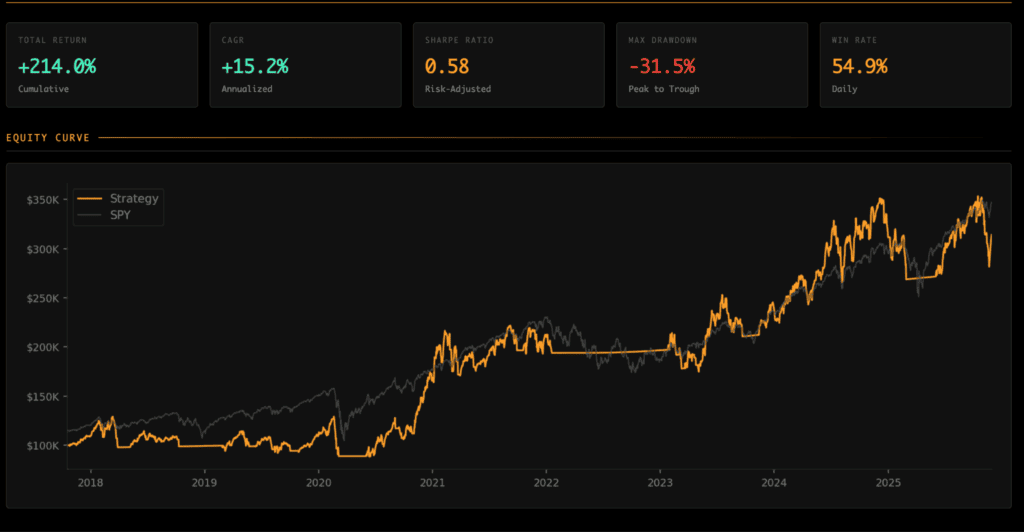
The upside without the pain of the downside.
Now, TrendLock alone beats SPY. You don’t need anything else.
But I have a second system that I’m including for free.
Monthly Flip.
And it’s dead simple. One trade per month. You get an email telling you what to buy. A few weeks later, you get an email telling you to sell. That’s it.
What’s the edge we are exploiting here?
It exploits the “turn of month” effect, one of the most well-documented calendar anomalies in equity markets. Institutions have been quietly profiting from this for decades. We just do it better.
It’s great if you just buy the stock.
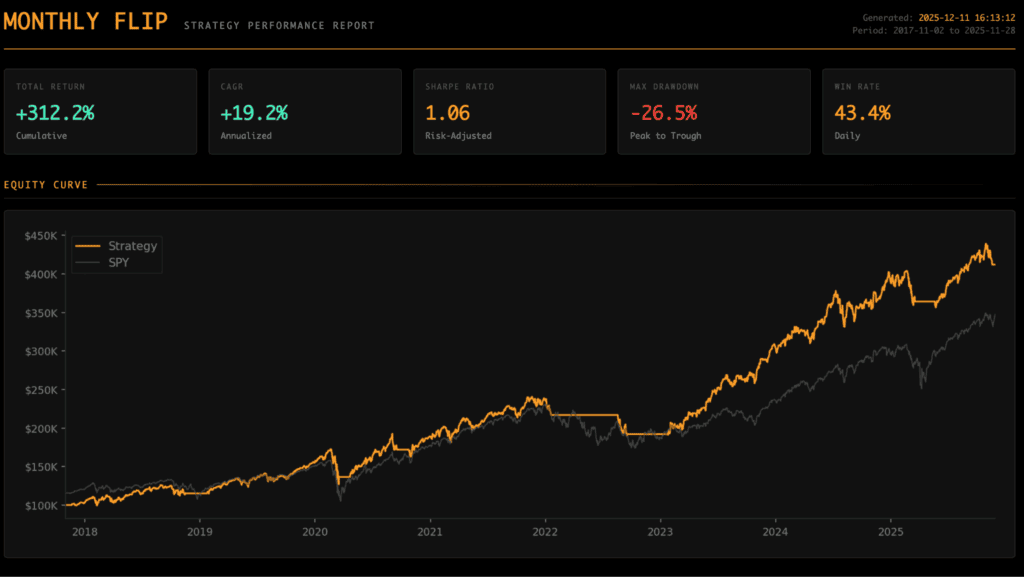
And when you use options instead of stock for Monthly Flip, specifically I use bull call spreads, the returns get ridiculous.
+34% compounded annually. 1.16 Sharpe ratio. Zero correlation to the S&P 500.
Read that last part again. Zero correlation. That means when SPY tanks, Monthly Flip Options doesn’t care. It’s doing its own thing. During COVID’s crash, when the market dropped 33%, Monthly Flip Options was down less than 7%.
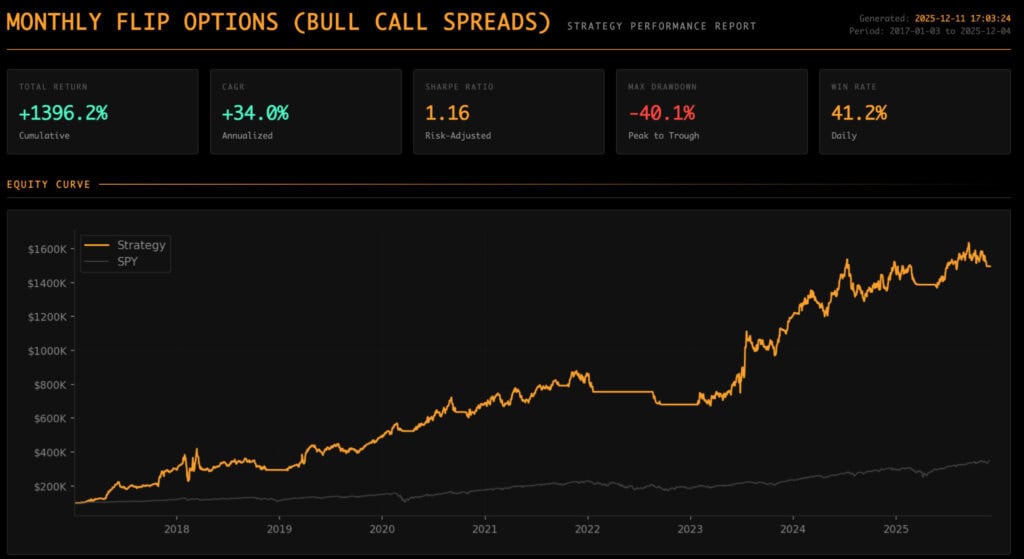
The math on combining uncorrelated strategies is beautiful. You get higher returns with lower drawdowns. It’s not magic, it’s diversification done right.
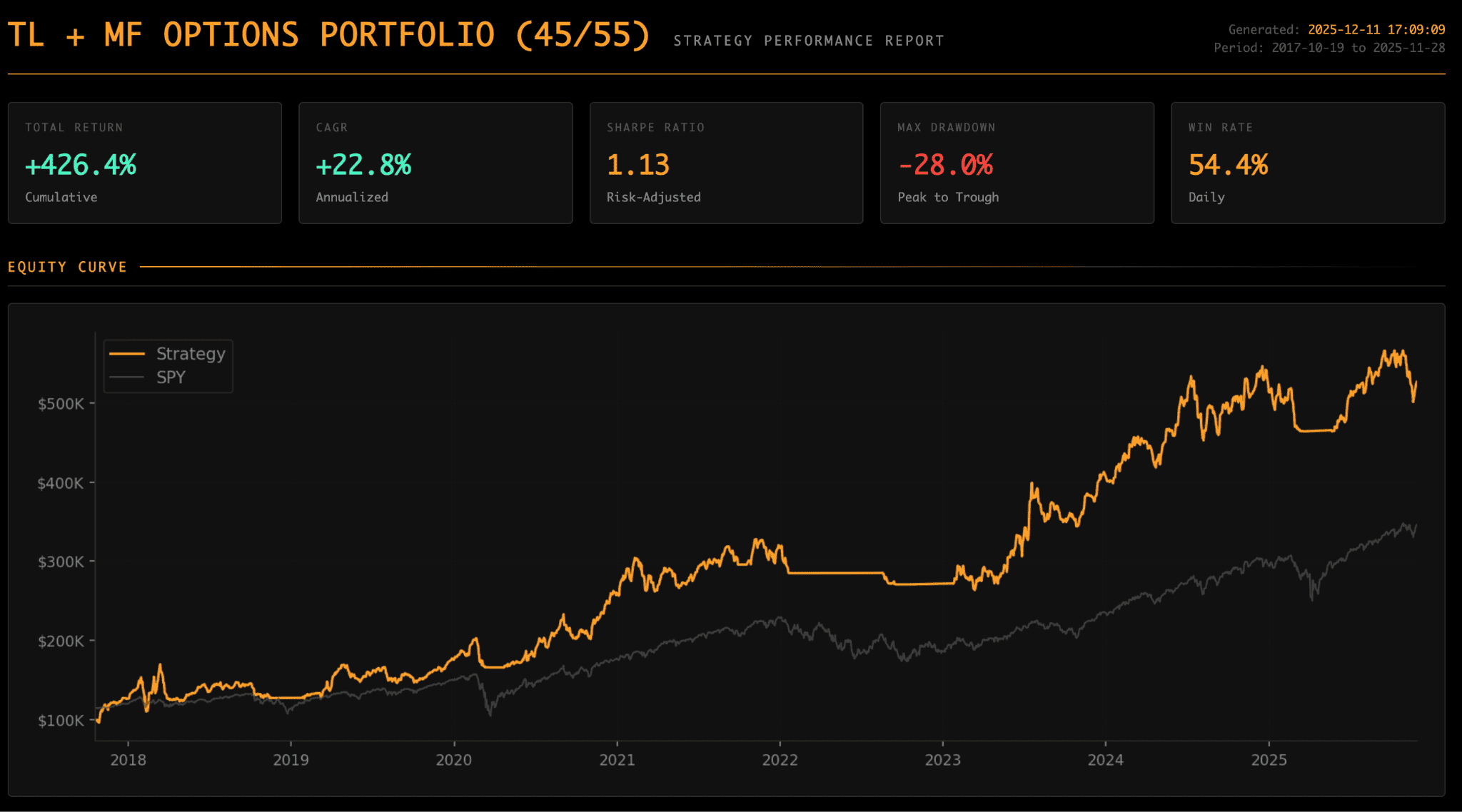
When you run TrendLock + Monthly Flip Options together, the combined portfolio has delivered:
+22.8% annually with a 1.13 Sharpe ratio and a max drawdown of just 28%.
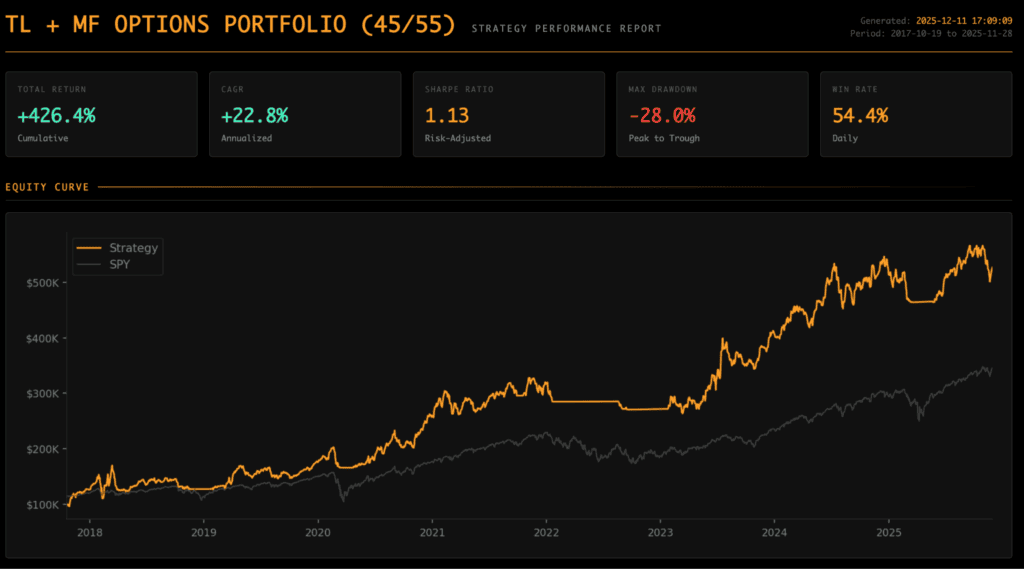
Compare that to buy-and-hold SPY: ~10% annually with 33%+ drawdowns and a Sharpe around 0.5.
Here’s what you actually do:
TrendLock (weekly): Sunday at 6pm, you get an email. It tells you to buy SSO, QLD, UWM, or rotate to BIL (cash). You execute. Done until next Sunday.
Monthly Flip (monthly): Once a month, you get an email telling you what to buy and how long you’ll hold it. I use bull call spreads for this (defined risk), efficient capital. If you’re not comfortable with options, you can just buy the stock. A few weeks later, you get an email telling you to sell.
Everything is on the dashboard. Every position. Every signal. Full transparency.
Look, I know what you’re thinking.
These returns look too good to be true.
I thought the same thing. So I stress-tested everything. 2008 simulation. COVID. The 2022 bear market. Thousands of Monte Carlo runs.
The edge is real. It’s held up for decades. But it requires one thing from you:
You have to actually follow the signals.
Not second-guess them. Not skip the ones that “feel wrong.” Not override the system because you think you know better.
The 22.8% CAGR assumes perfect execution. Miss signals, deviate from the plan, add your own ideas on top, and you’re running a different system with unknown results.
The monthly trade is coming up soon. If you’re not in, you miss it.
Sunday is the next TrendLock signal. If you’re on the fence, now is the time to get set up.
Either system alone beats SPY. Running them together makes things even better. But you don’t need both to start.
You just need to stop fighting your own psychology and let a system do what it’s designed to do.
Both strategies. Full dashboard access. Weekly and monthly signals delivered to your inbox.
The next signal goes out Sunday at 6pm ET.
P.S. – A year from now, you’ll either be following a system that’s been beating the market for a decade… or you’ll still be refreshing your portfolio, reading Twitter threads, and wondering why you keep buying tops and selling bottoms. Same price either way.
Hidden Content