Key points:
- Financials and health care retained the top two dual trend sector rankings
- The technology sector jumped from 7 to 3 in the rankings over the last week
- Application software had the highest proportion of absolute and relative highs
Sector and industry trends reflect a pro-cyclical market bias
The S&P 500 surged to a new record high last week, breaking decisively out of its multi-month consolidation. Although the major technology indexes have yet to reclaim their own records, technology stocks were a significant contributor to the S&P 500’s advance. This improvement is evident in our sector rankings, which apply our Dual Trend indicators and several other measures to individual stocks and then aggregate the results to produce a bottom-up ranking of each sector. Technology climbed from 7th place at the end of the prior week to 3rd place at the end of last week, trailing only financials and health care.
With five of the six top spots occupied by cyclical sectors, leadership continues to favor an offensive posture.
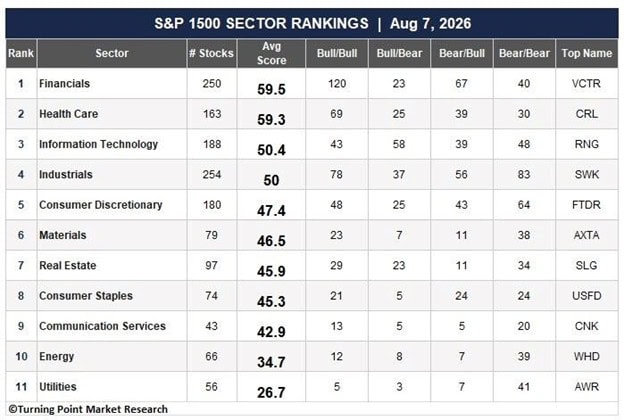
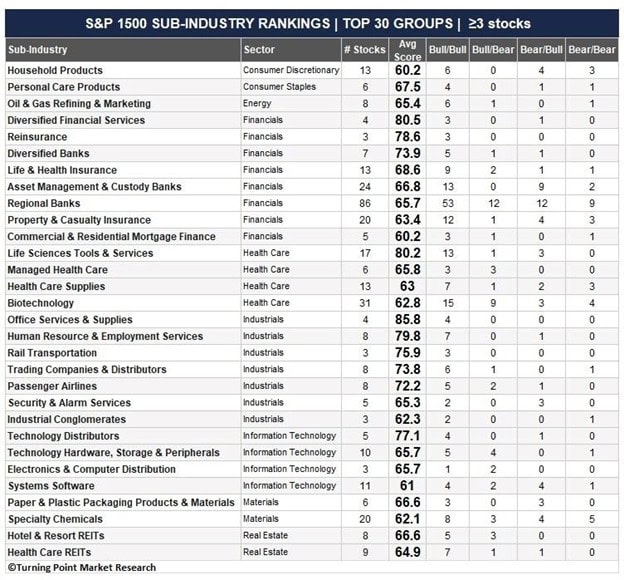
Within financials, diversified financial services ranks as the top sub-industry group, while life sciences tools & services leads within health care. Notably, life sciences tools & services ranks third overall across all sub-industries, with 13 of its 17 stocks exhibiting both bullish short- and long-term Dual Trend signals. Interestingly, systems software, which has been a laggard for much of the year, has climbed into the top 30 sub-industry groups.
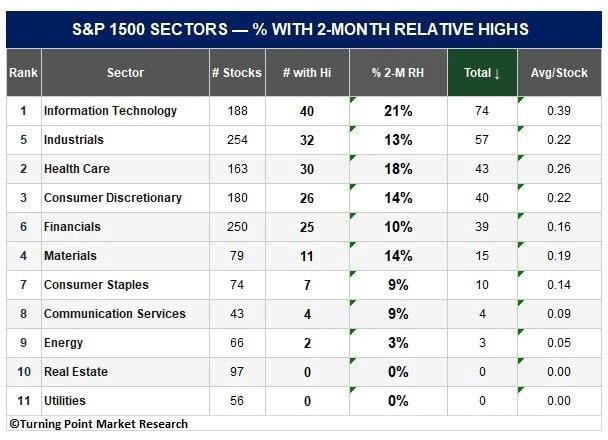
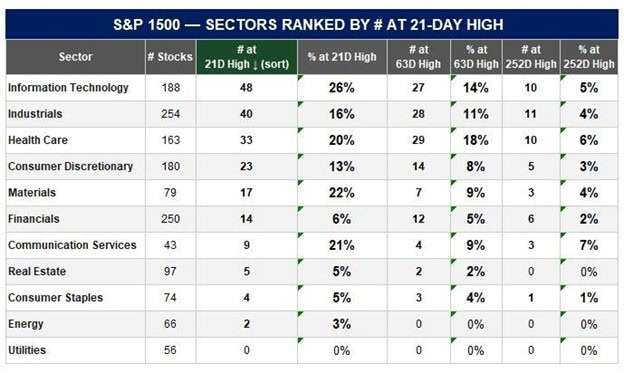
Over the past week, technology led all sectors in the proportion of stocks making new two-month relative highs, followed by industrials and health care. This once again points to a distinctly pro-cyclical configuration across the sector landscape, a common feature in stock market uptrends.
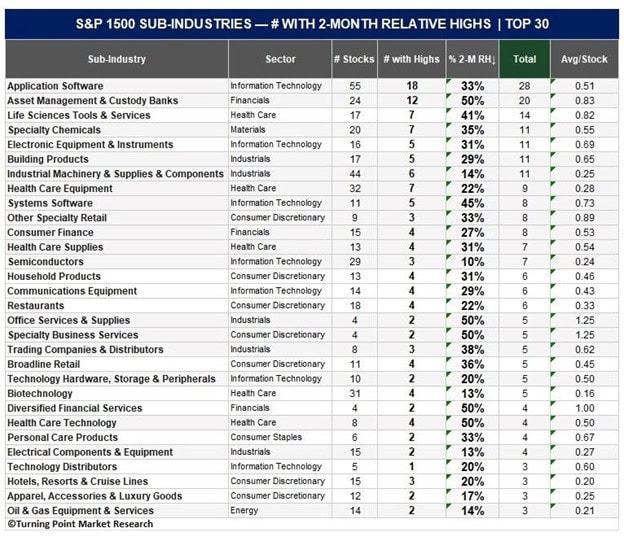
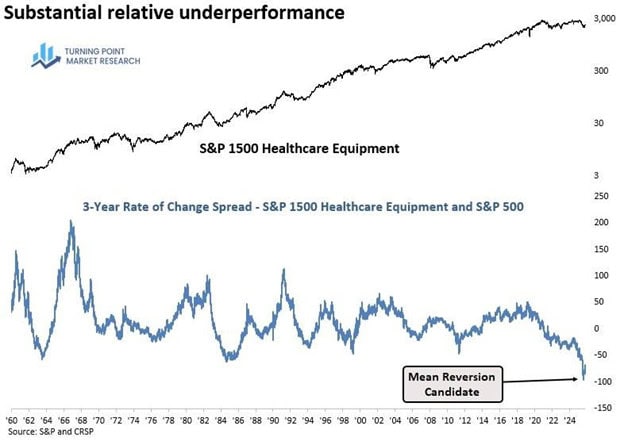
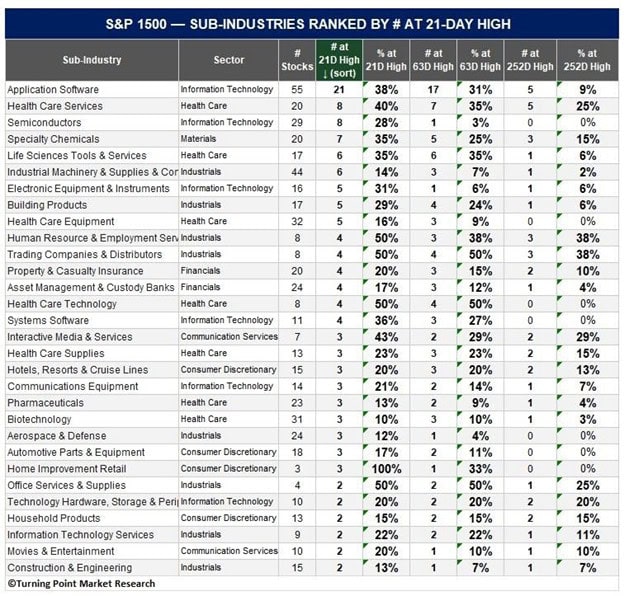
The increase in 2-month relative highs within technology was led by application software, which had the highest proportion of relative breakouts among all sub-industry groups. Another group that caught my eye was health care equipment, where several stocks posted new relative highs. This is particularly interesting given how severely beaten down the group has been, suggesting that a mean-reversion trade may be underway.
Within health care equipment, the following stocks currently maintain bullish short- and long-term Dual Trend signals: Glaukos, Integer Holdings, DexCom, Baxter International, CONMED, LifeStance Health Group, Envista Holdings, Solventum, and Teleflex.
Technology closed out last week with the highest number of 21-day highs, providing further confirmation of its improving trends alongside the relative breakout data.
Within sub-industries, application software also led all groups, posting the highest proportion of absolute breakouts last Friday, followed by health care services and semiconductors.
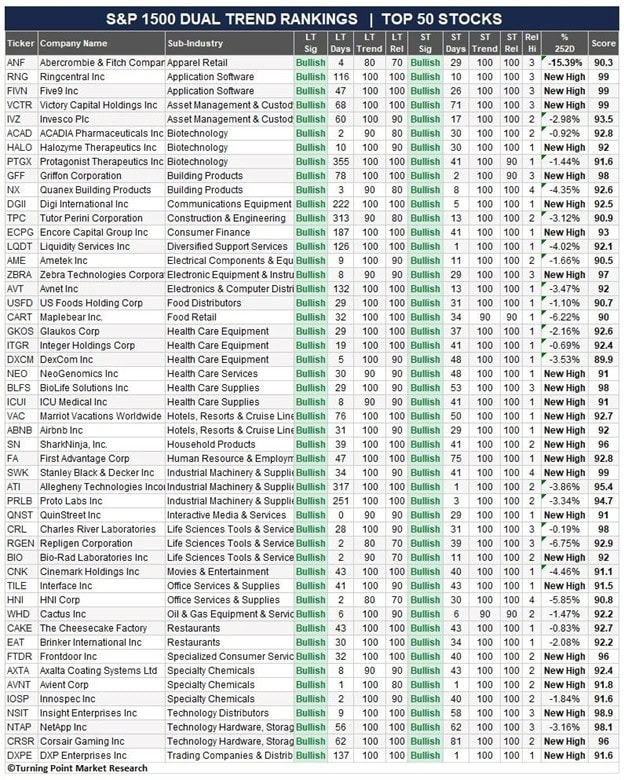
Health care stands out among the top 50-ranked stocks in the S&P 1500, with several names represented across biotechnology, health care equipment, health care services, and life sciences tools & services. Equally notable is the absence of AI-related stocks, which, for the most part, have yet to reestablish bullish profiles despite their recent bounce.
The following list includes S&P 1500 stocks that have shifted to a bullish short-term status over the past five sessions while maintaining a bullish long-term condition. Several of these stocks are AI beneficiaries, and their ability to regain bullish alignment early in the recovery is encouraging. When stocks are among the first to reestablish their trends following a correction, it can be an important sign that they are poised to resume leadership. We recently added Materion (MTRN) and Teradyne (TER) to the Dual Trend portfolio.
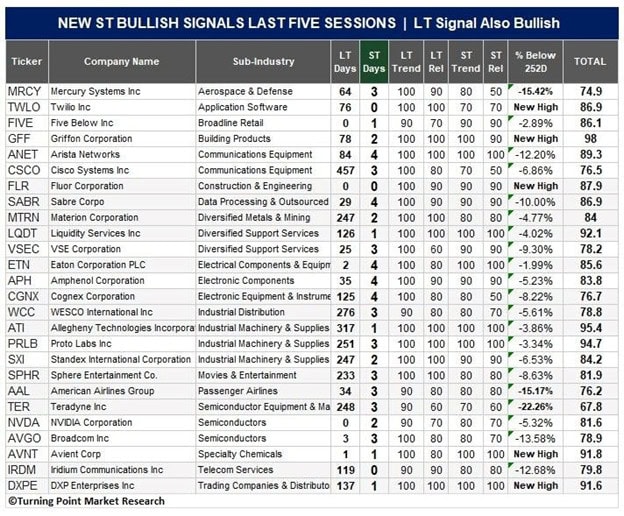
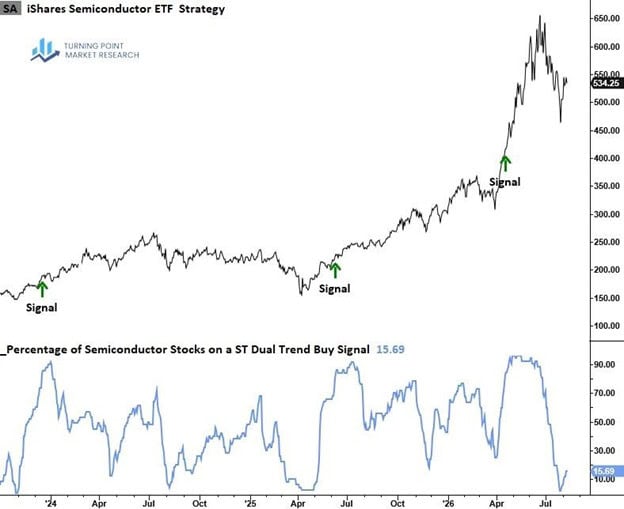
While a handful of semiconductor stocks, including Nvidia, Broadcom and Teradyne, have recently shifted back to a bullish short-term Dual Trend status, the group as a whole has yet to give the all-clear signal. We would therefore remain selective and maintain only a minor allocation until this indicator improves meaningfully.
What the research tells us…
Financials and health care remain the top two sectors in our Dual Trend rankings, but technology is quickly closing the gap, rising from seventh to third. The improvement reflects a recovery in AI beneficiaries as well as renewed strength among application and systems software stocks. The key question is whether these two groups can continue to advance together—a combination we have not seen consistently in some time. If that trend persists, it would be a constructive signal for both technology and the broader market. We are keeping a close eye on both for additional confirmation. If we choose to increase software exposure, the expanded IGV ETF would likely be our preferred vehicle. Within financials and health care, several stocks are also under review for potential inclusion in the Dual Trend portfolio, with health care equipment emerging as a likely area of interest as a mean-reversion setup appears to be developing.