Broad Market Thoughts
With the dog days of summer behind us, the S&P 500 has once again entered a consolidation phase, marking the second such period since June. But while the index has gone nowhere, the market beneath the surface has been anything but quiet. Energy and financials broke to new highs this week, while technology, communication services, and consumer discretionary remain locked in consolidations that have persisted for months.
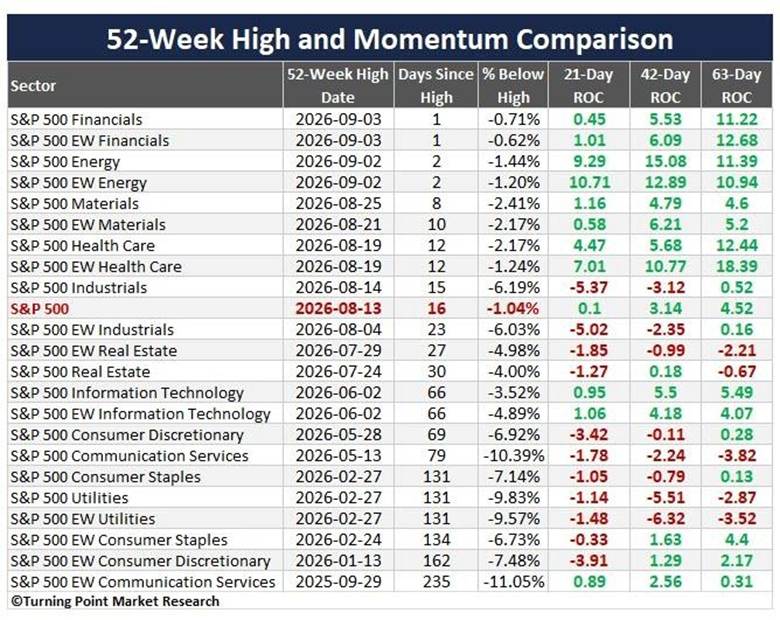
The sector performance table below highlights just how significant this rotation has been. Financials, energy, and health care have generated strong returns over the past three months, while most other sectors have struggled. This wide dispersion helps explain why the S&P 500’s overall performance has been relatively muted, despite substantial moves within individual sectors.
As long as this rotational environment persists, the broader market is likely to remain range-bound.
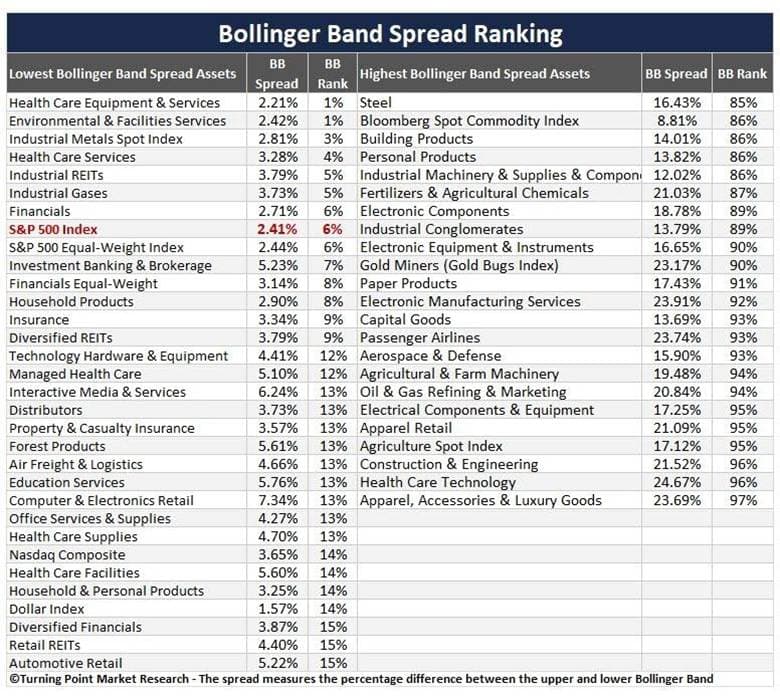
Given the S&P 500’s consolidation, I thought it was a good time to revisit my Bollinger Band Spread tool, which tracks the distance between the upper and lower bands across more than 175 assets to highlight periods of high and low volatility.
The S&P 500’s 2.41% spread ranks lower than 94% of observations since 1957 and has fallen to its lowest level of the year, reflecting an exceptionally tight trading range and significant volatility compression.
On the other end of the spectrum are several groups within industrials where volatility has picked up considerably as the sector has pulled back.
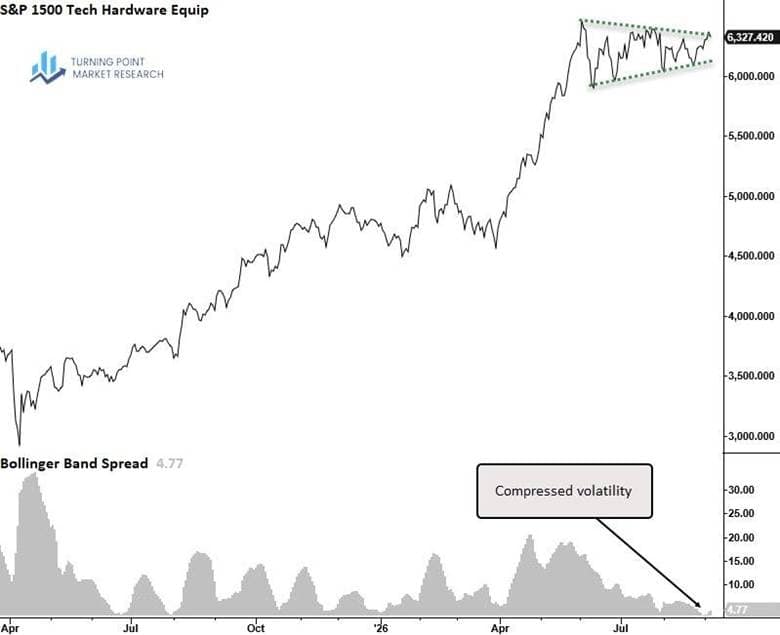
Another group that caught my attention is the S&P 1500 technology hardware & equipment industry group, where the BB spread fell to a new year-to-date low this week as the index continues to form a triangle pattern. The group includes several of the memory names, which makes this compression particularly interesting to me. These stocks have started to act better, and if a year-end rally develops as seasonality shifts from unfavorable to favorable, this could be a group worth owning.
As a reminder, compressed volatility doesn’t predict future direction, but as a general rule, markets tend to resolve in the direction of the previous trend.
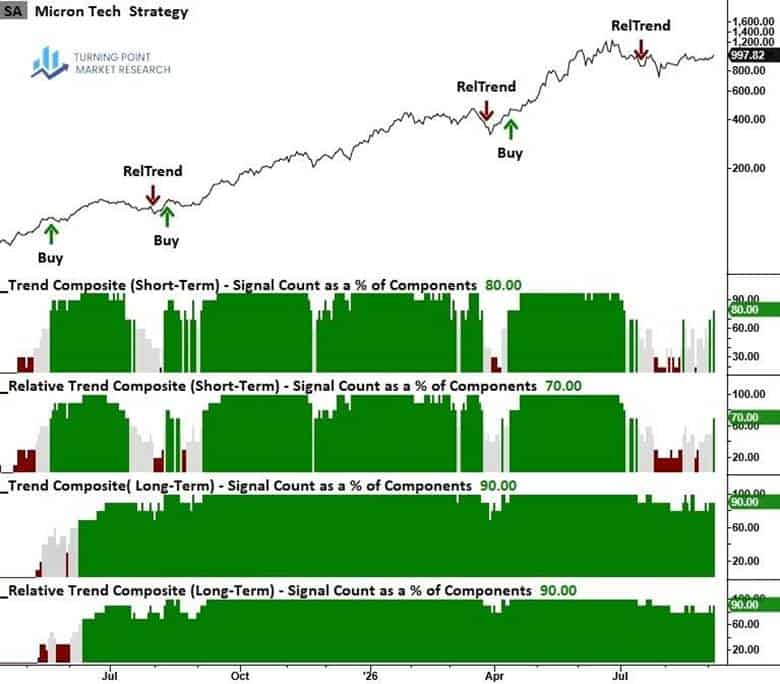
Speaking of memory names, Micron Technology (MU) looks poised to shift back to a bullish short-term dual-trend status, confirming the long-term model. Stay tuned!
Research this week
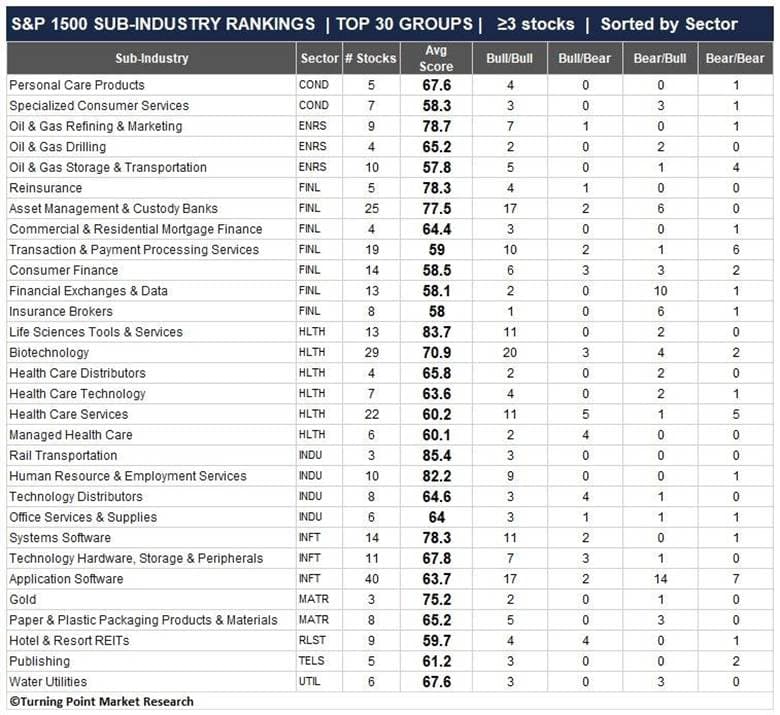
As AI stocks continue to struggle, software has emerged as a new source of leadership. Systems software and application software entered the top 30 sub-industry groups in Monday’s Dual Trend analysis, ranking 6th and 19th, respectively. Systems software’s strength is especially notable, with 14 of its 17 stocks carrying bullish short- and long-term signals.
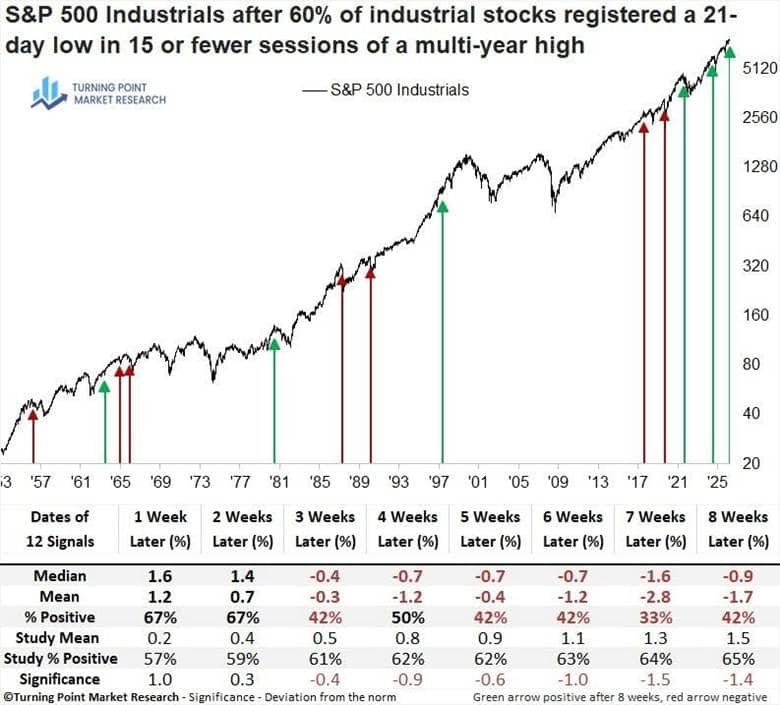
Wednesday’s report highlighted a substantial spike in 21-day lows among S&P 500 industrial stocks. Historically, when these expansions have occurred within three weeks of a high, the outlook for both industrials and the broader market has been unfavorable. However, as the report notes, broad market breadth remains constructive. For this reason, we view the warning as additional evidence to be cautious on industrials rather than a bearish signal for the broader market.
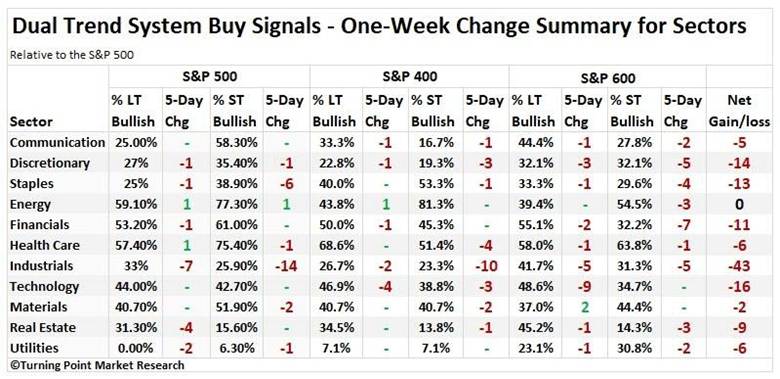
Dual trend analysis
It was a sea of red across the sector landscape over the last week, with every group except energy posting a net loss in Dual Trend signals. Industrials led the losses, reinforcing the concerns raised in Wednesday’s report.
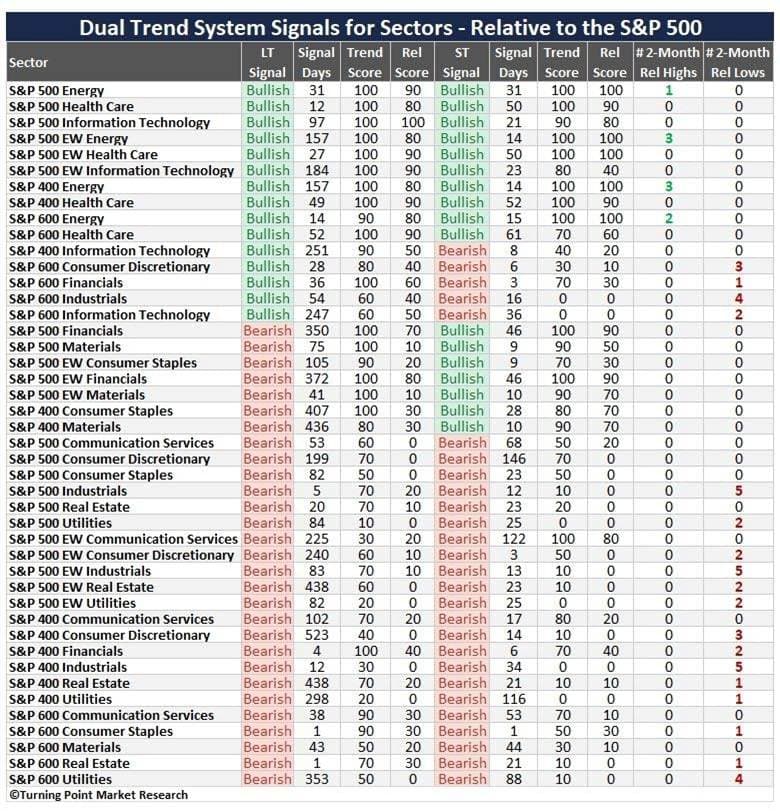
Not much changed in terms of new sector Dual Trend signals over the past week. However, the skew between relative highs and lows was pretty pronounced, with lows significantly outnumbering highs. Additionally, energy was the lone sector posting relative highs.
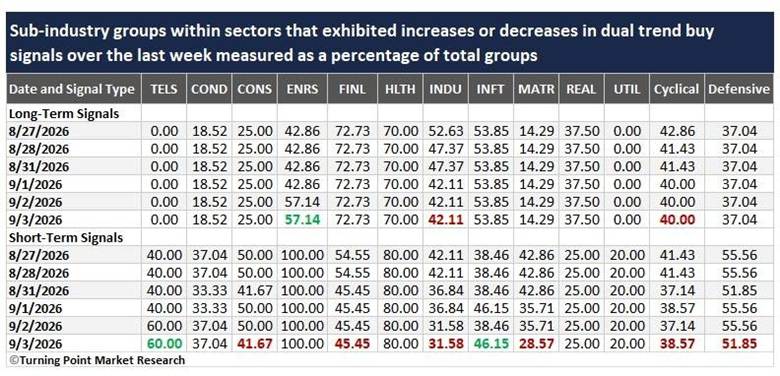
Sub-industry trends echoed the stock signals, with more groups posting week-over-week losses than gains.
Portfolio update
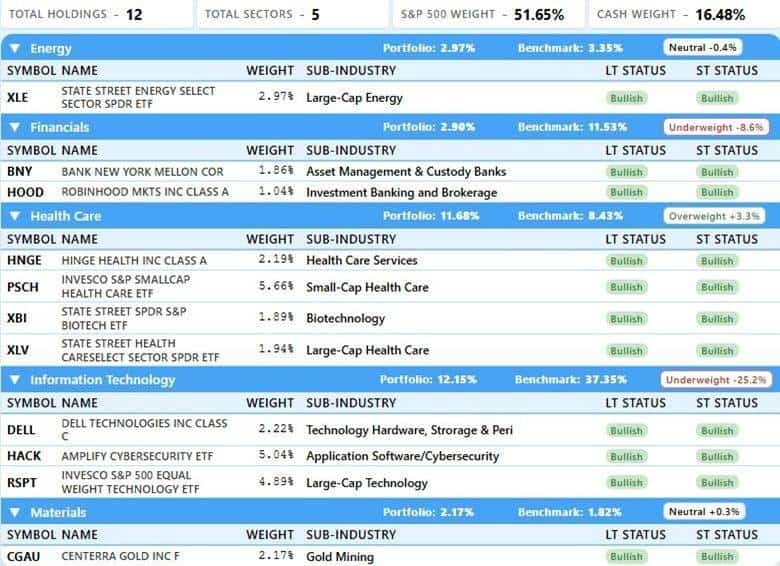
The Dual Trend portfolio exited Howmet Aerospace (HWM), a long-time holding that had shifted to a bearish short-term status and was later confirmed by a bearish long-term shift. The portfolio also sold positions in the Gold Miners ETF (GDX) and Eldorado Gold as volatility in the dollar index picked up around economic data and shifting Fed policy expectations. The portfolio also initiated a new position in Robinhood (HOOD) following a breakout supported by bullish Dual Trend confirmation.
Cash has drifted higher to 16%, reflecting a slightly more cautious near-term tone while still maintaining a medium- to long-term bullish bias.
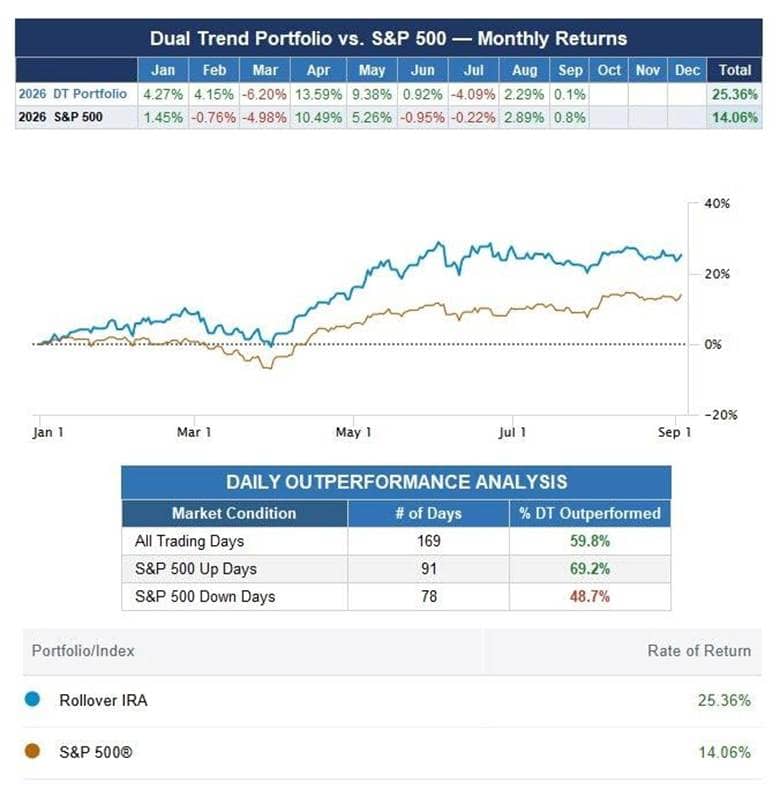
Through Thursday’s close, our Dual Trend portfolio had gained 25.36%, outperforming the S&P 500’s 14.6% return.
Final thoughts
The market remains rangebound despite several headwinds, including higher energy prices and elevated interest rates. Add in significant sector rotation, continued uncertainty around Fed policy, and an unfavorable seasonal period, and, remarkably, the S&P 500 is still sitting just a little more than 1% below its record high. Given all of that, it’s difficult to identify what might trigger a more pronounced pullback. A September Fed rate hike could certainly do it, but at this point, that outcome is little more than a coin toss. Until there’s more clarity around these factors, the market could continue to chop sideways for the foreseeable future, potentially leading to even further volatility compression. However, this too shall pass, and the memory group—where volatility has also compressed significantly—could be setting up for a year-end rally.