Key points:
- Thematic stocks and ETFs exhibit weak technical trend profiles
- Cybersecurity and financial technology rank the best among several categories
- The more speculative themes like quantum and uranium/nuclear should be avoided
A risk-averse environment
Thematic stocks, which tend to be more speculative, can provide a useful read on the broader market environment. These companies often attract capital when investors are confident, liquidity is abundant, and stocks are rising in unison. Think 2013, 2017, and 2021, when speculative areas of the market generally participated in the advance, and investors were more willing to hold higher-risk, higher-growth names in their portfolios. The opposite tends to happen when conditions deteriorate. As breadth narrows and liquidity becomes scarcer, capital increasingly rotates away from these areas and toward higher-quality companies.
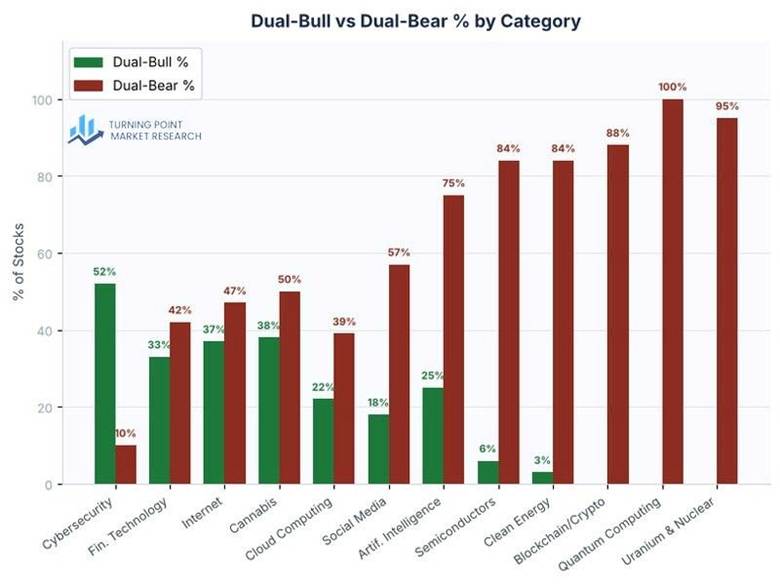
That is largely what the current data is showing. The thematic universe is broadly under pressure, with 68% of the 344 tracked stocks in a dual-bearish trend — meaning both long-term and short-term signals are negative. Only 53 stocks (15%) are dual-bullish, confirming that broad thematic momentum is absent.
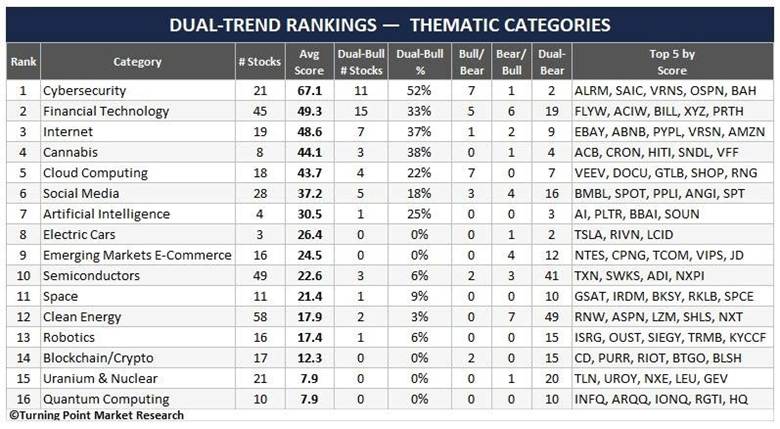
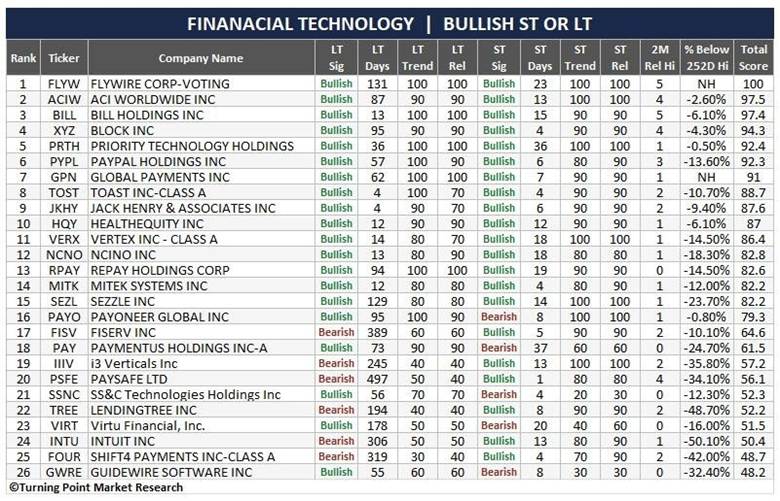
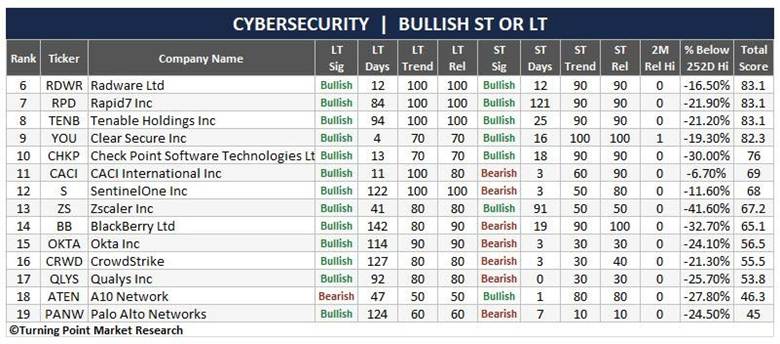
The dispersion between categories is striking. Cybersecurity (avg score 67.1) and financial technology (49.3) are the only categories with meaningful bullish breadth. Five categories — quantum computing, uranium & nuclear, blockchain/crypto, robotics, and clean energy — have average scores below 20, indicating overwhelmingly bearish internals.
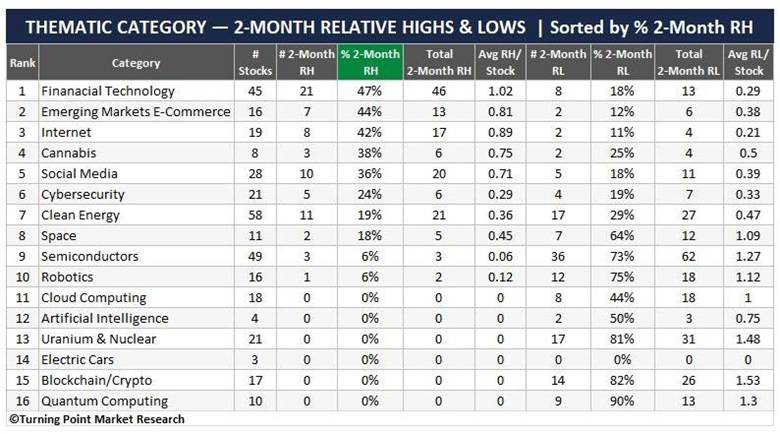
Over the past week, financial technology has led all thematic categories in the percentage of stocks registering 2-month relative highs, with emerging markets e-commerce, and internet stocks not far behind. In contrast, more speculative themes have recorded a significantly higher concentration of 2-month relative lows.
Financial technology, cybersecurity, and internet stocks dominate the thematic rankings, accounting for 31 of the top 40 stocks. Moreover, financial technology alone represents nearly half of that group.
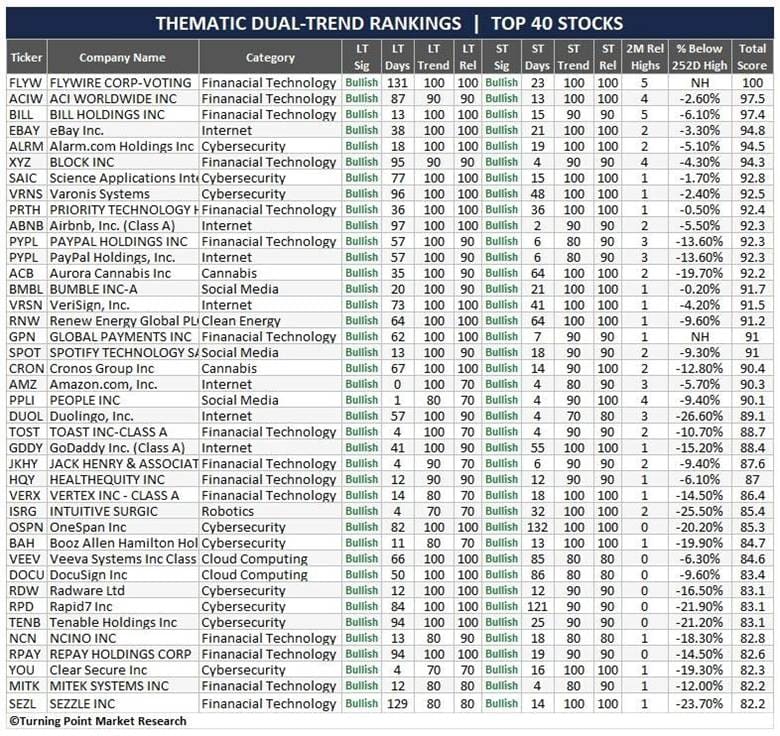
Payments companies make up the bulk of the financial technology category, accounting for 17 of its 26 constituents, with a few others falling into adjacent or overlapping businesses. This strength was also evident across a broader basket of stocks, as transaction and payment processing ranked among the stronger sub-industries in Monday’s S&P 1500 rankings.
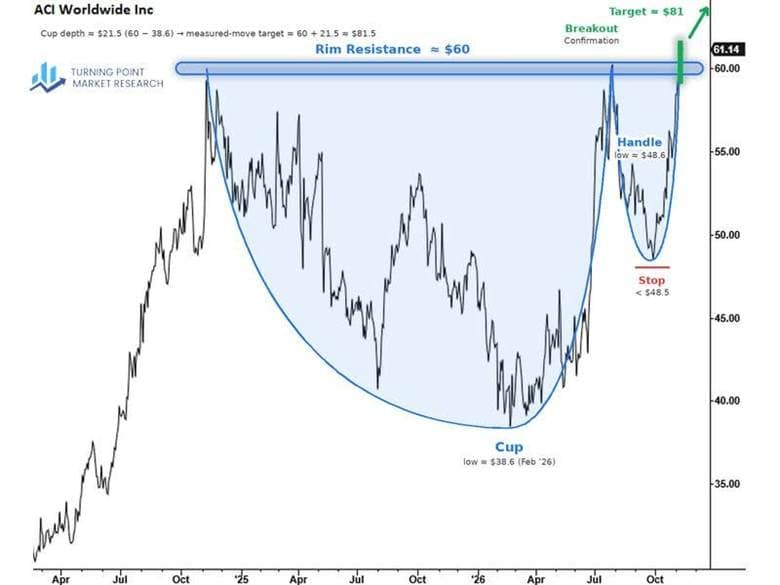
ACI Worldwide is one name worth highlighting. Its short- and long-term Dual Trend readings are both bullish, and a recent breakout from a cup-and-handle formation further confirms the stock’s improving technical profile.
The recent weakness has done little to damage the longer-term technical picture, with all but one cybersecurity stock retaining bullish long-term DT signals. Several lesser-known names remain bullish across both systems. Given the group’s favorable secular tailwinds, I wouldn’t be surprised to see cybersecurity stocks find their footing and resume their advance.
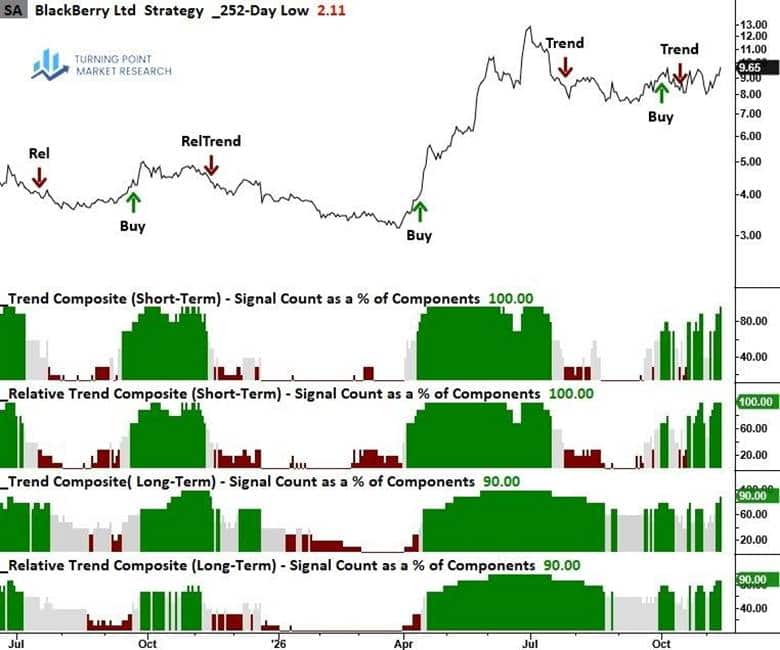
BlackBerry appears poised to regain a bullish short-term status, bringing it back into alignment with the long-term model. Additionally, the consolidation over the past several months provides a well-defined pivot point for managing downside risk.
The weakness evident among thematic stocks is also reflected in a broad universe of thematic ETFs. Just five funds maintain bullish Dual Trend readings across both time frames, with three of those five focused on health care and, more specifically, genomics.
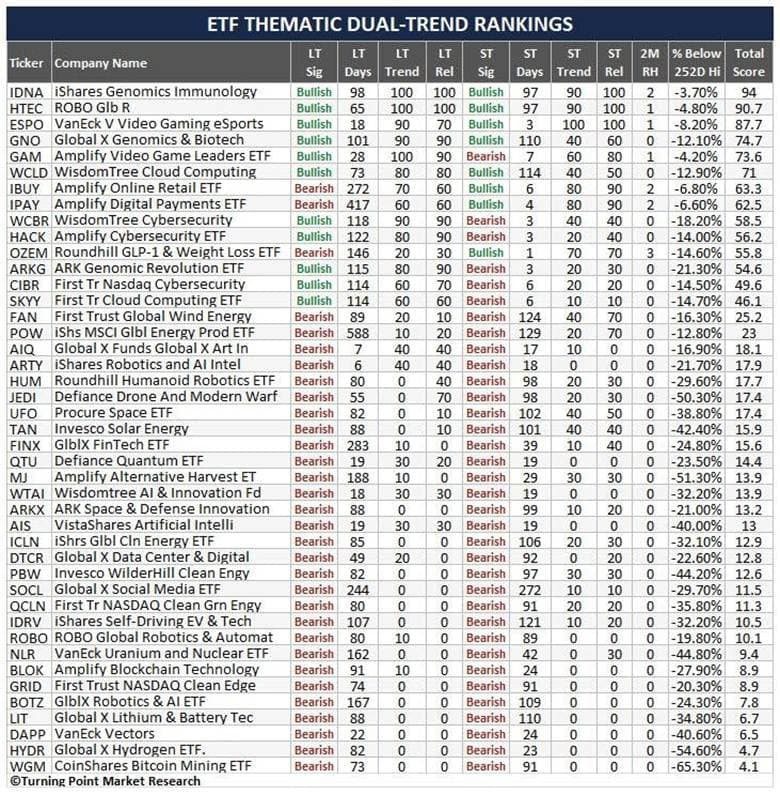
Several newer, well-known thematic ETFs, including DRAM, LYTE, and NCLD, were excluded from the analysis because they lack sufficient price history for the Dual Trend (DT) system.
What the research tells us…
Thematic stocks offer a useful window into investor risk appetite, and the current picture is far from encouraging. Most groups show weak technical profiles, suggesting investors remain reluctant to embrace higher-risk areas of the market. This lack of participation is generally consistent with a more challenging market environment. Exceptions exist, however, as cybersecurity and financial technology continue to show relative strength, particularly among payment processing businesses.