Key points:
- A substantial number of industrial stocks registered 21-day lows
- Similar expansions in new lows preceded a weak outlook for the sector
- Fuel-sensitive and AI beneficiaries are driving the weakness
One measure of short-term breadth flashes a caution signal
As the Iran conflict has flared up again—and I know I sound like a broken record—crude oil has surged from around $70 to $90 a barrel. The renewed inflationary pressure has pushed long-duration Treasury yields higher, creating a difficult backdrop for rate-sensitive stocks and fuel-intensive industries such as airlines.
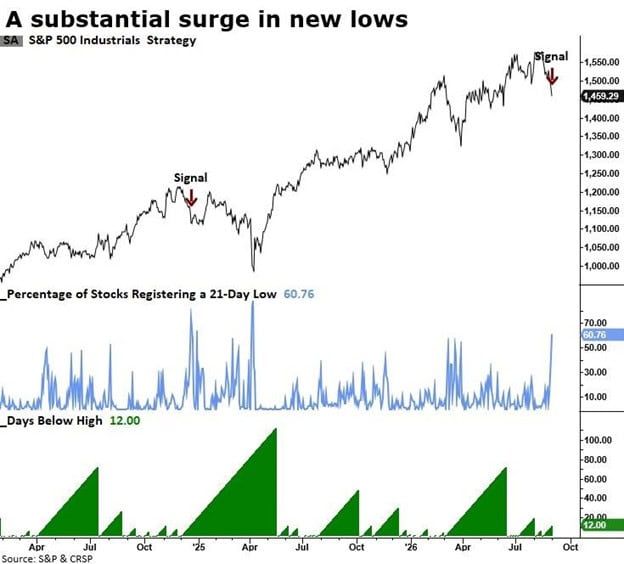
Digging into Tuesday’s market weakness, one area that stood out was the deterioration in industrials breadth. A significant number of these cyclical stocks hit 21-day lows, with the reading reaching its highest level since the Liberation Day selloff.
One potentially concerning similarity to 2025 is the timing. The initial move above 60% occurred within 15 days of the market high then, and the same condition is now in place.
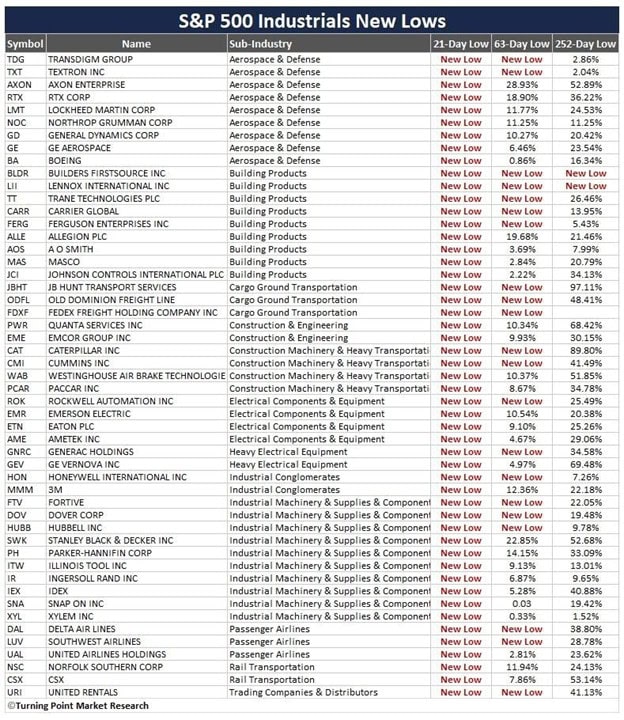
Surveying the S&P 500 industrial stocks hitting new lows reveals weakness across a broad range of groups, including fuel-sensitive transportation, beneficiaries of the AI data-center buildout, and aerospace and defense.
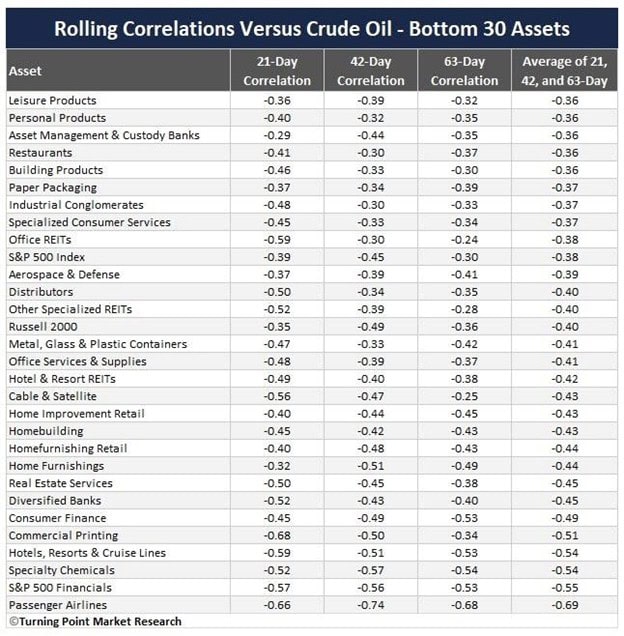
Given the sharp jump in crude oil, the following table highlights the assets least correlated with the commodity, showing the bottom 30 of 176 securities across several rolling periods. Not surprisingly, airlines show the strongest negative correlation with oil, while aerospace and defense, also prominent on the new-lows list, rank near the bottom. Beyond these industrial groups, consumer-oriented areas dominate the list.
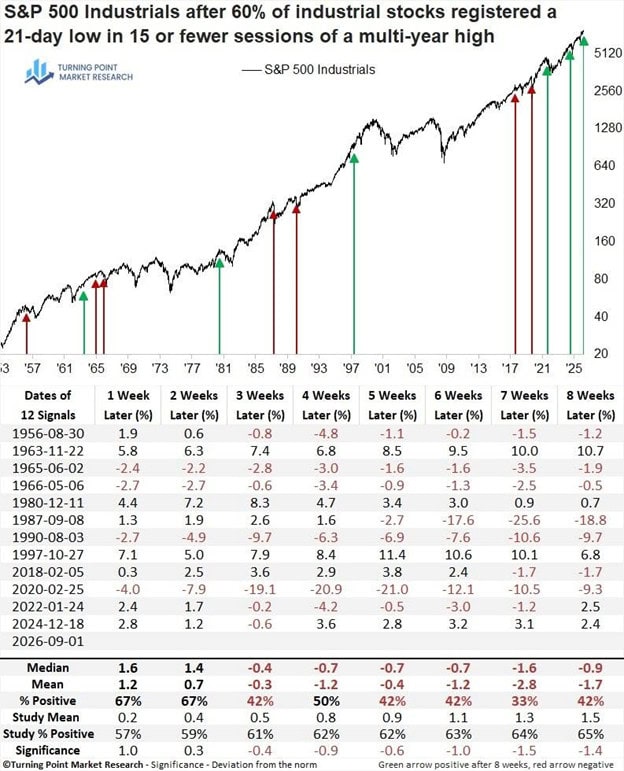
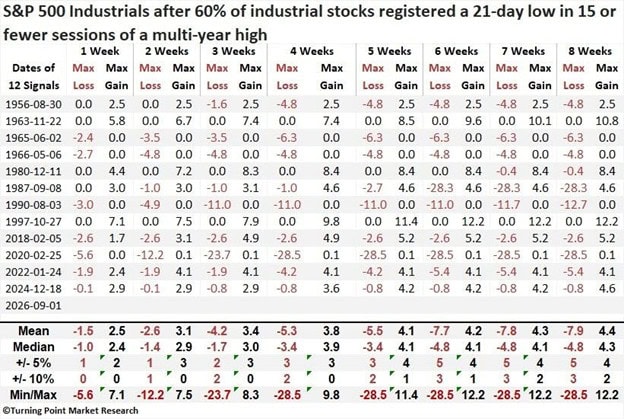
A pronounced expansion in 21-day lows, with a multi-year high nearby, has historically carried bearish implications for industrials, with the sector tending to weaken over the ensuing three to eight weeks
Over the following 8 weeks, risk/reward was somewhat balanced, as the odds of a 5% or 10% maximum loss were roughly equal to those of achieving a gain of the same magnitude.
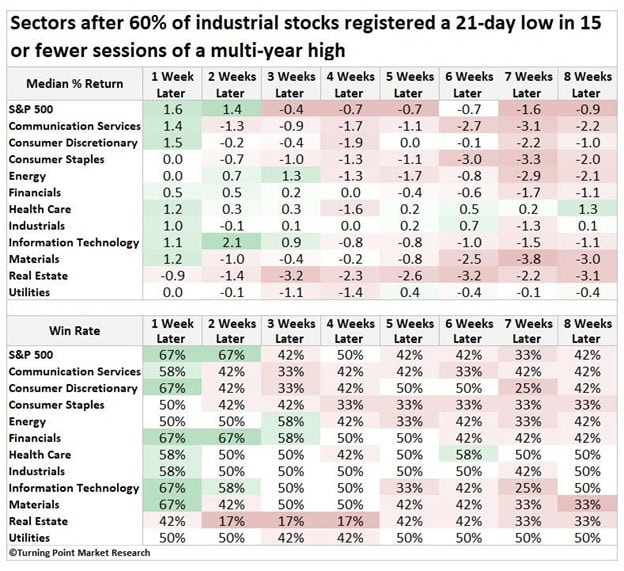
Similar to the industrials results, the S&P 500 and other sectors generally bounced initially, only to roll over in the weeks that followed. The fact that these signals tended to occur amid broader market weakness suggests they were often symptomatic of forces extending beyond any single sector. In this case, higher oil prices and interest rates appear to be the primary culprits.
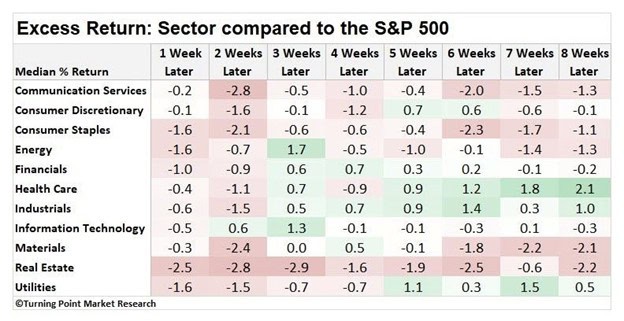
Interestingly, industrials showed initial weakness relative to the S&P 500 before posting positive excess returns. Health care stood out as the strongest performer, consistent with its favorable profile in the current environment.
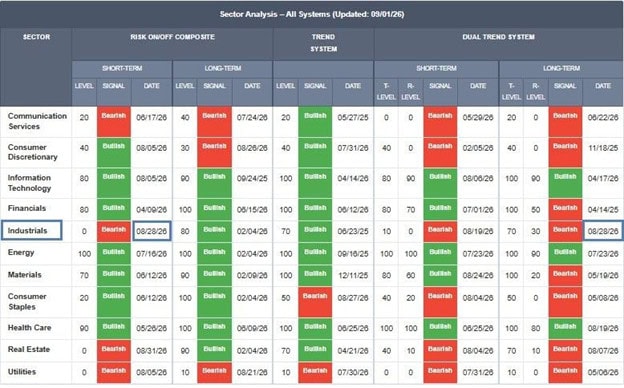
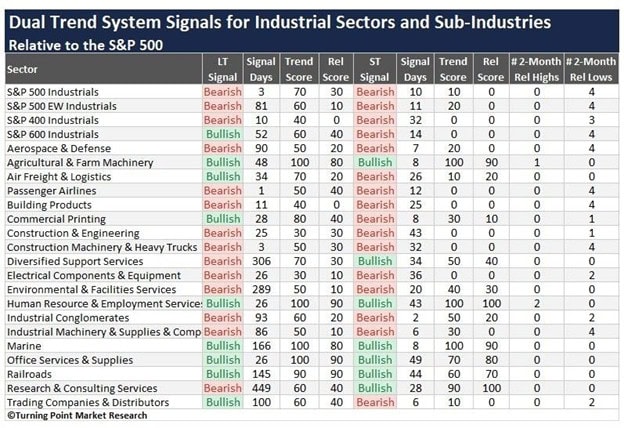
The long-term Dual Trend system for industrials shifted to a bearish status last Friday, confirming the short-term model. Further reinforcing the signal, the short-term Risk-On/Off system also turned bearish, with its composite at 0%, indicating that trend and breadth measures are fully aligned in a bearish configuration.
Across the various industrial indexes, spanning market caps and weighting methodologies, the picture is broadly bearish, with the S&P 600 as the lone exception. However, its relative composite currently sits at 40%, leaving it vulnerable to a shift into negative territory. The sub-industries are similarly tilted bearish, reflecting the headwinds from higher oil prices and interest rates, as well as growing risk aversion toward data-center beneficiaries.
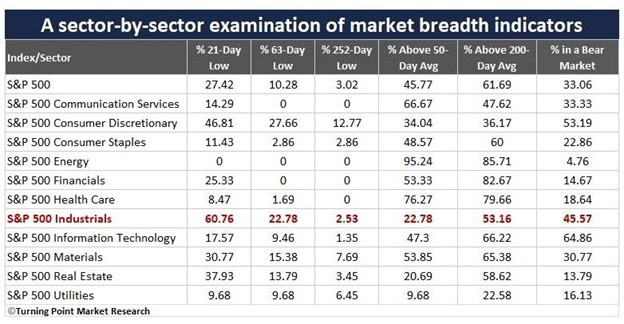
Breadth within industrials has weakened notably across several measures. The percentage of stocks above their 50-day moving averages is the second-lowest among sectors, trailing only utilities, which have likewise struggled amid elevated interest rates. Meanwhile, 45% of industrial stocks are in a bear market, defined as trading at least 20% below a 252-day high.
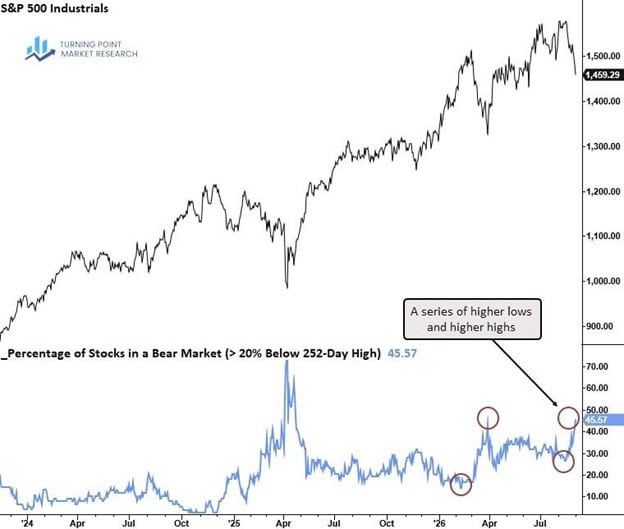
Speaking of the percentage of industrial stocks in a bear market, the current 45% reading has now surpassed the 43% reached at the March low, marking the highest level since the Liberation Day selloff in 2025.
What the research tells us…
Industrials have experienced a meaningful deterioration in their technical profile, highlighted by a significant spike in 21-day lows within three weeks of the recent high. Historically, similar breadth shocks have been unfavorable for both the sector and the broader market and have coincided with several important market tops. That said, the signal remains unconfirmed by broader market breadth deterioration, especially among long-term measures, which my systems weight most heavily. Two factors appear to be driving the weakness: elevated crude prices are pressuring fuel-sensitive groups, while investors may be becoming more risk-averse toward AI data-center beneficiaries amid concerns that election results could create greater regulatory uncertainty. Until these headwinds ease, caution remains warranted. Conversely, a pullback in oil or easing regulatory concerns could quickly reverse the sector higher, so it’s important to stay ready to react. That’s especially the case for airlines, given their negative correlation with oil prices.