Key points:
- An agriculture index has rallied for eight consecutive sessions
- Similar win streaks saw the ag index rally in all but one case over four months
- Deere and CF Industries maintain bullish trend profiles
Bullish momentum begets more bullish momentum
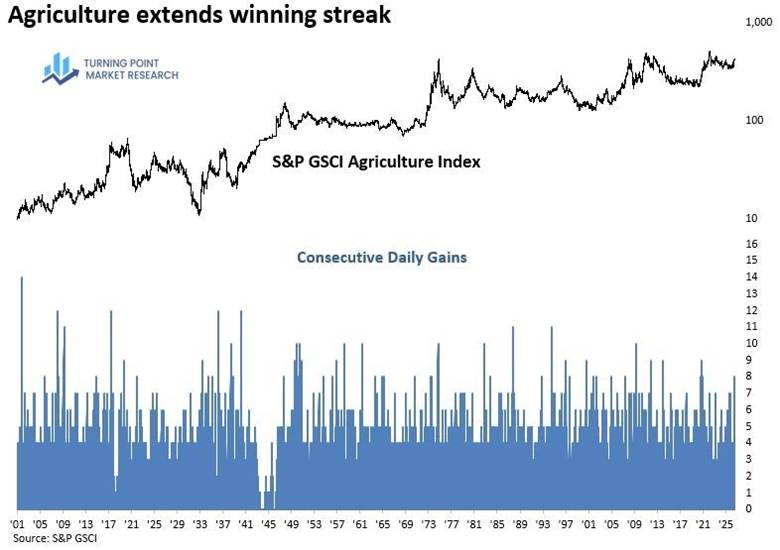
The agricultural commodity rally is becoming increasingly difficult to ignore. Grains, softs, and livestock have been rising with remarkable consistency, pushing the S&P GSCI Agriculture Spot Index higher for eight consecutive sessions.
The last time this happened was in 2020, near the outset of a powerful agricultural commodity upswing. Over the past century, only eight other episodes have produced a comparable burst of momentum—and every one was associated with a cyclical advance.
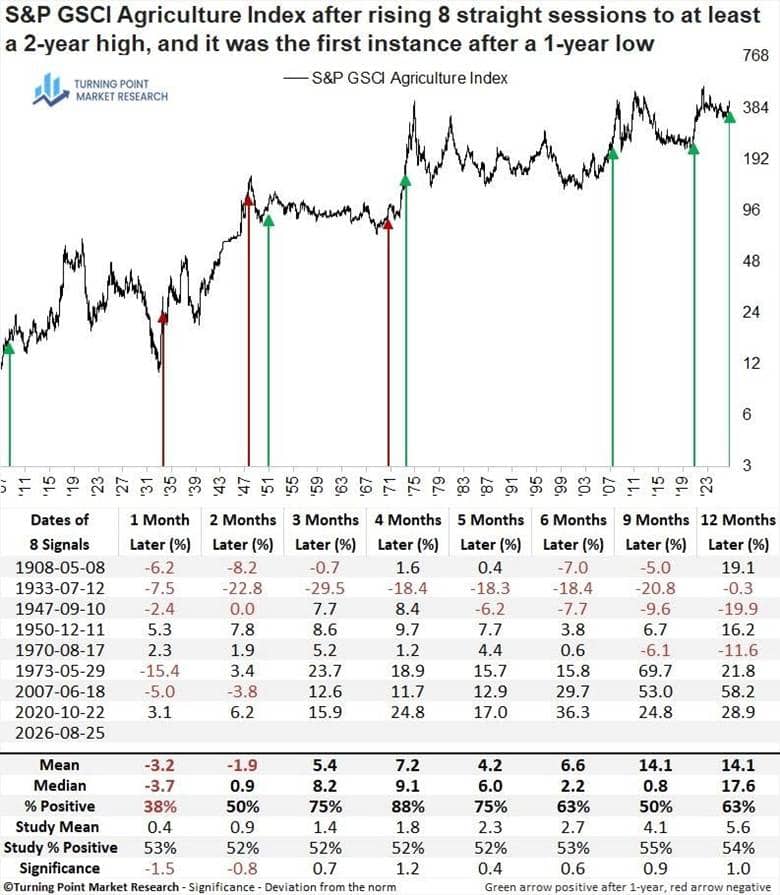
Although uncommon, S&P GSCI Agriculture winning streaks accompanied by multi-year breakouts have historically led to continued strength. The index gained over the next four months in all but one case, while the two most recent precedents—2007 and 2020—generated the largest 12-month gains.
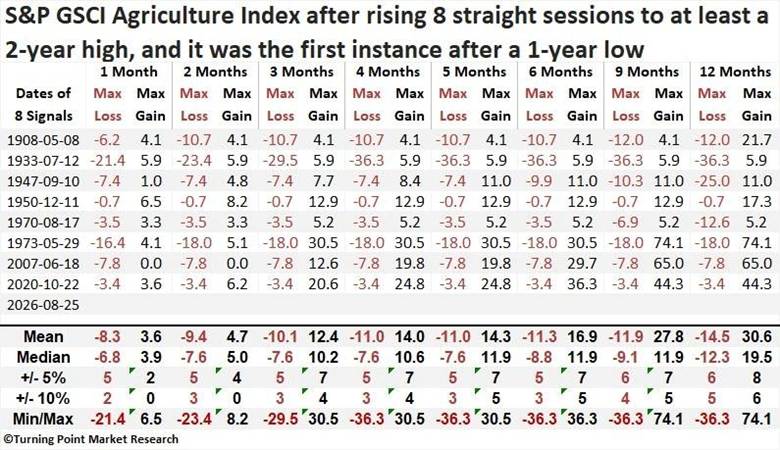
Over the following 12 months, risk/reward was not especially compelling, as the odds of a 5% or 10% maximum loss were roughly equal to those of achieving a gain of the same magnitude. Given commodities’ choppy, mean-reverting nature, cyclical upswings require a different approach than traditional stock investing.
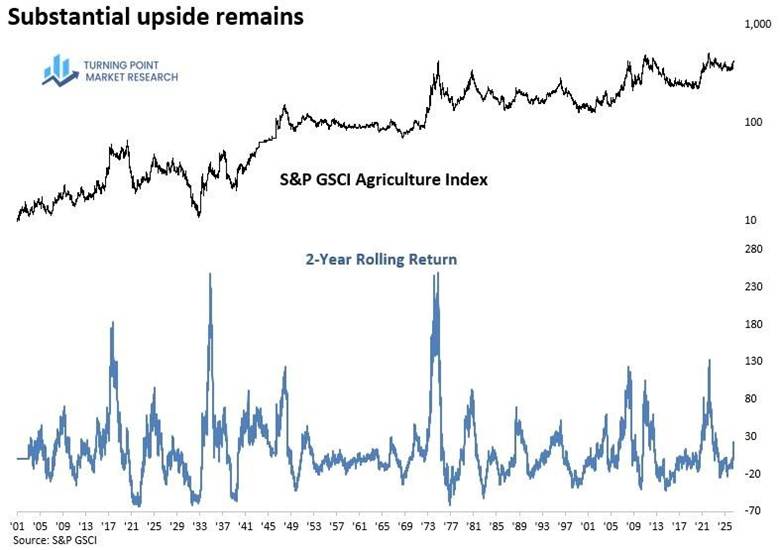
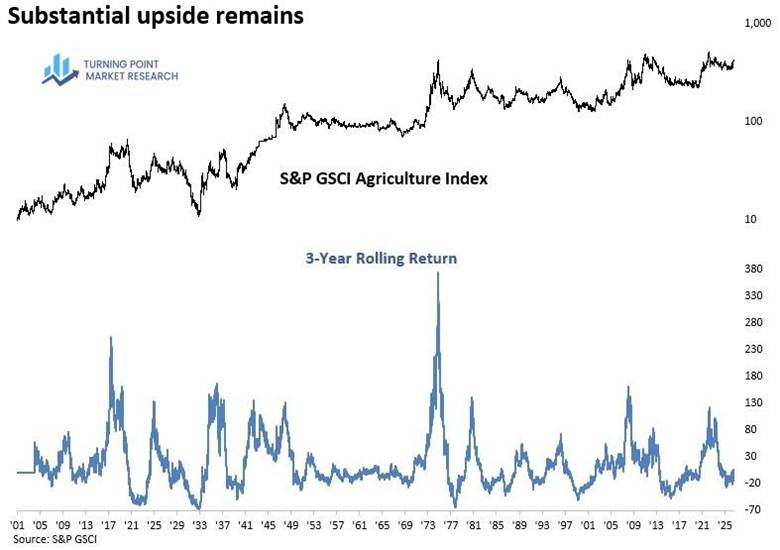
Taking a longer-term view, the Agriculture Index’s 2-year rolling return is currently 23%, a level that remains well short of the extremes typically associated with mean-reversion risk.
The 3-year rolling return currently stands at just 5%, also suggesting significant upside potential from current levels.
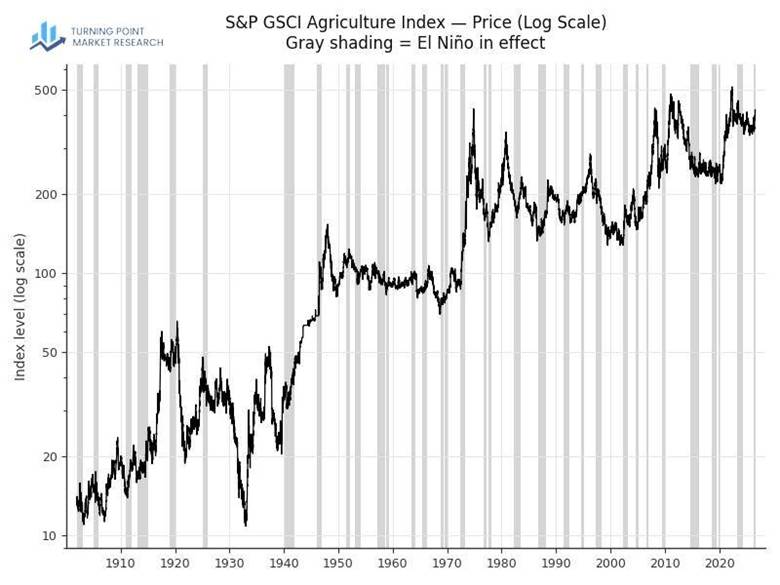
Adding to the potential upside for agricultural commodities, an El Niño pattern is currently in effect. Historically, the S&P GSCI Agriculture Index has risen two-thirds of the time during these episodes.
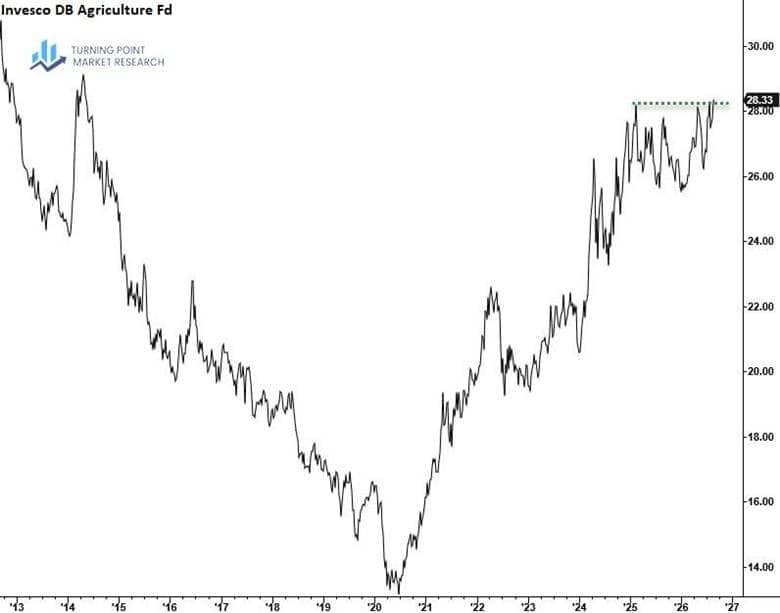
One way to capture an agricultural upswing is through the Invesco DB Agriculture Fund (DBA), which is breaking out of a bullish consolidation pattern.
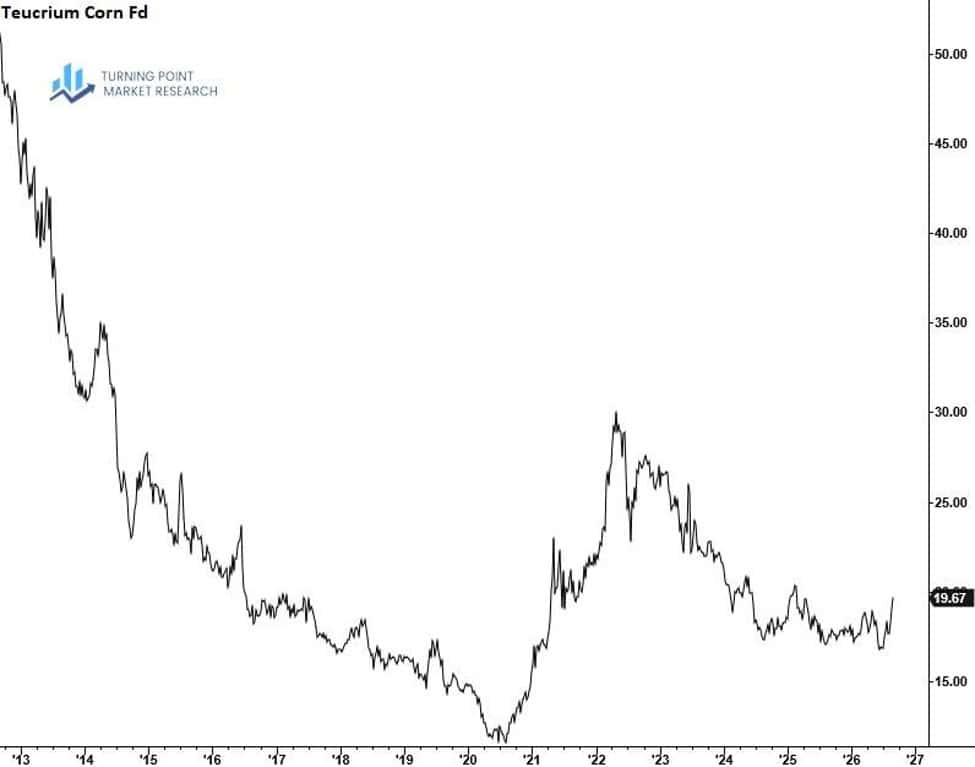
Corn, the agriculture index’s largest component, is showing encouraging technical strength, with the Teucrium Corn ETF (CORN) breaking out of a multi-month base and appearing positioned for further upside.
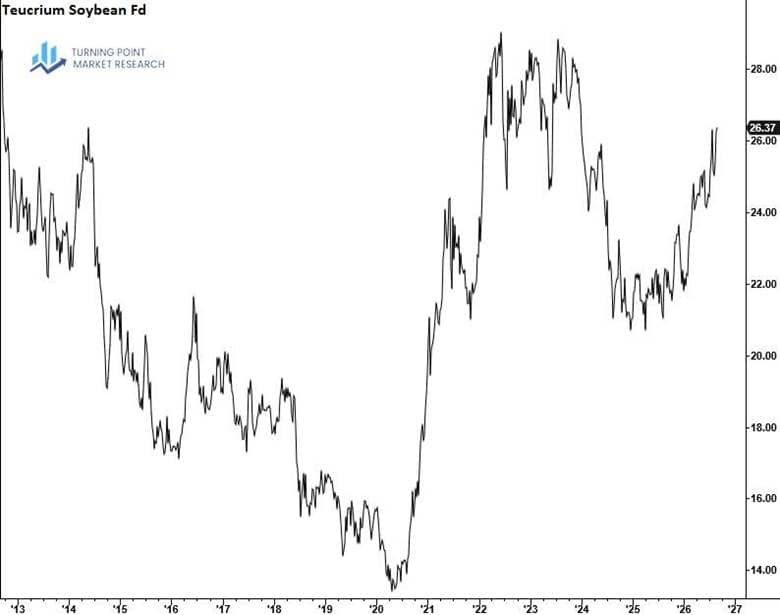
The Teucrium Soybean ETF (SOYB) has the most established uptrend of the three major grain markets and remains technically strong.
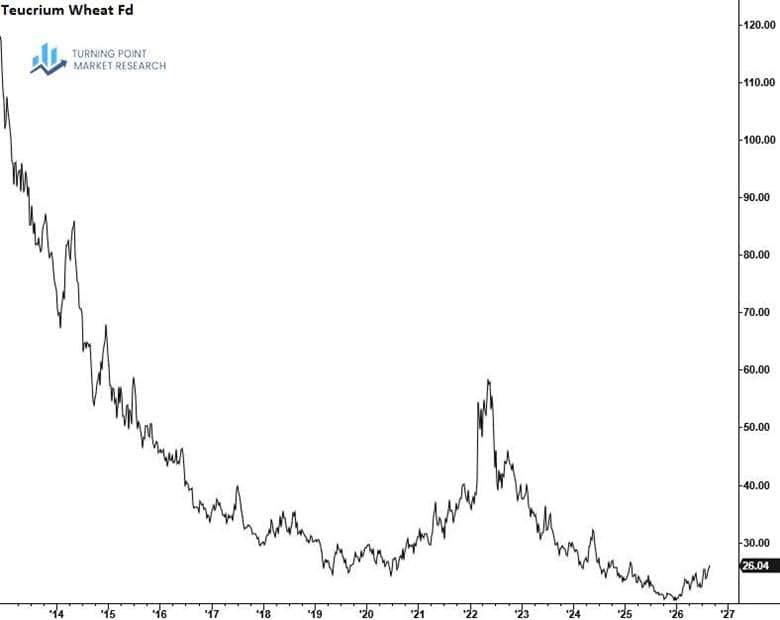
The Teucrium Wheat ETF (WEAT) is the most intriguing of the three major grains and may offer the greatest upside.
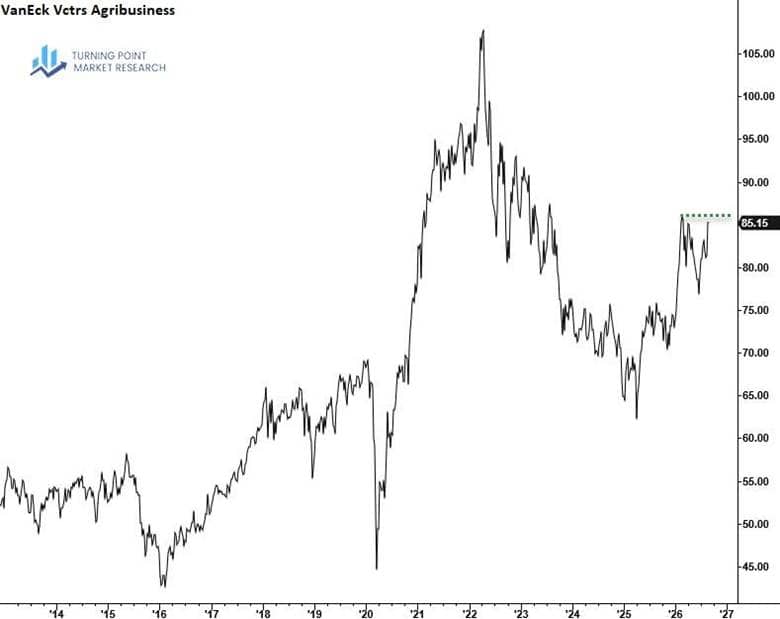
For investors looking beyond commodities, the VanEck Agribusiness ETF (MOO) offers exposure to a basket of agriculture-related stocks and is on the verge of breaking out to a new high.
Applying the Dual Trend ranking methodology to a basket of agriculture-related stocks drawn from ETFs such as MOO, VEGI, and FTAG reveals that only a handful of names maintain both short- and long-term bullish trends. Two of the most notable are bellwether companies closely tied to the agricultural cycle: Deere and CF Industries.
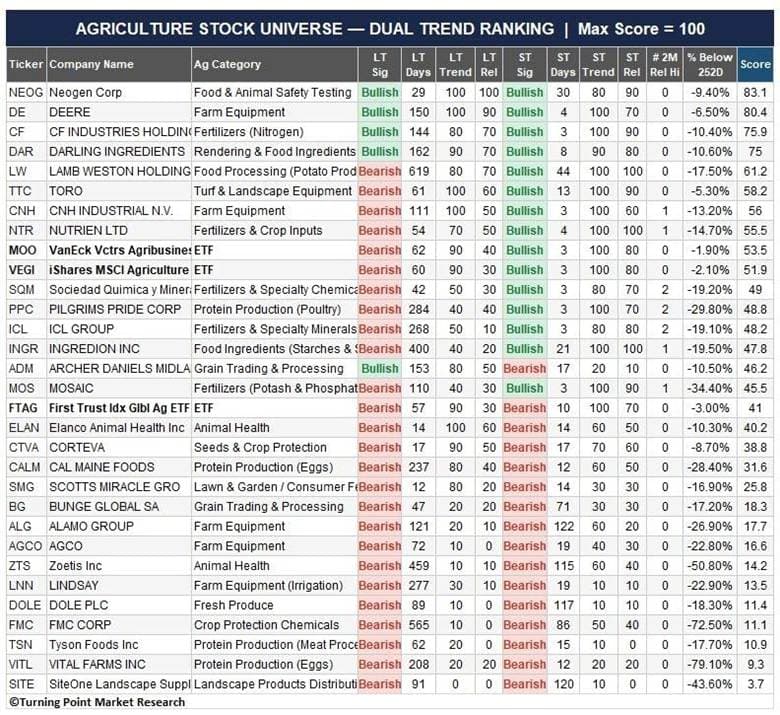
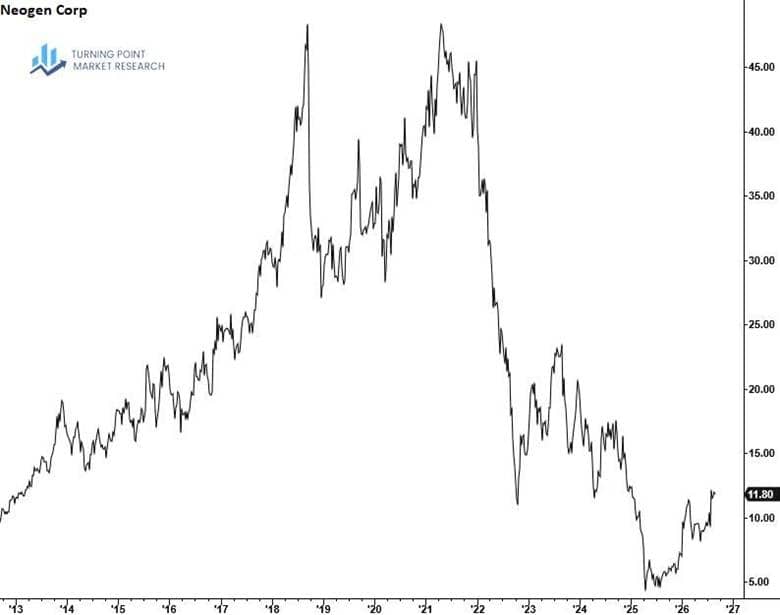
Neogen, the No. 1-ranked name, offers an interesting setup despite not being a pure-play agriculture stock, with the company exhibiting a bullish technical profile after an extended decline.
What the research tells us…
An agricultural index has risen for eight consecutive sessions, an unusually persistent streak for commodities given their historically choppy, mean-reverting behavior. Historically, when these winning streaks have occurred alongside a breakout to a multi-year high, the S&P GSCI Agriculture Index has tended to extend its gains, particularly over medium-term horizons. Meanwhile, longer-term momentum measures remain well below levels that would suggest elevated mean-reversion risk. Investors have several ways to participate in the trend, either through agriculture-focused ETFs or agricultural-related stocks, with corn and wheat looking especially attractive. Beyond potential returns, agriculture offers portfolio diversification benefits, providing an uncorrelated or low-correlated offset to equities and, in particular, exposure to themes such as AI.