Thank you all for the well wishes/congratulations as I celebrated the birth of my second daughter last week. I say it a lot, but I mean it. This is a special community, and it means more to me than you know to celebrate a big life milestone with you.
Alex forced me to take a week off from markets and trading. I tried and mostly succeeded, but it was hard.
I felt a strange pull to do “something.” Especially as an owner of a research business. There’s always a trade to take, a stock to research, and a market to analyze. Throw in an oil crisis/war, and it’s easy to feel lost going one day without “monitoring the situation.”
But you know what? The market was ready for me when I got back. I didn’t miss all the “good” setups. They were right where I left them. In fact, I felt more refreshed … while on less sleep!
And that’s the beauty of markets: opportunities abound.
I love the Stanley Druckenmiller story where he took six months off and traveled to Africa after “losing his mind” and losing billions buying the top in the NASDAQ:
“I think we’ve gone from like a 15% on the year to flat in a week. And I go, I can’t take this anymore. I’m burnout, I’m exhausted. I said I need a break. And I’m going to resign. He accepted that by the time I got out of all this stuff. Here we are again, we’re down 18%. And this is May, and I am a complete emotional wreck and mess.
So I decided to go on a sabbatical.
And I write a letter to all my Duquesne clients saying I’m going on a break. I don’t know when I’m coming back. I can’t even promise you I am coming back. You can have all your money back. Or you can leave it in cash. So what I did was I took a real break. I didn’t read the newspaper. I didn’t know where the market was. I wasn’t allowed to watch TV. Not only did I go to Africa, but I would play golf and read books, but nothing financial.”
While I didn’t unplug from financial news during my break, I tried to consume as little of it as possible. Instead, I read Dune, finished Radical: My Journey out of Islamist Extremism, and started reading a biography of Alexander the Great.
I shouldn’t need a newborn to force me to take breaks, but I’m getting better.
One last thing on taking breaks before we dive into our silver and solar thematic.
Australian swimmer Cam McEvoy recently broke the world record in the 50-meter freestyle. @GutOptimized explains how he did it (emphasis mine):
“Cam McEvoy ascended to a gold medal at the Olympics and now has broken the world record in 50m after controversially reducing his training volume by 90%.
This completely bucked traditional swimming methods and he struggled to even find a coach willing to help him implement this idea.
He studied the science of weight lifting and cycling, and decided traditional swimming training wasn’t ideal for 50m event.
I found this interesting and lends credit to some models people in the science based fitness community discuss. Namely that less volume, with more intensity, and focusing on rest/recovery, has its advantages.”
Huh … doing less and achieving more.
Here’s a good thought exercise: imagine how this would look in your investment process.
What would your day look like if you reduced investment “training” volume by 90% and focused on intensity, recovery, and rest?
This is what I’m trying to do at Macro Ops … spend 90% of my time waiting for Trifecta Lens setups and only taking those trades. And in between those trades, spending 90% of my time reading, writing, thinking, and recovering.
What if less is more?
Silver: A Buyable Bottom?
We added silver futures (SILK2026) and Gold Miners (GDX) to the book last night/this morning. Our base case is that precious metals (PMs) have reached a short-term tradable bottom, are deeply oversold in bull-quiet regimes, and present attractive risk/reward setups.
Let’s focus on silver (to the HUD!).
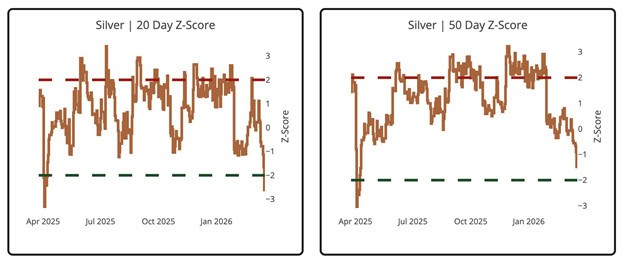
Poor Man’s Gold printed the strongest oversold signal since April 2025, during which silver dropped 23% in a week and traded below $30/oz.
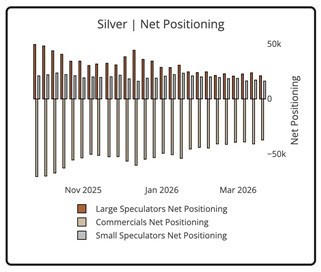
Large Specs positioning has also slowly declined from its December 2025 highs (see below).
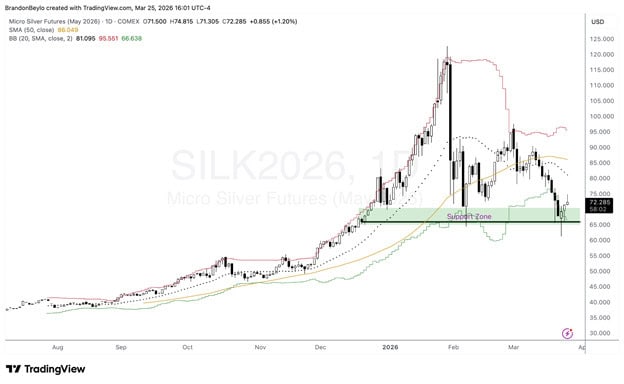
Finally, price found support around $68-$72/oz during a Bull Quiet Regime (see chart below).
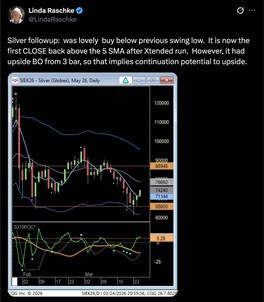
And it never hurts to have Market Wizard Linda Raschke on the same side of your trade.
Earlier today, I read a tweet from Jordan Roy-Byrne about gold’s current price action and comparing it to the 1970s move.
The main idea was that this gold move looks a lot like the 1970s analog … and if that’s true, the upside targets get silly (emphasis mine):
“Gold just replayed its 1971–1973 move, including the first big correction.
After peaking in ’73, it soared another 7x over the next 7 years, enduring brutal pullbacks of 29%, 24%, 45%, and 20% along the way.
This bull market will rhyme with the 1970s: sharp drawdowns, but much bigger upside ahead.”
We can apply the same idea to silver. Let’s quickly recap silver’s 1970s bull market: silver gained 2,000% from $1.86/oz in 1970 to its peak of $39.28 in 1980.
It also experienced three major corrections during its bull run:
- -30% from 1970-1971
- -24% in 1974
- -68% in 1980 (blow-off top/peak)
Unlike gold, silver is outpacing its 1970 analog to date (when scaling bull markets and pricing). For example, silver is up 283% over the past 3.5 years (or the start of its bull market), whereas the 1970s bull run was up only 151% by that point (see analog below).
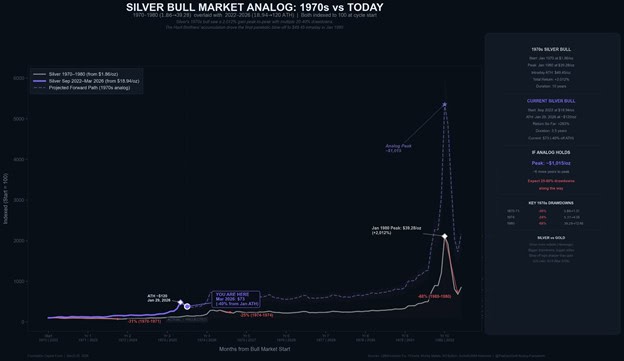
The $1,015/oz projection is the output of holding the current outperformance ratio constant. Take that number with a massive grain of salt.
I’m not making a price prediction, and I’m not a tin-foil-hat-wearing silver bug that believes the Big Banks are out to get my two contracts of micro silver futures (please take me out back and dispose of me if I ever get there).
However, this helps us understand what could happen if we get a true, 1970s-style bull market. Maybe we really haven’t seen anything yet. Maybe the old-timers were right, and we’ll need a telescope to see some of these metal prices.
Remember Bruce Kovner’s words …
“First, I have the ability to imagine configurations of the world different from today and really believe it can happen. I can imagine that soybean prices can double or that the dollar can fall to 100 yen.”
The most important question, then, is “What are the drivers that cause silver to reach $200+/oz?”
That’s where solar/renewable energy comes in.
Solar Energy: Tree-Hugging to Nationally Strategic
I have a pretty simple thesis on solar and wind energy that I think will play out over the next 18-24 months.
The Strait of Hormuz Closure/Iran War has made it obvious that alternative energy sources are (and will increasingly be) Nationally Strategic. Countries will be forced to invest massive amounts of capital in building out solar and wind power infrastructure, akin to China’s~$500B investment in 2025.
“Renewables absorbed a large share of new capital. China added more than 430 gigawatts (GW) of new wind and solar capacity during the year. This pushed combined installed wind and solar capacity beyond 1.8 TW for the first time. Solar and wind now account for nearly half of China’s total installed power capacity.”
Here’s the part most investors miss. They see solar companies as “horrible businesses” with awful economics, unable to compete with low-cost Chinese competition.
And they’re right. But it doesn’t matter because these assets will be Nationally Strategic.
This thesis holds because demand growth is anchored in irreversible policy commitments and technology adoption curves. At the same time, supply remains constrained by a byproduct-dominated production profile that can’t respond quickly to price signals.
Solar energy today reminds me of rare earths and critical minerals at the end of 2025/start of 2026. It’s just the next industry to get “Me Too’d” by the National Strategic bug.
Here are a few examples.
Indonesia plans to build 100 GW of solar panels within the next two years.
Octopus, the UK’s largest energy company, has seen a 50% increase in solar panel sales since the start of the Iran War.
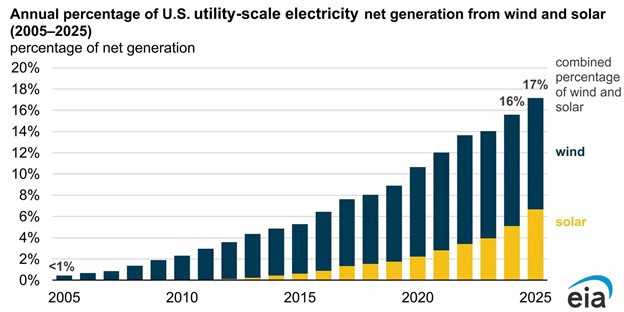
Solar and wind energy hit 17% of net electricity generation in the United States, a new all-time high.
All new homes built in the UK must have solar panels installed.
Do you see where I’m going with this?
These incentives and initiatives aren’t an accident. Governments are telling you where the next huge chunk of investment dollars will go and how they’ll frame it.
They are asking you to hate terrorism more than you hate solar panels on your roof.
India is building solar panel farms as far as the eye can see in deserts. 30 GW of power generation, capable of powering 18 million homes.
These are substantial infrastructure investments that you can’t turn on or off like a light switch. We’re witnessing decades-long bets that will alter supply/demand dynamics for solar energy and its entire supply chain.
You can see it in solar stock price action.
Solar Energy Cycle: How Long Will It Last?
According to the TAN/SPY ratio chart, solar stocks have had two major cycle lows and bull markets over the past 15+ years.
The first cycle low happened in December 2012. Solar stocks outperformed the SPY by ~187% over the following 18 months.
The next cycle low bottomed in Nov/Dec 2018, then solar stocks outperformed the SPY by 305% over the subsequent three years.
That brings us to today … solar stocks bottomed in May 2025 and have since outperformed the SPY by ~60%.
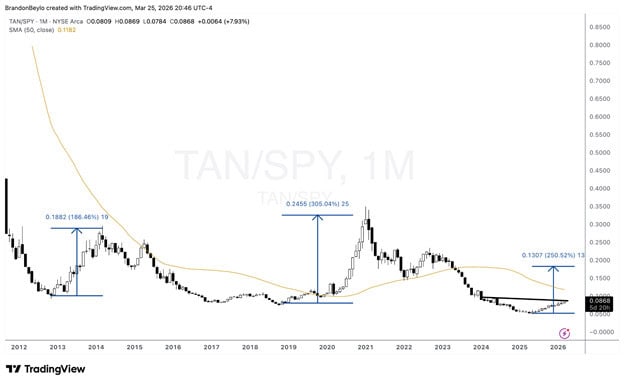
I know it’s only a sample size of two, but it feels like the current solar bull run has a lot more juice in the squeeze. A 250% outperformance from its cycle lows would not be uncommon.
Playing Both Sides
Silver and solar are two sides of the same coin. What’s bullish for solar is bullish for silver, and vice versa.
Countries are ramping up solar investments, which require more silver (which we don’t have), putting further strain on the energy security mandate and making energy security that much more important. This, in turn, forces even greater investments in solar and wind energy, adding more demand for silver.
Solar energy accounted for 14% of total silver demand in 2014. It jumped to 29% in 2024.
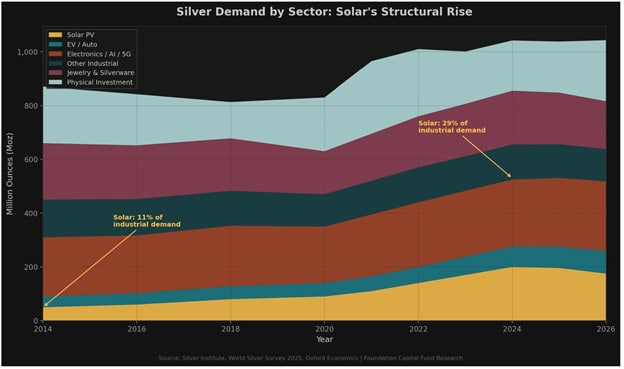
A peer-reviewed study published in Resources, Conservation and Recycling estimates that by 2030, the solar industry alone could require 321 to 450 million ounces of silver annually. This would represent 29-41% of the total silver supply at current production levels.
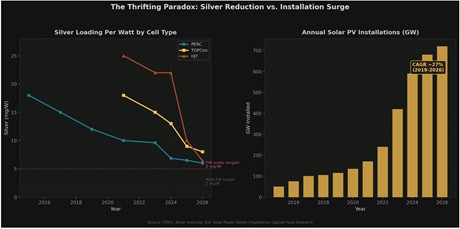
The bear argument is that solar technology has improved so dramatically that today’s panels require substantially less silver than prior models.
While that’s true, it ignores the fact that total solar adoption rates have increased 6x, offsetting any “thrifting” gains made from manufacturing and technology (see below).
The best part about this thesis is that nobody’s talking about it.
My commodity/mining friends are obsessed with oil and hate the idea that solar and wind assets could outperform hydrocarbons over the next 18-24 months. And my value investor friends don’t want to touch solar panel manufacturers or really any company associated with solar energy because it’s a “bad, capital-intensive business.”
The good news is that silver and solar should both work tremendously well if I’m directionally right on my thesis. Wind should also do very well, which we’ll discuss in future Long Pull Reports.
Which reminds me … here’s how I’m thinking about structuring my next few weeks of research around the solar/silver trade.
- Deep dive into solar energy supply chains to learn as much as I can about every aspect of how the industry works.
- Interviews with solar energy experts (CEOs, analysts, power traders, manufacturers, etc.) to generate Podcast Notes.
- Deep dives on highly asymmetric silver miner plays.
Please DM me if you know of anyone in the solar industry who would be interested in a Collective-only interview.
We’re at the beginning of an Energy Security Renaissance, and no energy form is off limits. Solar and wind are two of the most left-for-dead corners of the market, and the ancillary benefits from silver and the miners provide excellent hunting grounds for investment ideas.
I hope you enjoy these next few weeks and learn something new along the way.