“Everything in nature moves in cycles … our solar system moves in a cycle around the center of the Milky Way galaxy … the planets mve in precise and predictable cycles around the sun … the cycle of the tilt of the earth causes the cycle of the seasons … the rotation of the earth produces the cycle of night and day … the full moon occurs with predictable regularity as do the rise and fall of the tides. Each year geese migrate, animals hibernate, and salmon swim upstream to spawn, to mention just a few of the Seasonal Cycles with which we are familiar.” – Walter Bressert
Tiger Woods won the 1997 Masters tournament by 12 strokes. He was 21 years old. Two months later, he became world number one, the youngest to hold that ranking in golf history.
So Tiger did what any 21-year-old golf phenom would do at that point: he completely rebuilt his swing.
I want to stop here so you can internalize how insane that move is at that point in Tiger’s career.
He had everything going for him. Masters champion, the youngest to ever reach world number one. Imagine all the Yes Men in his ear, chanting, “Tiger you’re the man! You’re the best in the world! Nobody can stop you. Keep doing what you’re doing.”
Why would he change his swing? What would compel someone to do that at that moment in their career?
Because Tiger Woods wanted to be the greatest golfer ever.
The swing change results were incredible. From GolfDigest (emphasis mine):
“The two-year swing overhaul under the supervision of coach Butch Harmon led to the greatest stretch of golf in history. Between August 1999 and June 2002, Woods won seven of 11 majors, as close to golf perfection as anyone has ever come.”
Woods traded two years of underperformance for a four-year run that cemented him as one of golf’s greatest athletes.
But the best part of this story is why Tiger rebuilt his swing, in his own words (emphasis mine):
“I didn’t see one flaw. I saw about 10. I had struck the ball great that week, but by my standard, I felt I had gotten away with murder. From a ball-striking standpoint, I was playing better than I knew how.”
I love the “I felt I had gotten away with murder” part. It shows how well Tiger knew his game and the reason he changed his swing in the first place. Back to the Golf Digest article (emphasis added):
“The genius of Woods’ swing overhaul is it wasn’t focused on his best shots, but in elevating the quality of the bad ones.
“At that time I still thought I had good hands and I could time it up,” Woods explained decades later. “But the problem is timing that golf swing at that particular time, I’m going to hit some serious foul balls, too, and I need to get the foul balls in the position where I can play and compete, and give myself a chance every single time I teed it up. I didn’t feel like I could do that.””
Tiger’s swing overhaul focused on reducing the left tail of bad swing outcomes (i.e., foul shots). He understood that he couldn’t eliminate bad shots. But if he could improve the result of the bad shots (when they inevitably came), he would improve his overall scoring.
I want to rebuild my “swing” this year. Maybe I take a performance hit for 12-18 months. But I know it will be worth it.
This essay outlines why I’m changing my swing, what it will look like, and how I will do it.
Why I’m Changing My Swing: Getting Away With Murder
My trading feels like I’m getting away with murder. We’ve generated solid performance at Macro Ops – roughly 45% CAGR from 2023-2025 – but not all of that is from the equity book, and there are still so many holes … so much room for improvement in my equity trading.
I’m a breakout investor by nature. I buy breakouts to new highs, ride trends, and hope the trends last long enough to realize a good year. I chase relative strength leaders because momentum is one of the strongest market signals, and I usually end up overweight one primary/dominant theme with massive left-tail risk to that theme suddenly not working.
In other words, the past three years felt like “playing better than I knew how.”
I’m changing my swing to reduce left-tail outcomes in my current trading style/technique. I want to turn the foul balls (read: large drawdowns) into smaller drawdowns … more minor misses so that I can trade better throughout the year, despite lulls in my breakout/relative strength tactics.
This won’t be a dramatic 180-degree swing change. Instead, I’m focusing on adding one new skill to become a more holistic trader.
Because, like Tiger, I want to become one of the greatest traders to ever live. I know it’s unusual to think that, let alone write it so others can read it, but as actor Timothy Chamalet says:
“I’m in pursuit of greatness. I know people don’t usually talk like that, but I want to be one of the greats. I’m inspired by the greats.”
And when is Lisan Al Gaib ever wrong?
Let’s get after it.
The Swing Change: Buying Dips (& Bottoms)
Buying dips, whether that’s in existing uptrends or at long-term support, is the worst part of my trading process. It’s the part of my game where, “I don’t see one flaw, I see ten.”
Ask @ChrisM about my dip-buying abilities, and he’ll probably respond with, “Hahahahahaha what ability.”
There are three reasons why it’s the worst part of my game:
- I haven’t studied/backtested a dip buying/buying support strategy (laziness).
- I didn’t think I needed to master this skill because I could “just be a breakout trader” (ego).
- I used price action as a crutch. If I buy something going up, I must be right … right??? (fear).
As I mentioned above, I will still trade breakouts, but I want to adjust the type of trades I take. Instead of buying stocks making new ATHs, maybe I buy stocks that are showing relative outperformance over 1-3 month periods but are down 50-70% over the past 1-3 years.
One of the great things about Mike G is that I don’t have to worry about breakout trading leading stocks making new ATHs. He has that corner covered. It then allows me to focus on long-term, mean-reversion setups that provide real alpha to our MO portfolio.
That feels like the missing link.
So I spent the last few months of 2025 reading everything I could on cycles, dip-buying strategies, and trading philosophies focused on buying long-term support. This led to me Walter Bressert and his seminal work, The Power of Oscillator/Cycle Combinations.
I read it in a weekend, and it’s become the foundation of my v1 Long-Term Mean Reversion Strategy.
Building My Dip Buying Strategy: Basic Technicals + Bressert Cycle Analysis
A lot of this strategy will sound basic to those familiar with buying dips or long-term support. But I had to build something from scratch, so I started with the basics.
My primary goal was to keep things simple. No Elliott Waves or Fibonacci sequences, just price action, one support line (or support box), and Walter Bressert’s Double Smooth Stochastic Oscillator (DSS Bressert, for short).
The first step was to identify stocks that are at (or near) long-term support levels. Ideally, these stocks should be in large drawdowns as they find long-term support (to capture the mean reversion alpha).
Novo Nordisk is a great example (see below).
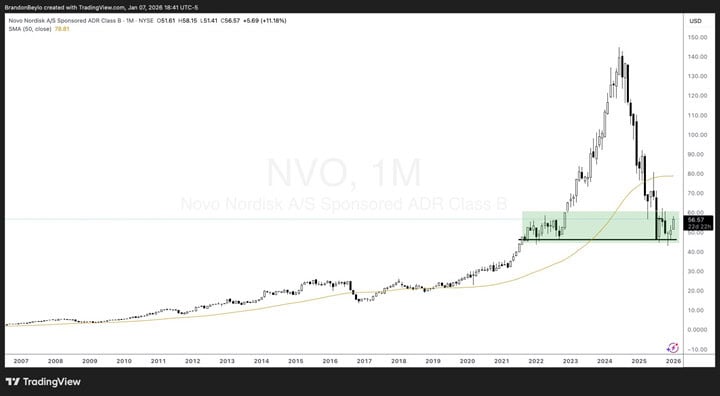
The stock is down 60% from its prior highs but found support around its 5YR lows. This is the ideal setup.
Notice that I only need to draw one support line to connect the lows (I started using rectangle support areas as a better visualization of long-term support … you don’t need to do this).
Alex always says that a strategy isn’t a strategy until you can codify it. So, the next step was to determine how to screen for more stocks like NVO. Could I develop a screener to systematically find these names, rather than relying on a random Twitter post that just so happened to cross my feed?
How To Find Mean Reversion Trades
Here are the criteria for my “Left For Dead” screener.
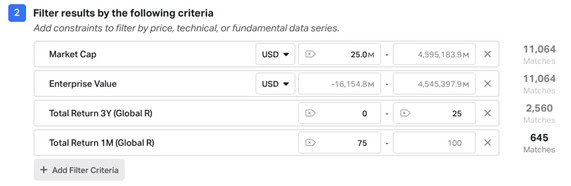
The big idea is to find the worst-performing stocks over the past 3 years that are also breaking out over the past month. I want to see signs of life.
I’m pleased with the results so far (see below).
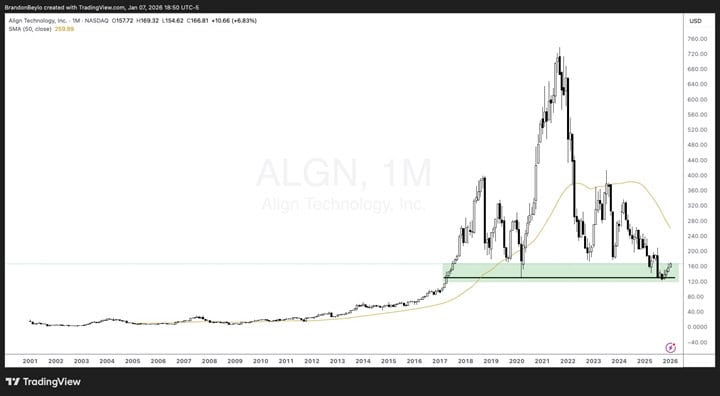
Align Technologies (ALGN)
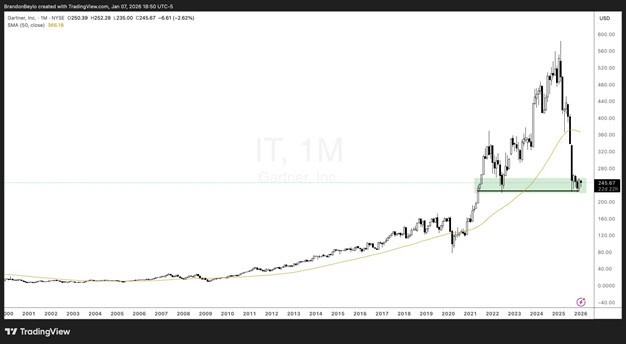
Gartner, Inc. (IT)
Biomerin Pharmaceuticals (BMRN)
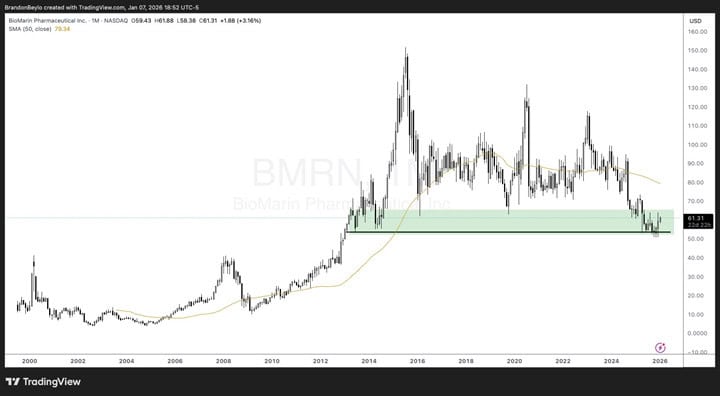
These are just three examples from the 645 results generated by the screener. You can already see the power of similarity between these charts. Things become repeatable.
The other benefit of this screener is that most of these companies are at their cheapest levels over their 10YR history (makes sense given the drawdowns).
Here’s the Valuation Percentile Rank for BMRN (see below).
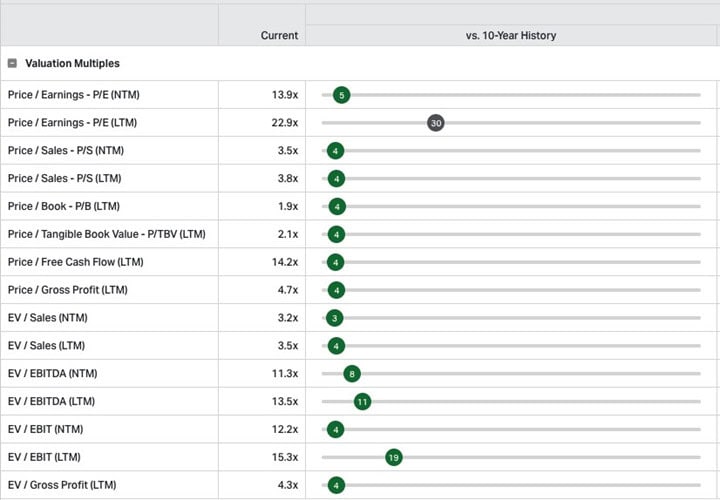
You begin to see how quickly we can find Mean Reversion Trifecta Lens setups:
- Fundamentals: Most stocks trade around their lowest valuations over the past 10YRs.
- Technicals: Most stocks have found long-term (3-5YR) support and are showing price strength off those levels.
- Sentiment: These stocks are the bottom 5th percentile performers over the past 3YRs (nobody wants to touch them).
I know all of this sounds simple … maybe too simple. But that’s the point. I want a simple system and a simple screener to identify Mean Reversion Trifecta Lens trades.
This is where it gets exciting. We have a process for identifying:
- Leading industries over the long term (RS Composite)
- Leading industries over the short term (RS Inflection)
We can use the top three industries from RS Composite and RS Inflection as filters for trade identification in Mean Reversion setups.
Let’s use our November RS Inflection Report as an example. Pharmaceuticals ranked fourth among industries in that report (see below).

Two of the three names I mentioned here in the Left For Dead screener were biotech/pharmaceutical names.
This is why I’m so excited about this Mean Reversion System. We’re taking existing processes and adding another trading tactic to capture more alpha out of markets.
Suddenly, I can make a compelling bull case for BMRN … the stock is the cheapest it’s been in 10 years, it’s bouncing off 5YR support with strength, and it’s in one of the strongest-performing industries over the past 1M and 3M periods.
Maybe there’s something there, maybe not. The point is that it’s a great starting point for a potentially significant trade.
The final step in our system is to use the DSS Bressert Oscillator to confirm the cycle low and entry signal bar.
The DSS Bressert Oscillator
The DSS Bressert isn’t a magic indicator. It’s like any other relative strength Stochastic measurement. Think RSI or CCI. DSS Bressert measures Overbought/Oversold conditions and helps identify potential cycle lows and highs.
DSS stands for Double Smooth Stochastic. According to Gemini, the standard Stochastic Oscillator can often be “choppy,” jumping up and down with every minor price wiggle. The Bressert DSS fixes this by applying a two-step mathematical filter:
- First Smooth: It calculates a standard Stochastic value but immediately smooths it with an Exponential Moving Average (EMA).
- Second Smooth: It then performs a second Stochastic calculation on that already-smoothed data and applies another EMA.
- The Result: A very smooth, wave-like line that reacts quickly to real price turns but stays steady during minor fluctuations.
The oscillator moves between 0 and 100, with <20 marking “oversold” and >80 marking “overbought” levels.
Here it is on the NVO monthly chart.

As expected, NVO is bouncing off the lowest DSS Bressert levels since 2017, which marked its last significant reversal.
No indicator can predict an exact cycle low. But that’s not the point. The goal is to help tilt the probabilities in our favor that we’ve identified a cycle low.
Let’s look at ALGN with the DSS Bressert indicator.
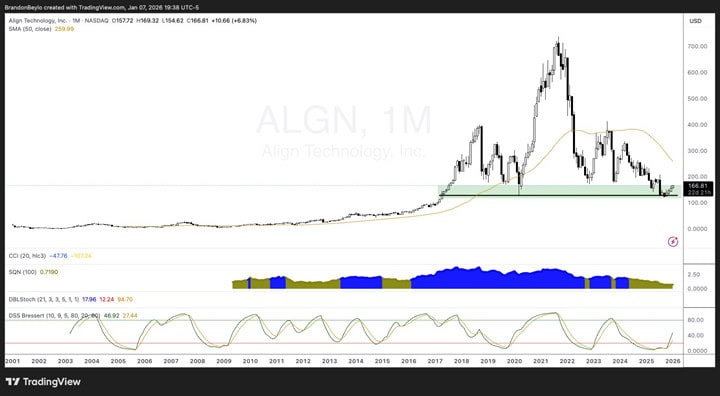
ALGN has broken above its 20 level on the DSS Bressert, in a Bull Quiet, at 5YR support … maybe that’s the cycle low?
We can even use it on weekly charts to identify cycle lows. Check out the NICU chart since inception (see below).

The green shaded areas represent each time the DSS Bressert traded below oversold levels and reversed higher.
Can you use RSI or CCI? Of course. I found DSS Bressert more helpful for longer time frames. It smooths price action and lets me see cycles I wouldn’t otherwise. And so far, that’s helpful.
Trading Rules Around DSS Bressert
Here are the trading rules using Bressert’s DSS Oscillator (according to Bressert):
- DSS Bressert must drop below 20 (red line).
- The candle (or bar) that turns the Green MA Oscillator up is the Signal Bar.
- Buy stop a tick above the Signal Bar.
- Sell stop a tick below the pivot point (or cycle bottom).
Although Bressert doesn’t explicitly mention it, I like the idea of the Signal Bar being the bar that pulls the Green Oscillator back towards the 20 (or red) line. It’s more concrete than “find the bar that turns the oscillator up.”
Let’s use NVO as our example trade.
- DSS Bressert must drop below 20: Check.
- The bar that turns the Green Oscillator to the 20 level is the Signal Bar: Highlighted on the chart.
- Buy stop: A tick above this month’s highs.
- Sell stop: A tick below the November monthly lows.
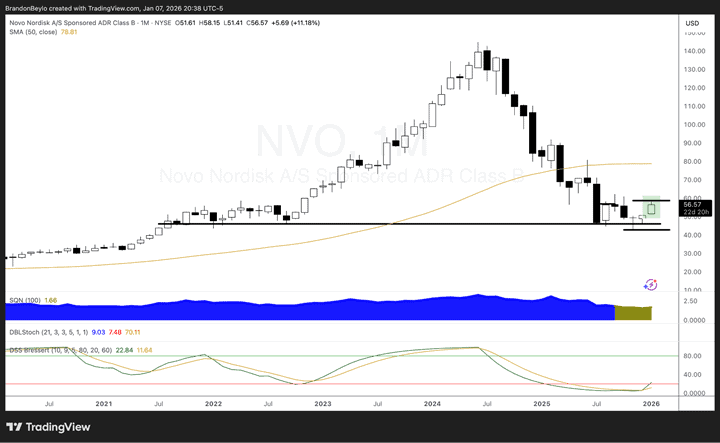
There you have it. A complete v1 Mean Reversion System that identifies Trifecta Lens Trades in a corner of the market I’ve rarely fished: beaten-down names bouncing off long-term support.
Next Steps: Backtesting & Go Live
The next step is to backtest this trading system during the year. My goal is to have a bunch of trades to analyze by summer and, if profitable, implement the strategy in the MO portfolio.
Trading and investing are lifelong pursuits of perfecting one’s craft. Tiger Woods did it with a golf club. I want to do it with a trading book and PnL. If the world’s greatest golfer can recognize issues in his game and dedicate years of underperformance to fix them, what’s stopping you from becoming the best trader this year, and every year?