A big thank you to @Tobias for making our first MOHO Idea Lunch webinar of 2026 a great one.
Tobias is a software/AI transformation consultant. He’s spent 30+ years in the software industry (living in the heart of Software in Silicon Valley) and has seen every massive technological change you can imagine.
So when Tobias describes AI as “this time will be different”, you should listen very carefully.
We spent 90 minutes diving deep into many AI topics, including:
- How to use AI as an investor
- The role of human (i.e., active) investors in the age of AI trading
- Universal Basic Income
- How AI is eating all the software development jobs (and what that means for society)
- Personal security and defense around “bad actor” AI
- The best investment ideas to play the Bullish AI thematic
And more! This is 90 minutes of pure information and value from an industry veteran, and I’m thrilled (and humbled) we have someone like Tobias in our Collective. That is the power of this community.
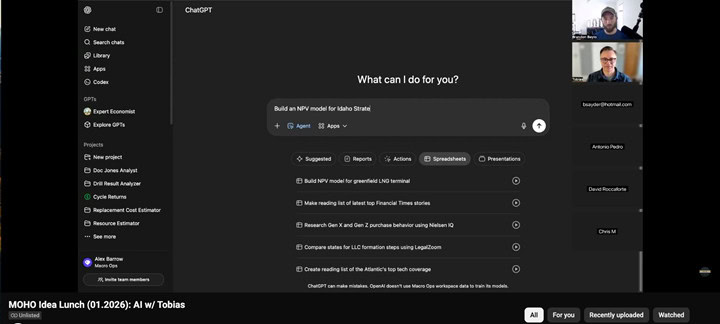
Watch the entire webinar here.
Speaking of AI taking all of our jobs and doing all of our work … I had Claude Cowork create a Detailed Summary Report of the webinar, which I’ve pasted below.
It’s not perfect, but it’s a damn good synopsis that took me maybe 30 seconds of prompting.
We’re in the early innings of using these AI tools to leverage our human capabilities. I don’t want us (the Collective) to get left behind. It’s why these webinars are so important. It’s why experimenting with tools like Claude, ChatGPT, Gemini, and the hundreds of others is so important. We learn by doing, sharing, and iterating along the way.
I hope this webinar encourages you to use these tools in your daily investment process. Let’s level up together.
(Claude-generated report below).
.
AI and Its Impact on Investing
Macro Ops Collective Webinar Report
January 15, 2026
Executive Summary
This webinar brought together the Macro Ops Collective community to explore the transformative impact of artificial intelligence on investment research, analysis, and decision-making. Led by Brandon Beylo with participation from Tobias, Alex Barrow, jdavidr, Chris M, Antonio, Brent, and other community members, the 90-minute session provided hands-on demonstrations of AI tools for investors.
The discussion covered six major themes: AI-driven investment ideas, enhanced investment analysis capabilities, the future of software development jobs, Universal Basic Income implications, security and defense applications, and practical guidance for using AI as an investor or everyday person.
1. AI-Driven Investment Ideas
1.1 Idaho Strategic Resources (IDR) Case Study
The webinar featured a comprehensive demonstration using Idaho Strategic Resources (IDR), a gold producer with a large land package in the Idaho Rare-Earth Belt. This case study illustrated how AI can accelerate fundamental investment research.
Company Overview
IDR controls three early-stage rare-earth projects: Lemhi Pass, Mineral Hill, and Diamond Creek, together covering more than 19,000 acres. Exploration to date has focused on soil and trench sampling, geophysics, and limited drilling.
Project Details Extracted by AI
Lemhi Pass: Greater than 12,000 acres with first recorded monazite-bearing carbonatite discovered in 2025. Samples contain up to 68% magnet rare-earth elements (Nd, Pr, Dy, Tb) and approximately 15% SEG (Sm, Eu, Gd) content. Carbonatite outcrops show rare-earth oxides (TREO) up to 11%.
Mineral Hill: Approximately 2,500 acres with at least three carbonatites identified. Numerous samples exceed 30% TREO. Drone-based magnetics reveal potential deep magnetic anomalies. Monazite is the primary ore mineral, occurring in pure bands.
Diamond Creek: Approximately 4,500 acres with mineralization primarily consisting of monazite.
1.2 NPV Model Generation
The demonstration showed ChatGPT building a complete Net Present Value (NPV) model for the IDR rare earth element land package. The AI was prompted to assume the role of a leading geologist with 30+ years of experience in modeling early-stage exploration projects.
Price Assumptions Used
The AI gathered current rare-earth element prices for the analysis: Neodymium (Nd) at US $149/kg, Praseodymium (Pr) at US $144/kg, Dysprosium (Dy) at US $183/kg. Bulk light REEs such as lanthanum and cerium were priced below US $3/kg. Using current prices and assuming Samarium (Sm) at approximately US $2/kg (samarium oxide price), the model yielded a weighted price of approximately US $60/kg of TREO.
Comparable Assets Referenced
Mountain Pass (California, USA) was cited as a comparable, representing a world-class bastnaesite deposit producing approximately 15% of global REO supply. The 2024 technical report notes an after-tax NPV of approximately US $5.3 billion with total revenue of US $20.2 billion over the life of mine.
The AI also referenced IDR’s Mineral Hill carbonatite samples returning greater than 17.6% TREO with visible monazite bands, and Lemhi Pass carbonatite samples showing up to 11% TREO.
Model Methodology
Given the lack of a compliant resource, the model uses scenario analysis. The general methodology includes: (1) Resource and grade assumptions estimating total ore tonnage and average grade for each scenario based on analogous deposits and IDR sampling results, with scenarios ranging from low-grade/small to high-grade/large; (2) High-level geological assumptions to model potential economic outcomes using a 10% discount rate; (3) Consideration of comparable assets based on jurisdiction, geology, and metallurgy.
The AI generated Python code to calculate NPV scenarios, demonstrating the ability to write functional financial models programmatically. The terminal output showed the model adjusting high-case scenarios and flagging when assumptions appeared unrealistic.
2. AI for Investment Analysis
2.1 Custom GPTs for Investment Research
The webinar showcased the Macro Ops team’s suite of custom ChatGPT applications (GPTs) designed specifically for investment analysis. These tools demonstrate how investors can build specialized AI assistants tailored to their research needs.
Available Custom GPTs Demonstrated
Expert Economist: Analyzes macroeconomic trends, policy impacts, and economic indicators relevant to investment decisions.
Doc Jones Analyst: Specialized for document analysis, extracting key insights from SEC filings, annual reports, and technical documents.
Drill Result Analyzer: Purpose-built for mining investors to interpret drill results, grade calculations, and exploration data.
Cycle Returns: Analyzes historical market cycles and return patterns to inform timing decisions.
Replacement Cost Estimator: Calculates asset replacement values for valuation analysis, particularly useful for mining and infrastructure investments.
Resource Estimator: Helps model resource estimates and tonnage calculations for exploration-stage companies.
2.2 Document Analysis Capabilities
The webinar demonstrated AI’s ability to read and analyze complex PDF documents. Using the PDF reading service, ChatGPT opened IDR’s 2025-8K Corporate Presentation and extracted structured data including project locations, sample grades, and exploration timelines. This capability dramatically reduces the time required to digest lengthy technical reports and SEC filings.
2.3 Web Research and Data Gathering
Live demonstrations showed ChatGPT searching for RBC site data, accessing Yahoo Finance for stock market information, and gathering commodity prices from multiple sources (strategicmetalsin…, scrapmonster.com, idahostrategic.com). The AI handled restrictions and loading issues by automatically searching for alternative sources, showcasing its adaptability in real-world research scenarios.
2.4 Presentation and Report Generation
A particularly impressive demonstration involved the AI creating a complete PowerPoint presentation on “Electric Vehicle Market: Nickel’s Critical Role.” The system planned slides, ensured alignment with document key points, included styling and imagery per specifications, and generated the presentation files programmatically using pptxgenjs. The terminal showed the AI searching for the pptxgenjs installation, loading the module, and creating answer.js in a slides directory to build the presentation.
3. The Future of Software Development Jobs
3.1 AI as a Coding Partner
The webinar provided firsthand evidence of AI’s growing capabilities in software development.
Throughout the demonstrations, ChatGPT wrote functional Python code for NPV calculations, JavaScript for PowerPoint generation, and handled terminal commands for file management and package installation.
Key Observations on AI Coding
The AI demonstrated the ability to import necessary libraries (numpy, pptx.writeFile), define complex functions with multiple parameters (npv_calc handling ore_tonnage, grade, recovery, payability, price, opex, capex, throughput, life), implement control flow and error handling, and debug in real-time when scenarios produced unrealistic results.
3.2 Implications for Developers
The discussion touched on how these capabilities are reshaping the software development landscape. Junior coding tasks that once required entry-level developers can increasingly be handled by AI. However, the need for human oversight, architectural decisions, and complex problem-solving remains essential. The consensus was that developers who learn to leverage AI tools will be more productive, while those who resist adaptation may face displacement.
3.3 Investment Implications
For investors, this trend suggests potential headwinds for traditional software services companies relying on large developer workforces, while creating opportunities in AI infrastructure, tools, and platforms that enable this transformation. Companies that successfully integrate AI into their development workflows may gain significant productivity advantages.
4. Universal Basic Income (UBI) Discussion
4.1 The AI-UBI Connection
The webinar addressed the growing conversation around Universal Basic Income as a potential response to AI-driven job displacement. As AI capabilities expand into domains previously requiring human expertise, questions arise about how society will adapt to potentially significant shifts in employment patterns.
4.2 Economic Considerations
Participants discussed the economic feasibility of UBI programs, noting that increased productivity from AI could theoretically generate the wealth needed to support such systems. However, the distribution mechanisms, inflation concerns, and incentive structures remain hotly debated topics. The discussion acknowledged that while AI may displace certain jobs, it also creates new categories of work and increases overall economic output.
4.3 Investment Angles
From an investment perspective, UBI discussions connect to broader themes around consumer spending patterns, government fiscal policy, and the potential for new policy-driven market dynamics. Investors should monitor political developments around UBI experiments and proposals as potential indicators of future policy direction.
5. Security and Defense Applications
5.1 AI in Defense Technology
The webinar touched on the significant role AI is playing in defense and security applications. From autonomous systems to intelligence analysis, AI is transforming military capabilities. The rare earth element analysis presented in the IDR case study connects directly to this theme, as rare earths are critical components in defense technologies including missiles, radar systems, and advanced electronics.
5.2 Strategic Resource Implications
The discussion highlighted how domestic rare earth production (such as IDR’s Idaho projects) has national security implications given current supply chain dependencies on China. AI-driven exploration and resource estimation tools can accelerate the identification and development of strategic mineral deposits in friendly jurisdictions.
5.3 Cybersecurity Considerations
The expanding use of AI also raises cybersecurity concerns. As investors increasingly rely on AI tools for research, questions about data security, model reliability, and potential manipulation become relevant considerations. The webinar noted the importance of understanding the limitations and potential vulnerabilities of AI systems.
6. How to Use AI as an Investor
6.1 Getting Started with ChatGPT
The webinar demonstrated practical workflows using ChatGPT 5.2 (the version shown in the demonstration). Key features highlighted include the Agent mode for complex multi-step tasks, Apps integration for extended functionality, Report generation for structured analysis, Spreadsheet creation for data organization, and Presentation mode for creating slides.
6.2 Effective Prompting Strategies
The IDR case study illustrated effective prompting techniques. The prompt used specified the task clearly (build an NPV model), assigned a role (world’s leading geologist with 30+ years experience), defined constraints (early-stage exploration with limited data), and requested specific considerations (comparable assets, jurisdiction, geology, metallurgy). This structured approach yields more useful and accurate outputs.
Sample Investment Research Prompts Shown
The ChatGPT interface displayed several suggested tasks that investors can perform: “Build NPV model for greenfield LNG terminal,” “Make reading list of latest top Financial Times stories,” “Research Gen X and Gen Z purchase behavior using Nielsen IQ,” “Compare states for LLC formation steps using LegalZoom,” and “Create reading list of the Atlantic’s top tech coverage.”
6.3 Building Custom GPTs
The Projects section visible in the ChatGPT interface showed how the Macro Ops team has organized their AI tools. Custom projects included Doc Jones Analyst, Drill Result Analyzer, Cycle Returns, Replacement Cost Estimator, and Resource Estimator. Building custom GPTs allows investors to create specialized assistants trained on specific domains, methodologies, or data sources.
6.4 Company Knowledge Feature
The webinar showed ChatGPT’s Company Knowledge feature, which allows teams to build shared knowledge bases that the AI can reference. For investment teams, this enables consistent access to proprietary research, investment frameworks, and institutional knowledge across team members.
6.5 Limitations and Caveats
The webinar appropriately noted limitations. The ChatGPT interface displayed a disclaimer:
“ChatGPT can make mistakes. OpenAI doesn’t use Macro Ops workspace data to train its models.” Users were reminded that AI outputs require verification, particularly for financial decisions. The demonstration also showed cases where the AI flagged scenarios as “unrealistic,” demonstrating the importance of human judgment in interpreting AI-generated analysis.
Key Takeaways for Collective Members
- AI accelerates, but doesn’t replace, fundamental analysis. The IDR case study showed how AI can compress hours of research into minutes, but human judgment remains essential for investment decisions.
- Custom tools multiply effectiveness. Building specialized GPTs (like Drill Result Analyzer or Replacement Cost Estimator) creates reusable intellectual property that compounds over time.
- Prompting is a learnable skill. Structured prompts with clear roles, constraints, and output specifications yield dramatically better results.
- AI is reshaping competitive dynamics. Investors who master AI tools gain research leverage; those who don’t will fall behind as the capability gap widens.
- Watch for second-order effects. AI’s impact on software jobs, UBI discussions, defense applications, and strategic resource development creates multiple investment angles beyond pure-play AI companies.
- Verify AI outputs. The demonstration showed AI flagging its own unrealistic scenarios. Always cross-check critical data and assumptions before acting on AI-generated analysis.
Conclusion
This webinar demonstrated that AI has moved from theoretical potential to practical investment tool. The Macro Ops team’s ability to conduct complex NPV modeling, document analysis, web research, and presentation generation in real-time illustrates capabilities available to any investor willing to learn these tools.
For Collective members, the path forward is clear: experiment with these tools, build custom solutions for your investment process, and stay informed about AI’s expanding capabilities. The investors who thrive in the coming years will be those who view AI as a powerful amplifier of human intelligence, not a replacement for it.
Next Steps: Access ChatGPT’s team features, experiment with the prompting strategies demonstrated, and consider what custom GPTs would be most valuable for your investment process. The Macro Ops team will continue sharing updates on AI tools and techniques through the Collective community.