This week, I interviewed Peter Mantas of Logos LP. I’ve had Peter on the podcast twice, both in 2025, to discuss his “Left Tail” philosophy and investment approach to biotech and healthcare stocks.
I wanted to interview Peter again because I believe we’re in the early stages of a healthcare/biotech bull market.
We spent over an hour discussing biotech and healthcare winners/losers, how to spot real products/services versus vaporware in the “AI Age”, how biotech bubbles form and why they’re important, and why focusing on discoveries, not recoveries, is the way to play the coming biotech bull market.
As always, I leverage Claude/AI to create these Podcast Notes pieces. The cool thing about this series is that it incorporates Peter’s two prior podcast episodes, providing a cohesive overview of everything we’ve discussed over the past two years.
Let’s get after it.
The Setup: Why Biotech, Why Now
Across three conversations — January 2025, September 2025, and a June 2026 sit-down recorded the day before uniQure’s pivotal FDA resolution — Peter has been making one argument with increasing conviction: biotech is the deepest left tail in the market, and the bubble that eventually forms here will be the most real one in a generation.
Start with his self-description. “I’m a capital-cycle whisperer,” Peter says. “I know where the left tail is, and I just get really big when I see it.” He doesn’t pitch himself as a drug picker or a scientist. He’s a cycle investor who happens to play in biotech.
That distinction is the key to everything that follows. The macro backdrop he describes is straightforward. Biotech endured a brutal capital cycle from roughly 2021 to 2025 — high rates from inflation, biotech funding drying up, a COVID hangover that wrecked the comps for life-science tools, and a glut of pre-clinical “science projects” that came public in the 2021 froth and couldn’t prove out what they had.
As he puts it, biotech doesn’t need rates at zero; it needs stable, predictable rates. The other ingredients of a durable bull — available capital, approvals, robust research funding (NIH), and serious science policy — are arriving unevenly, which is exactly why he still thinks it’s early.
His single most-repeated market aphorism: “You can’t have a proper bubble without biotech.” Over 10 years to mid-2026, the XBI biotech ETF returned roughly +35%, while the S&P 500 returned north of +300%. The bubble he’s preparing for “is not one of recovery. It’s one of discovery.”
Peter’s Left Tail Framework
This is the heart of Peter’s process, and the reason I keep bringing him back. If you take one thing from this report, take this section.
1. Think in tails, not multiples
Most investors frame a position as “buy at 15x earnings, sell at 30x.” Peter reframes everything as a distribution. Every stock sits somewhere on a bell curve: a right tail (everything has gone right — a once-in-a-cycle tailwind is already in the numbers), the mean, or a left tail (everything has gone wrong — maximum pessimism, often trading below cash).
The power of the frame is in the asymmetry. “I live in the left tail,” he says. “When I look for investments, I don’t need it to go to the right tail. I just need it to get out of the left tail.” A move from the left tail merely back to the mean — one standard deviation — can be a triple or a 5x. A move all the way to the right tail might be a 50- or 100-bagger, but you don’t have to underwrite that to make the bet work. You’re paid for the journey out of despair, not for the journey into euphoria.
2. The hard part: temporary vs. terminal
The danger in left-tail investing is what Peter calls the “inverse hockey stick” — a chart that just bleeds out. “Sometimes it deserves to be bombed out. In a left tail, it’s terminal.” The entire skill is separating the temporarily-left-tailed (cyclical, fixable, mispriced) from the terminally-left-tailed (bleeding to zero).
He admits this is the hardest judgment in the discipline, and he leans on two things to make it: broad sector mapping and conversations with industry experts.
His contrarian tell for a bottom is “the existential question”. When portfolio managers stop asking “is this cheap?” and start asking “why would I ever invest in this space at all?”
3. Mapping the pond before you fish
Peter doesn’t screen for tickers first; he maps sectors and asks which ponds are in left tails, which are at the cusp of the end of a right tail, and which are fair.
The mapping process is deliberately old-fashioned: start with primers, talk to customers and operators (“walk me through your workflow, walk me through what matters in your cycle”), and build a picture of the ecosystem and who supplies whom.
As we’ll see later, AI has collapsed the cost of building that map, which he thinks is itself a structural tailwind for the whole sector.
4. Position sizing: bet on politics, not biology
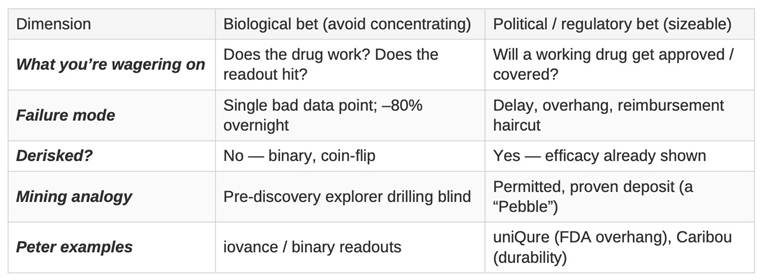
The most actionable part of the framework is how Peter decides what to size up. He draws a sharp line between two kinds of risk:
- Biological risk: a wager on whether the science works, whether a drill-result-equivalent readout comes back positive, or whether a patient’s multi-year follow-up stays clean. “The moment you get a sniff that one patient might get cancer, the stock drops 50% in a day.” He won’t concentrate here. It’s too close to a coin flip.
- Political/regulatory risk: a derisked asset whose science already works, held back by an FDA overhang, a political tug-of-war, or a reimbursement question. These he can size, “because political winds change very often, especially when you’re dealing with people’s lives.”
Discovery, Not Recovery: How Biotech Bubbles Form
The defining line of the most recent episode was, “You want to buy discovery, not recovery.”
It is the organizing idea behind Peter’s entire current positioning, and it’s what frames his view of biotech bubbles going forward.
According to Peter, bubbles are born on the darkest days, in pessimism, when no one believes. “Bubbles die on froth and optimism.” But the fuel that ignites them is not fake science or science fiction; it is a verifiable, jaw-dropping element of truth: “Holy cow, we found a cancer drug we’ve never seen before. Cancer used to be a death sentence; now it’s an annoyance.”
Once the truth lands, the narrative extrapolates fast. That extrapolation is the bubble. This is why he insists the coming wave is one of discovery. The 2021 cohort came public as preclinical science projects at billion-dollar valuations with one patient, or a monkey model, and no human data.
Four years later, that same cohort has run the gauntlet: a phase-one asset from 2021 is now phase three, and the ones that survived are printing data that genuinely surprises. “We’ve discovered a silencing treatment for Huntington’s. We’ve discovered an anchor therapy for drug-resistant epilepsy. That is game-changing.” That is what makes monster companies.
The corollary is a warning about recovery trades. He points to Danaher (and the diversified tools “shopping malls”) as recovery plays — names climbing out of a COVID/vaccine headwind. “That’s why Danahers aren’t working right now. Those are recovery trades.” They will eventually work, but they are not where the violent, narrative-driven returns are born this cycle.
He even reframes the speculative end the same way: “Sh*tco season is a derivative of discovery, not recovery.”
Platforms and Railroads: Making $50 Billion Companies
If “discovery” is what ignites the bubble, “platform” is what makes the resulting company durable. Peter is emphatic that the common belief — “you can’t have compounders in biotech” — is simply false, and points to Alnylam, Vertex, Regeneron, Crinetics, and Argenx as proof over the last 5– 10 years.
His central metaphor is the railroad. “The cargo is almost irrelevant — the drugs are almost irrelevant. It’s the railroad.” The railroad is the manufacturing process and the IP portfolio fortified around it (the AAV vectors, the delivery process, the production know-how). That process is the true source of R&D productivity, and R&D productivity is to a biotech what return on invested capital is to a quality compounder.
The best operators take one core technology and repackage it across many indications. Eli Lilly is his gold-medal example: one GLP-1 molecule, packaged for cardiovascular disease, Alzheimer’s, dementia, breast cancer, melanoma — same manufacturing, hugely synergistic, with the patent cycle constantly upgraded. “One RNA technology, five drugs in the first five years” is how he describes Alnylam. A platform company can in-license, out-license, and iterate — “think iPhone 1, then 2, 3, 4, all the way to 16. Then an infusion, then a pill.”
This is why he frames uniQure as “the big kahuna.” Its mRNA/gene-therapy platform silences a toxic gene rather than adding genetic instructions — which sidesteps the cancer-risk fear that has dogged gene therapy — and the same platform plausibly attacks Huntington’s, severe epilepsy, and (theoretically) Parkinson’s and Alzheimer’s. “That’s how you get to the $70 billion biotech. The next platforms are going to be built in neuroscience and neurodegenerative disease.”
A mature platform, in his rough rule of thumb, trades around 10x sales as a median multiple — with 90% gross margins and 50% net margins once a true blockbuster is approved. The drug developers, he notes, capture the majority of the unit economics; the tools and delivery names are a tax on top of that (discussed later).
AI in Biotech: Real Edge vs. Vaporware
I asked Peter how he spots real platform companies from science projects touting AI developments that are really just vaporware in VC-backed landing pages. Here was his answer:
“What you want is robust human data, an asset that has moved through the cycle, and proof. There has to be proof. You don’t become bubble-esque from pie-in-the-sky science fiction.” Encouragingly, he notes the IPOs hitting the market in 2025–26 (his example: Peter Thiel’s cancer-detection name, billiontoone) are real companies, not science projects — a sign the easy money has not yet been made.
Where AI genuinely helps: discovery and molecule design. “Biotech truly is one of the greatest beneficiaries of AI — but contain it to the discovery side.” AI can accelerate molecule design, target identification, and the identification of the right candidate. It brings the cost of knowledge toward zero, and knowledge is the single largest input to biotech.
Where AI does not help: the clinic. The bottleneck is regulatory capture, not computation. “You still have to test on humans. It still takes a long time. There are still safety issues.” AI will not get a gene therapy to market in two years. If anything, he argues, AI could make trials more onerous — if a model predicts an effect, regulators may simply ask you to confirm it in more patients. And because the regulated, monopoly-like nature of an approved drug is precisely the moat, the discovery edge partially commoditizes itself. So: temper expectations.
The underrated second-order effect: flows
Peter’s genuine contrarian take isn’t about drug discovery at all — it’s about capital. “Now every generalist has a biotech analyst in their pocket.” A generalist who previously avoided the space because the learning curve was too steep can now map the Twist–10x–Illumina–Grail ecosystem in minutes, understand the unit economics, and conclude they no longer need to wait for GAAP EPS before allocating. The result: neglected, multiple-compressed names get re-rated sooner as flows arrive faster. He thinks this is underappreciated and structurally bullish for the sector.
How to sort real from vaporware in practice: ask whether the AI angle changes the unit economics of a business that already works, or whether it is the entire story. Twist passes — he liked it on diligence and valuation alone (“I didn’t even need the AI stuff”); the AI narrative (DNA synthesis as a bottleneck to AI-driven discovery) is upside, not thesis. A company whose only claim is “we use AI” is the opposite.
The Barbell: Picks-and-Shovels vs. High-Torque
Peter’s portfolio construction for the coming wave is explicitly a barbell, and he was unusually concrete about it. “It really depends what game you want to play.”
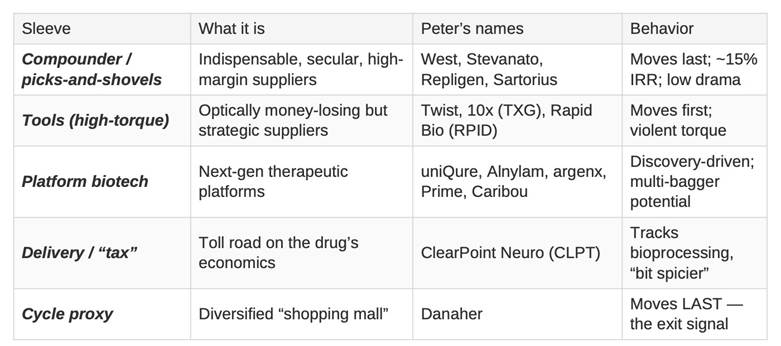
The compounder sleeve (don’t have to think about it)
On one end sit the indispensable, secular, cash-generative picks-and-shovels: the bioprocessing and pharma-supply names with enduring franchise value and high gross profits. “If I want a compounder sleeve I don’t have to think about and can do 15% IRR for a long time — go buy Repligen, Stevanato, West, or Sartorius and call it a day.” West Pharmaceutical and Stevanato he likens to each other (Stevanato the smaller); Repligen and Sartorius are the bioprocessing pure-plays. These move last and least violently.
The high-torque sleeve (face-ripping upside)
On the other end sit the names that, in his words, can “rip your face off.” These are the tools and platform-biotech names that are optically money-losing — affectionately, his “shtcodes,” many of them out of the ARK Genomics (ARKG) universe — but are actually good businesses. His tools list: Twist (TWST), 10x Genomics (TXG), and Rapid Bio (RPID). His platform-biotech list: Prime Medicine (PRME), Caribou (CRVU), and similar gene-editing names. “You want to buy platform companies in biotech, and on the tool side you want things that are indispensable, growing fast, with high gross profits — the 2015–2021 IPO vintage.”
The sequencing matters as much as the names. “It’s sh*tco season. The smart money goes there first — the optically money-losing, SBC-driven names are the first to move. The stuff that moves last is your West, your Sartorius, your Danaher.” When the diversified “shopping malls” are finally mooning, the generalists have arrived, and the easy money is done.
The proxy: watch Danaher
Peter offers an elegant tell for how early you are in the biotech cycle: Danaher. As the ultimate diversified “shopping mall for pharma,” it needs everything firing at once — low rates, a good FDA, NIH budgets on fire, biotech funding at record highs, pharma spending freely. “The fact that Danaher has not moved at all is a good sign” — confirmation that the wave is still early. When Danaher rips, it’s time to take chips off the table across healthcare and biotech.
Winners and Losers Going Forward
Where Peter is leaning in
- Gene & cell therapy. If forced to pick one theme in public markets, this is it. Two things still hold it back — no proven mega-blockbuster yet, and lingering distrust (“you’re modifying DNA”). He thinks both will be disproven this cycle, and that the next $50–100B in biotechs will be built here.
- Neuro / neurodegenerative disease “an endless supply of drug-pipeline growth” — the “five horsemen” (Parkinson’s, Alzheimer’s, dementia, epilepsy, Huntington’s). The biggest prizes (Parkinson’s, Alzheimer’s) are still ahead.
- Biologics & their toll roads monoclonal antibodies and antibody-drug conjugates (ADCs — “next-gen chemo”), where big pharma is betting heavily; plus anything that is a “tax on biologics” — bioprocessing and diagnostics.
- Longevity GLP-1s as “version 1.0 of the longevity trade,” plus next-gen GLP-1s and a real, durable demand shift toward health, wellness, and life extension (the “silver tsunami”). He flags the double-edge: reimbursing a $1M drug for an 80-year-old is a harder sell than curing a 30-year-old’s Huntington’s.
- Selective specials: phase-three psychedelic assets for severe depression and PTSD (no standard of care, trading near cash), plus selective single-name pipelines like Leap Therapeutics (LPTH, FGFR-targeting; Gilead owns ~20%).
Where he avoids — and why
- Binary biological readouts: the framework is built to avoid concentrating in coin-flip science (iovance is his cautionary example — great data, but one bad patient = –80% in a day).
- GLP-1 adjacency/aesthetics: he stays out of med-tech and GLP-1-adjacent names not because he can’t model them, but because the ROI on the modeling time is poor. Sorting out how GLP-1s hit Stryker, Medtronic, ResMed, DexCom, Insulet, etc. is a “massive modeling assumption” for a 20–35% IRR — not worth it.
- Recovery trades (e.g., Danaher today): the diversified “shopping malls” climbing out of the COVID/vaccine hangover. They work eventually, but they’re not where this cycle’s violence lives.
- China cost-arbitrage pressure: a structural overhang across the sector — big pharma can discover or license a molecule in China at ~1/5 the cost (e.g., WuXi discovering a molecule in ~6 months), which suppresses US biotech funding and M&A appetite. This is also why the value accrues to the domestic “railroad” (process, vectors, equipment).
Three Case Studies in Left-Tail Investing
These are the names Peter has built the most conviction in over the three episodes. They are presented as illustrations of his frameworks — his views, not recommendations.
uniQure (QURE)
uniQure is the cleanest expression of the “size political, not biological” rule. The chart told the story: from ~$17 up to ~$70 and back to ~$27, whipsawed by an FDA regime change. Under the prior FDA, AMT-130 (a one-time gene therapy that silences the toxic Huntington gene) had reasonable alignment for accelerated approval; a new FDA influenced by Arnold Ventures — structurally skeptical of expensive rare-disease and gene therapies — pushed back, demanding a phase-three trial. Investors hate buying political bets, so the stock landed in “no man’s land.”
Peter’s downside frame was the whole point: “My bear case is the trade becomes a double.” He didn’t need the US — a sum-of-the-parts across UK, EU, Australia, Japan, and the Gulf approvals already underwrote a valuable company. “You’re buying a pre-commercial asset for a scienceproject valuation.” In September 2025, the three-year data printed a home run — a result so far beyond his model it wasn’t in any of them — and the stock ran ~250% in a day, dragging partner ClearPoint up ~58% with it. uniQure smartly launched a $200M raise into the spike.
The update that closes the loop: on June 17, 2026 — the day after the most recent episode — the FDA agreed the three-year analysis can serve as the primary basis for a BLA seeking accelerated approval, with a Q3 2026 filing planned. Independent reporting on the data describes a statistically significant ~75% slowing of disease progression on the composite UHDRS (p=0.003), a 60% slowing on Total Functional Capacity, and a mean ~8.2% reduction in neurofilament light at 36 months — corroborating Peter’s read that this was a “home run,” and that the overhang was political, not scientific.
ClearPoint Neuro (CLPT)
ClearPoint is Peter’s favorite “tax” play and the bet Brandon himself owns. The thesis: cell and gene therapies for the brain (Parkinson’s, Huntington’s, epilepsy, the pediatric Parkinson ’s-analog AADC deficiency) must be injected into precise sub-regions — you cannot get there reliably via a pill or IV past the blood-brain barrier. ClearPoint owns the patents and the regulatory-capture position for that direct delivery; the FDA may even require its imaging data for every brain-delivered therapy. “There’s only one company that can do that right now.”
The model is a transition, not just a device sale: ClearPoint is shifting from selling navigation systems to hospitals toward becoming a supplier to pharma — a toll road on the drug’s economics (think pre-filled cannulas packaged into the supply chain, milestone payments, and royalties at ~100% incremental margin). Peter pegs normalized economics at ~70% gross / 30–40% EBIT, comping it (“whether fair or not”) to chemomedic. With only ~28 million shares outstanding, it’s violently torquey — and it needs UniQure to cross the finish line for its own call-options to be rerated. “It’s the same trade.”
Current-status check: ClearPoint guided 2026 revenue to $52–56M with Q1 up 43% year-overyear to $12.1M and 60+ active biopharma partnerships — consistent with the hockey-stick, near-profitability, multi-program picture Peter described (the company turns profitable around ~$50M of revenue, and is essentially there).
Twist Bioscience (TWST)
Twist is Peter’s textbook narrative-shift trade: a DNA-synthesis (“DNA on a chip”) maker once dismissed as a commodity producer, trading near ~3x EV/sales while growing ~20% a year — “a comical valuation” for a strategic, near-single-source supplier to the entire NGS diagnostics community (the “arms dealer” to personalis, billiontoone, Tempus, et al.). Layer on hyperscaler DNA orders and a biosecurity / DNA-computing optionality the CIA and Bezos have backed, and you have his “ASML/TSMC of synthetic biology” framing. His call: “We go to triple-digit Twist.”
The stock broke out of a four-month cup-and-handle last month and trades around $85/share at ~11x sales.
China, National Security, and the FDA
Peter’s most expansive thesis is that biotech is becoming a national-security industry on par with critical minerals and semiconductors — and that value will accrue to the domestic “railroad.” “You don’t want Chinese DNA discovering drugs, Chinese AAVs, or Chinese equipment in the process.”
Because the FDA already tightly regulates manufacturing, much of pharma’s infrastructure is domestic by necessity, making the process layer the durable, defensible asset. Twist’s biosecurity business (DNA-based false-positive screening, facial/thumbprint recognition, weapons detection) is his cleanest example of the security angle.
On the FDA itself, his view is two-sided. He defends the core safety/efficacy bar (“you can kill somebody in this field”) but argues the bureaucratic delay is the fixable problem: there’s no reason a derisked therapy with real efficacy, real safety, a special designation, and a filed BLA should wait 18–24 months. He frames an approval as a national win — a “gold medal” that incentivizes American companies to keep spending. “Perfect is the enemy of good in this community, because there’s no ROI to perfect.” The political read on uniQure was explicit: the first-ever Huntington’s approval is irresistible messaging — “America first, science first” — and the Huntington’s lobby is “10x more vocal” than the Sarepta lobby.
Idea-Generation Playbook & Spotting the Next Leaders
Pulling the three episodes together, here is the repeatable process Peter describes for sourcing ideas and identifying tomorrow’s leaders.
- The “left-for-dead, now moving” screen: run the 5–10-year charts for the most bombed-out names, then look for the ones moving over a 1–3-month window — the best one-to-three-month performers inside the worst long-term charts. This is the practical screen for left-tail names showing signs of life.
- The supplier-deck filter: a powerful single filter Peter uses — identify which public companies appear on ClearPoint’s partner/presentation deck. If ClearPoint promotes them, it sees the procedure data in real time and “knows which horses in its stable will win the race.” It also derisks you (direct-to-brain, orphan/breakthrough designations, no standard of care). The same “who relies on the indispensable supplier” logic applies to any industry.
- Discovery over recovery: favor the “discovery” end (a never-before-seen readout, a first-in-class data point) over the “recovery” end. The richest setups pair good data with the realization that competitors have failed — the “double whammy” (his example: a name that re-rated from ~$300M toward $1–2B on exactly that combination).
- Read the right feeds, then use AI to map: Twitter/X remains his #1 source for idea generation and finding the ticker; Substack is for deeper learning (he name-checks the “Clinical Trial Abundance” Substack for weekly scientific discoveries). And the AI “analyst in your pocket” is now a legitimate way to map an ecosystem in minutes.
- What a future leader looks like: the next leaders are platform companies with an element of truth — a fortified process/IP moat, high R&D productivity, the ability to in- and out-license, and a discovery (not recovery) narrative. “Anything with the word ‘platform’ that has an element of truth.”
The State of Play (Mid-2026)
Peter’s framing held up well against the tape. The independent data points below are current as of June 2026 and corroborate his core thesis that biotech is transitioning out of its left tail — while suggesting, as he argued, that it is not yet a full-blown bubble:
- XBI: up roughly 50% over the trailing twelve months (and ~+37% off the 2022–24 lows), with the IPO window effectively open — yet still a fraction of the S&P’s decade-long run. Consistent with “still early.”
- M&A: approximately $106B of biotech deal value year-to-date, on pace for $250B+ — the strongest year since pre-COVID — driven by a ~$170B annual patent cliff and big pharma’s scramble for pipeline. This is the M&A wave Peter and Brandon forecast based on patent-cliff logic back in January 2025.
- Names: uniQure cleared its FDA path on June 17, 2026; ClearPoint is compounding 40%+; Twist is re-rating cyclical-to-secular. The “discovery” names are leading.
I’ll close the report with my favorite quote from the podcast:
“I’m a capital-cycle whisperer. I know where the left tail is, and I just got really big when I see it. Right now, the left tail’s in biotech.”
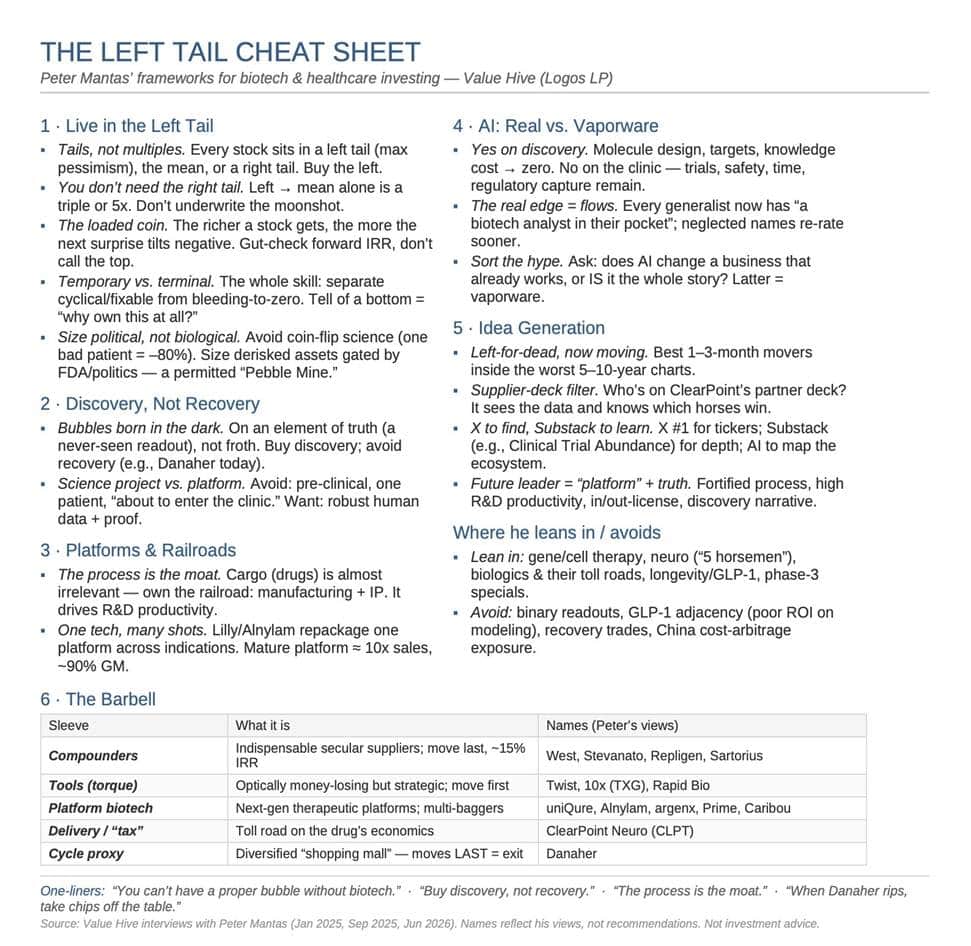
I thoroughly enjoyed my conversation with Peter. One last thing before we go. I created a “Left Tail Cheat Sheet” to help you find new ideas and learn more about Peter’s process. Check it out on the following page.