Silica is the second most-used industrial commodity on the planet, yet high-purity silica, the kind that goes into solar glass, semiconductor crucibles, fiber optics, and the photonics layer Nvidia is racing to build into the next generation of AI data centers, is genuinely scarce.
China dominates almost every downstream silicon-based product on earth, but ironically does not control the high-purity feedstock that makes its dominance possible.
This week, I share my Claude-powered Podcast Notes from my conversation with Brian Leeners, CEO of HomeRun Resources (HMR.V).
This is an industry crash course on what silica is, what makes a great deposit, how to value one, where the demand is going, and why Brazil sits near the center of the ex-China bull case.
There’s a ton of information through these next 13 pages. Use this as a guide as you navigate the silica, solar, photonics, and any other industry silica touches (which is a lot more than you think!).
Enjoy!
Why Silica Matters Now
Silica is the second most widely used industrial commodity on the planet (water is first). It sits inside the glass on your phone, the windows of your house, the paint on your walls, and the chips that run your laptop.
But there is an enormous gap between the silica that goes into your kid’s sandbox at five dollars a ton and the silica that goes into the crucibles used to grow the silicon ingots for semiconductor wafers, which sells for $10,000 a ton. Those are the same elements on the periodic table, but completely different businesses.
There are four “mega-themes” driving silica demand:
- Solar at scale
- Semiconductor manufacturing reshoring
- The photonics layer being built to feed AI data centers
- The early scaffolding of quantum computing.
Brian argues that, aside from copper, silica is the only base material that is a critical input across all of them.
The second piece of the story is supply. China dominates the downstream silicon stack — polysilicon, wafers, cells, modules, solar glass, and crucibles — to a degree that makes the rare-earth playbook look diversified.
But the upstream feedstock that drives that dominance comes from a handful of deposits scattered across a few jurisdictions, most of which have only just realized what they have and have started restricting exports. Indonesia banned silica sand exports. Egypt has tightened. Saudi Arabia wants to keep its silica at home. The world has woken up to the fact that without high-purity silica, none of the rest of this works.
That is the setup.
The rest of this report includes: what silica actually is, how to evaluate a deposit, where the demand is going, what the China scoreboard looks like, why Brazil specifically matters, and a case study on Homerun Resources (HMR.V) as the cleanest available expression of the thesis.
The Material: Quartz, Silica Sand, and the Grade Ladder
Two kinds of feedstock
Silica is not really one material. There are two basic feedstocks for the industry: hard quartz and silica sand. Hard quartz is exactly what it sounds like: a rock that must be crushed, milled, and chemically processed to release the SiO2 grains.
Silica sand is hard quartz that nature has weathered over geological timescales into small sand-sized grains. Sand deposits are easier to process, generally cleaner, and dramatically cheaper to bring to spec.
That distinction matters because the cost of removing impurities scales with the amount of material you have to handle. A great silica sand deposit has the work half done before you ever break ground.
Why Impurities Are Everything
Pure SiO2 by itself is not the question — the question is what else is in it. Geological events leave behind metals: titanium, iron, aluminum, magnesium, and calcium. The exact mix depends on what was happening when the deposit formed. Some of those impurities are easy to wash out. Some are bonded into the crystal lattice and require chemical purification. Iron is the one that matters most for the most important near-term use case, solar glass, because iron absorbs the wavelengths of light you want to pass through. The lower the iron, the clearer the glass, the more efficient the panel.
Putting numbers on it: Chinese silica used in solar glass typically runs 100 to 140 ppm iron in the ground. Mitsubishi’s Cape Flattery deposit in Australia, one of the best in the world, runs around 100 ppm Fe2O3 in product. Homerun’s Bahia silica is roughly 300 ppm in the ground and drops to under 10 ppm after a simple wash. That is a step-change difference, and it is the entire reason the conversation about Brazilian silica exists at all.
The N-grade ladder
The industry talks about purity in “Ns” — the number of nines after the decimal. 3N means 99.9% pure. 4N is 99.99%. 5N is 99.999%. By the time you hit the spec for the inner wall of a semiconductor crucible — which has to hold liquid silicon at 1,400 degrees C without contaminating it — you are at 99.998%, and there are exactly two companies on earth that produce that grade.
- Sandbox / construction sand — effectively free, $0 to $5 per ton.
- Container glass and bottle glass — low single digits per ton.
- Solar glass feedstock — roughly $40 to $60 per ton, often called out at “$50 plus or minus $10.”
- 3N industrial silica (99.9%) — into specialty glass, ceramics, foundry uses.
- 4N silica (99.99%) — $500 to $2,000 per ton; into optical glass, lighting, certain photonics.
- 5N silica (99.999%) and above — into fused silica wafers, photonics, quantum substrates.
- Crucible-grade (~99.998% with strict trace metals) — up to $10,000 per ton.
A great deposit is one that can credibly target the upper end of that ladder. Most cannot. Most of the silica produced on earth never leaves the bottom three rungs.
Five Rules for Evaluating a Silica Deposit
Brian gave the rubric in passing during the conversation, almost as an aside. It is genuinely useful, and worth pulling out as a standalone framework. These are the five things to grade any silica deposit on, in roughly the order they matter.
Rule 1 — Grade is the gating condition.
Without grade, nothing else matters. If your in-ground SiO2 percentage is too low, or your impurity profile is too dirty, the deposit cannot economically reach the high-margin tiers no matter how much money you throw at processing. Grade is the precondition; everything else is downstream of it.
Rule 2 — Size determines whether the project is investable.
Once grade clears the bar, scale determines whether the capex required to build a processing complex is justifiable. Single-digit million ton deposits get studied. Hundred-million-ton deposits get built.
Five-hundred-million-ton districts get vertically integrated. Brian’s framing: he controls 60+ million tons today, can target over 200 million tons within his existing leases, and the broader district is north of 500 million tons.
Rule 3 — The impurity profile drives the use case.
A deposit with 99.95% headline SiO2 and high titanium is a different business than one with 99.95% SiO2 and high iron. The trace-metal mix tells you which downstream products you can credibly serve.
For solar glass, iron is the killer. For crucibles, every metal matters. Two deposits with the same nominal grade can have wildly different economic value depending on which impurities they carry.
Rule 4 — Logistics are the unspoken filter.
Silica is the inverse of gold. A gold mine ships out 1.25 grams per ton of mined material — you can put the entire output of a mine on an airplane.
Silica is the opposite: you ship 99.9% of what you dig. That makes geography, port access, rail, and the location of your downstream customers structurally critical. Brian’s read on Bahia is instructive: the prior owners had been sitting on the deposit for 40 years and never made money because the logistics did not line up with then-existing industry. His unlock was to bring the industry to the resource.
Rule 5 — Deposit value follows downstream cash flow.
There is no public spot price for high-purity silica. There is no futures market. Sibelco does not disclose what it charges for crucible-grade quartz, and the buyers do not disclose what they pay. That has a non-obvious implication: an in-situ valuation of a silica deposit is almost meaningless on its own. The deposit’s real value is a function of the cash-flow business you can build around it.
This is why every successful high-purity silica producer is at least partially vertically integrated, and why China’s solar dominance is built end-to-end rather than as a string of separately-listed pure plays.
How to Value a Silica Deposit
Pricing opacity is the single biggest analytical challenge in this industry. With gold or copper, you take ounces times spot, discount the operating cost, and you have something defensible. With silica, you cannot do that, because there is no spot.
In practice there are three approaches investors and operators use, none of them perfect:
- Best-use-case in-situ valuation: Pick the highest-probability use case the deposit can credibly serve, take the implied silica-per-ton price for that segment, and apply a discount for the share of resource that is actually in measured/indicated category. For Homerun’s Bahia silica, the “best use case at lowest processing” is solar glass at roughly $50 per ton; that becomes a defensible floor for the in-situ math.
- Downstream DCF: Build a discounted cash flow model on the integrated business — the silica mine plus the solar glass plant, plus optional 3N/4N/5N processing modules. Value the deposit as the residual claim once the integrated cash flows are valued. This is how Brian thinks about Homerun: “the solar glass plant alone, at 365,000 tons per year nameplate, is roughly a billion-dollar revenue business if it executes. The deposit’s value to Homerun is a function of feeding that.”
- Comparable transactions: Rare and noisy. The Sibelco expansion at Spruce Pine, recently announced at roughly $700 million, gives one anchor. The Mitsubishi-Kao Flattery acquisition is decades old. The market caps of Sibelco and Quartz Corp are not directly comparable because both are subsidiaries of larger entities. Useful as sanity checks, not as primary methodology.
The takeaway: in silica, the deposit is an option on an integrated business. That is fundamentally different from how most resource investors think about gold, copper, or even rare earths. Treating a silica deposit as if it were a gold deposit and applying ounces-times-spot logic produces meaningless numbers.
Following Demand
High-purity silica has at least four major demand vectors, all of them growing at rates that are unusual for an industrial material. The trick is that each vector targets a different point on the N-grade ladder, which is part of why the upstream supply picture is so tight.
Solar glass — the biggest near-term demand vector
Every solar module on earth has at least one piece of glass on it, and increasingly two. The transition to bifacial modules — panels that generate from both sides — has structurally doubled the glass content per panel. According to industry estimates, the world produced roughly 88,000 tons of solar glass per day in 2025, and analysts forecast that figure rising to 200,000 tons per day by 2030 and roughly 300,000 tons per day by 2036 as bifacial penetration matures and total solar deployment continues to scale. Brian quotes a 30% CAGR; the more conservative published forecasts cluster around 15% to 18% over the next half-decade. Either way, solar glass is one of the rare large industrial markets growing at a double-digit rate for an extended runway.
Crucially, the silica spec for solar glass benefits enormously from low iron. A producer who can make antimony-free, ultra-low-iron solar glass — which Homerun claims it can — actually increases the efficiency of the panel itself by passing more light through to the cell. That is a product differentiation, not just a cost story.

Crucibles and polysilicon — the choke point
To make a silicon wafer, you first have to grow a silicon ingot. To grow a silicon ingot, you melt polysilicon at roughly 1,400 degrees C inside a fused-quartz crucible. The crucible has to be effectively pure on its inner wall, because anything that leaches into the molten silicon contaminates the wafer. Crucible-grade quartz is the highest-purity silica product produced in commercial volume — roughly 99.998% with strict trace-metal limits.
Almost the entire global supply of crucible-grade quartz comes from a single mountain town: Spruce Pine, North Carolina.
Two operators — Sibelco and The Quartz Corp (a JV between Imerys and Norsk Mineral) — mine adjacent orebodies and produce the IOTA-branded high-purity quartz that, by industry estimate, supplies 70% to 90% of the crucibles used to grow the silicon that becomes 95% of the world’s semiconductors. Hurricane Helene briefly took both operations offline in late 2024 and the entire global semiconductor industry held its breath. Sibelco has since announced a roughly $700 million expansion. There is no second source of comparable scale.
The fact that China’s 95% share of finished silicon depends on a small mountain in North Carolina is one of the most important supply-chain anomaly in the materials world. China knows it. Their most recent five-year plan explicitly names high-purity silica as a strategic critical material.
Photonics — the AI-era demand pull
Photonics is moving data with light instead of electrons. Long-distance photonics is a mature technology — fiber optics is what carries the internet across oceans. The new development, and the reason photonics is suddenly an investor-relations talking point, is short-distance photonics inside data centers. AI training generates so much data flowing between GPUs that copper interconnects literally cannot keep up. Light can.
Nvidia spent 2026 making this explicit. In March, the company announced a $4 billion investment split between Coherent and Lumentum to scale co-packaged optics. The Spectrum-X Photonics and Quantum-X switches launching in 2026 use silicon-photonics interconnects that promise 3.5x better power efficiency and an order of magnitude better network resiliency. Every one of those modules sits on a fused-silica substrate. The demand for high-purity silica feedstock for photonics applications is at the start of an S-curve, not the end.
Quantum — the optionality layer
Quantum computing is further out commercially, but the materials stack is already taking shape, and silica is in the middle of it. The leading non-silicon-based quantum architecture uses lithium niobate as the active layer, deposited on a fused-silica intermediate, deposited on a silicon substrate.
The China dynamic
Any analysis of an industrial material in 2026 starts and ends with China. The way Brian thinks about it is to look at what China dominates today, identify what they are still buying from abroad, and read those imports as a map of where their five-year plans are going to push next.
China’s most recent five-year plan (released Q1 2026) explicitly names high-purity silica as a strategic critical material in four specific applications: solar glass, semiconductor crucibles, semiconductor substrates, and fused silica for photonics and quantum. This is not subtext. It is the text.
Check this out:
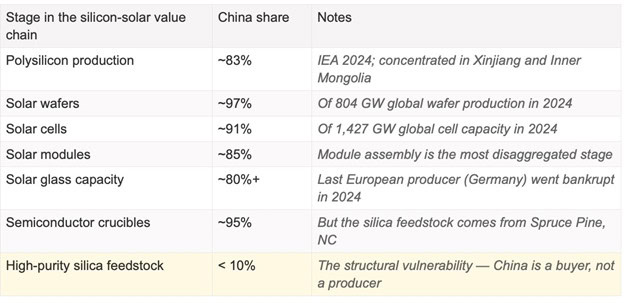
China owns the conversion chain — polysilicon, wafer, cell, module, glass — but does not own the upstream high-purity feedstock that makes the whole chain possible. Their crucibles are made from quartz mined in North Carolina. Their solar glass requires extra-clear silica that mostly comes from Mitsubishi’s Cape Flattery in Australia, plus assorted deposits in Indonesia, Egypt, and a handful of other jurisdictions that have all started restricting exports. This is the structural vulnerability.
The pinch-and-swell strategy
Brian uses the phrase “pinch and swell” to describe how China operates in materials. The swell phase is what they did to global solar from roughly 2018 to 2023 — flooding the world with subsidized output, accepting losses on exports that were partially offset by VAT refunds and other government support, and driving Western competitors out of business.
By the time the swell ends, China owns 80%+ of every layer of the value chain. The pinch phase is what we are entering now: the subsidies are gone, the global competition is gone, and China rationalizes domestic capacity to extract margin from its locked-in dominance.
Tariffs from the US, India, Brazil, and eventually Europe are the only thing that prevents the pinch from being even more profitable.
Two implications for us here. One, anything China currently dominates is structurally hard to compete in on cost, the swell already happened. Two, anything China still relies on others for is the next strategic asset, and the upstream feedstock for the silicon stack is the most important example.
Resource Nationalism and the Deposit Landscape
The supply side of the high-purity silica story has been transformed by a wave of resource nationalism in the last 24 months. Indonesia, sitting on roughly 25 billion tons of silica sand reserves, banned silica sand exports in 2023 to push downstream into glass, ceramics, and eventually silicon wafers — its government laid out an explicit downstreaming roadmap stretching to 2035. Egypt has tightened. Saudi Arabia, with high-purity assets of its own, has telegraphed it wants to retain its silica for domestic industrial development. The pattern is the same as we saw earlier with rare earths: countries that have historically exported raw material wake up to the value they could capture by integrating downstream, and the export taps start closing.
What that leaves is a remarkably short list of ex-China, ex-restricted-jurisdiction high-purity silica deposits at meaningful scale. The three most significant are below.
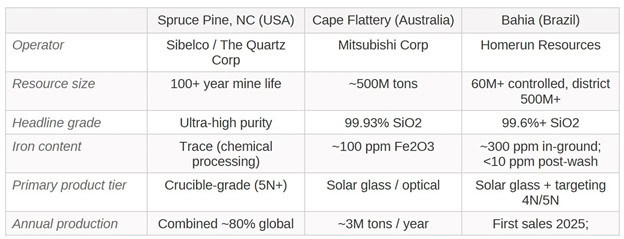
A few things stand out from the table. Spruce Pine is its own category — those two operators essentially are the global crucible-grade market, and their resource is hard quartz that requires intensive chemical purification.
Cape Flattery is a benchmark high-quality silica sand asset that has been mined for almost 50 years and serves Asian markets, primarily through Mitsubishi’s integrated trading network.
Bahia is the new entrant, arguably with the cleanest in-ground iron profile of the three for solar glass purposes, and the only one of the three with a vertically-integrated downstream plan moving from feedstock through solar glass and into 4N/5N processing.
The Brazil and LatAm Bull Case
Brian’s top-down case for Brazil rests on three observations.
- Brazil is a “buffet” jurisdiction for critical materials. It has commercial-scale resources of rare earths, niobium, lithium, copper, potash, iron ore, and now silica, all in roughly the same country.
- It has a 200+ million-person domestic market, which means whatever you build can be sold inside the country before you ever consider exports.
- Latin America has been doing business with Canadian mining capital for decades, which lowers the friction for ex-China investment relative to most other emerging-market jurisdictions.
The Brazilian energy market is restructuring in real time
What makes Brazil specifically interesting for a solar-glass-led integrated silica play is the country’s ongoing energy transition. Brazil was historically one of the most hydro-dependent grids in the world — hydro supplied roughly 90% of electricity in the early 2000s. Climate-driven precipitation changes have steadily eroded that base.
Hydro’s share of Brazilian generation fell from 90% in the early 2000s to roughly 65% a decade ago, and to 52% in 2025. Solar share, meanwhile, has gone from 1.1% in 2019 to 9.6% in 2024 to 24.5% by January 2026 — one of the fastest energy mix shifts of any major economy on record.
The trade and policy backdrop
Brazil has imposed tariffs on cheap Chinese solar imports, similar to the US and India, and is actively pushing to build domestic solar manufacturing capacity. BYD has built a major EV factory in Brazil. The last European solar glass producer (in Germany) went bankrupt in 2024, leaving no Western Hemisphere domestic-source solar glass producer at all. A producer who can credibly fill that gap with locally-sourced ultra-low-iron silica is, on paper, the most strategically positioned solar glass operator in the Americas.
There is precedent for Brazilian materials companies becoming global heavyweights — Vale being the obvious example. The country can absolutely produce a global-scale critical-materials champion when the conditions are right.
What Could Break the Thesis
Here’s everything that could break the bullish silica thesis:
- Perovskite displacement of silicon solar. Perovskite-silicon tandem cells have hit ~35% efficiency at lab scale (LONGi has the certified record), and Oxford PV is producing the first commercial-scale tandems in Germany. If perovskite displaces silicon solar within the next decade, the demand for silicon-grade silica feedstock and crucibles cools off — although solar glass demand and fused-silica/photonics demand keep growing regardless. China leads perovskite R&D, which complicates the geopolitics.
- China decides to swell again. The pinch is voluntary. If margins compress in domestic Chinese solar, central planning could pivot back to subsidized export volumes, restarting the pricing pressure on Western producers. Tariff regimes in the US, India, and Brazil mitigate but do not eliminate this risk.
- Sibelco / Quartz Corp expansion at Spruce Pine. A $700 million Sibelco expansion is underway. If the incumbent crucible-grade duopoly meaningfully expands capacity, the long-term shortage thesis at the very top of the N-grade ladder could ease — though crucible demand grows alongside semiconductor capex, so it is not a zero-sum.
- Brazilian execution and FX risk. Brazil is a higher-friction jurisdiction than the US or Australia. Currency volatility, political turnover, and execution risk on the Bahia logistics plan are all real. The flip side is that it is also a higher-margin jurisdiction; both halves are real.
- Pricing opacity cuts both ways. Without a public market, new entrants are at an information disadvantage relative to incumbents. The same opacity that prevents commoditization also means small operators can be squeezed in negotiation by larger buyers.
Case study — Homerun Resources (HMR.V)
Applying the framework from our earlier discussion directly to Homerun is the cleanest way to see how the thesis lands on a specific name.
Rule 1 (Grade): Strong
The Santa Maria Eterna deposit in Belmonte, Bahia is reported at 99.6%+ SiO2 with roughly 300 ppm iron in the ground — and, critically, drops to under 10 ppm iron after a simple wash. That post-wash iron number is genuinely exceptional and is the foundation of the antimony-free solar glass pitch.
Rule 2 (Size): Strong
25.12 million tons measured/indicated and 38 million tons inferred at the lead lease. Brian indicates Homerun controls 60+ million tons across its leases, can target 200+ million tons, and the broader district is 500M+ tons. The recent acquisition of an additional 582 hectares adjacent to the existing 64-hectare site consolidates district control further. Scale is not the limiting factor.
Rule 3 (Impurity profile): Differentiated
Low iron after wash is the single most valuable trait for solar glass. The deposit also carries low titanium and low aluminum — not crucible-grade as is, but a credible base for stepwise purification to 4N and eventually 5N. The roadmap moves from washed feedstock (industrial silica) to 3N to 4N to 5N processing, with each step opening new end markets.
Rule 4 (Logistics): Solved by design
This is the unlock that distinguishes Homerun from the prior 40 years of district owners. By siting the solar glass plant adjacent to the resource — bringing the industry to the silica rather than trying to ship low-value material to distant industry — the historical logistics constraint that made the district uneconomic disappears. The deposit is in northeast Bahia, which is also Brazil’s best solar resource zone, so the geography aligns.
Rule 5 (Downstream linkage): The whole thesis
Homerun is one of the very few high-purity silica plays globally that is structured as a vertically-integrated business from the ground up. The plan is feedstock to solar glass (1,000 tons/day in first iteration, ~365,000 tons/year, BFS completed in late April 2026) to 3N processing to 4N to 5N. The bankable feasibility study on the solar glass plant is the inflection point — it converts a resource story into a cash-flow story, which is how silica deposits are actually valued.
Capital structure and dilution
Homerun trades at roughly $50 million USD market cap as of mid-2026, with listings on the TSX Venture (HMR.V), OTCQB, Frankfurt, and recently sponsored BDRs on Brazil’s B3. The stock is down meaningfully from its 2024 highs after a discovery-style run, which has put the thesis in the unloved-during-development phase of the Lassonde curve.
On dilution, Brian’s framing is the most interesting part of the conversation. The plan is to finance the solar glass plant inside a Special Purpose Vehicle, with any equity dilution occurring at the SPV level rather than at the parent company.
The math he sketches: if the solar glass plant is worth roughly $1 billion as a functional operation and Homerun retains a controlling stake, the implied uplift on a sub-$50 million market cap is large. That is the asymmetric setup, and it lives or dies on execution of the BFS, financing close, and 24-month construction window.
Conclusion: Three Key Takeaways
- High-purity silica is genuinely scarce. Not “industry-press scarce” — actually scarce. There are a small number of ex-China deposits at the top of the N-grade ladder, the export-controlling jurisdictions are closing taps, and the demand vectors are stacking up. This is closer to the rare-earth supply story of 2021 than the lithium oversupply story of 2023.
- The demand stack is multi-vector and growing. Solar glass alone is a 15%-30% CAGR market for the next decade, depending on which forecast you trust. Layer crucibles, photonics, and quantum on top, each with their own independent S-curve, and you get a base material with more demand optionality than almost anything else in the industrial complex. Outside of copper, no other material is critical to all four.
- Brazil is the cleanest available ex-China expression. A high-quality deposit, in a jurisdiction with growing domestic demand, with tariff protection, with hydro de-rating forcing solar buildout, with no incumbent Western Hemisphere solar glass producer, and with a vertically-integrated operator already in development. The setup does not need to be perfect to be asymmetric.
I’ve never thought about investing in silica. But this conversation changed that. I’m already halfway into silica via our bullish solar thesis, and HMR looks like a potentially world-class, Nationally Strategic asset for multiple growth avenues (solar, AI, energy, photonics, etc.).
I like that Brian owns a lot of the company and lives in Brazil. Still unclear about the pricing mechanisms behind high purity silica and how that translates into in-situ values and other metrics, but I’ll do more work.
I hope you guys enjoyed this Podcast Notes. I’m finding a lot of value in these with each edition.