One of my big goals this year is to write more Podcast Notes pieces. Another one of my goals is to leverage AI tools (like Claude, Gemini, etc.) to perform better work while maintaining the essence of learning from that work (i.e., not letting AI think for me).
This week, I’m excited to share the latest iteration of Podcast Notes. I want to push these AI tools to their limits and provide you with the highest-quality signal … something that condenses an hour-long conversation into an actionable essay.
Please let me know your thoughts in the Slack (via DM) or email. How can I improve on these essays?
This report distills the key themes, operational updates, and forward-looking catalysts from my second Value Hive podcast interview with Jason Jessup, CEO and founder of Magna Mining (NICU).
NICU is a company in a fundamentally different position than when Part 1 aired in November 2024. The market cap has surged to approximately C$942M (approaching the C$1B milestone), metal prices across the board have moved sharply in Magna’s favor, and the R2 zone discovery has added a high-grade copper-precious metals dimension that wasn’t on anyone’s radar a year ago.
Jason laid out an 18-month roadmap that includes revenue generation from Levack, pre-production revenues at Crean Hill, activity at Podolski, further acquisitions within Sudbury, and a potential TSX uplisting.
Here’s the TL;DR: Jason now believes the original FNX Mining comparison, once aspirational, is now insufficient for what Magna can become.
“I think becoming the next FNX Mining would be doing a major disservice to our shareholders.” – Jason Jessup
Let’s get after it!
The Three Pillars of Growth
Magna’s strategy has remained consistent since inception: grow through production, exploration, and acquisitions of non-core assets from major mining companies.
What has changed is the scale and velocity of execution across all three pillars simultaneously. Different pillars take the lead at different times, but all three are contributing to what Jessup describes as “real momentum” and “real wind in our sails.”
Pillar 1: Production — McCreedy West as the Proving Ground
NICU acquired the producing McCreedy West mine from KGHM in February 2025. They inherited a mine that needed investment and optimization. Key operational changes included shifting from contract mining to a fully internal workforce, changing shift schedules, revising the mining method, and investing deferred maintenance capital. None of this happened overnight.
“Never underestimate the work that needs to go into making changes… it takes effort, it takes follow-through, it takes a lot of communication.” — Jason Jessup
Jessup now reports that the 700 zone is “set up pretty well,” with the team ahead on drilling and development, and multiple stopes broken on the ground — meaning three draw points across three levels that provide production contingency.
2025 was all about getting McCreedy to a point where it stands alone and begins generating meaningful cash flow in 2026, which funds the rest of the growth pipeline.
Pillar 2: Exploration — The R2 Zone Discovery
The R2 zone discovery is the single most significant development since Part 1 of this interview. The story of its discovery, and Jason’s reaction, is hilarious.
Jessup was on a board visit for Dryden Gold when VP Exploration Dave King called with photos of core boxes. Jessup put the call on silent, then saw the texted photos and realized he needed to call back immediately. King estimated about 30% copper based on the chalcopyrite content and was hoping for some precious metals.
The copper assays came back first: 29% copper over a meter. Encouraging, but the precious metals assays were still outstanding. The next day, Jessup was driving back from Toronto when King called with the full results.
“I had to pull over. I couldn’t even drive. I said, Dave, read those back to me again. Like, did I hear you right? And when it’s 53 grams silver, 29 grams gold… I was like, wow, OK, this is different. This is better than I thought.” — Jason Jessup
Seven holes have now been drilled into the R2 zone and every hole has hit. Jessup is now comfortable calling it a genuine discovery. The zone sits approximately 400-500 meters from the Morrison deposit and carries the critical advantage of having no royalty or stream on precious metals — Magna retains 100% of the recovered value from gold, platinum, palladium, silver, and cobalt.
At current metal prices (gold ~$5,000/oz, silver ~$108/oz, copper ~$6/lb, PGMs up 60%+), the in-situ value of R2 zone mineralization is substantial. Jessup hinted at spending Friday nights at his kitchen table running mine economics: mining at 200 tons per day, calculating dilution under various mining methods, and estimating NSR at spot prices.
He says the potential value is “hundreds and hundreds and hundreds of millions of dollars” sitting beneath them. The 2026 program will focus on delineating the zone, particularly up-dip to the north toward the #3 footwall zone.
Just for fun, I asked Claude to generate a preliminary Resource Estimate based on the latest R2 drill results. I ran out of Deep Research credits, but here are the results.
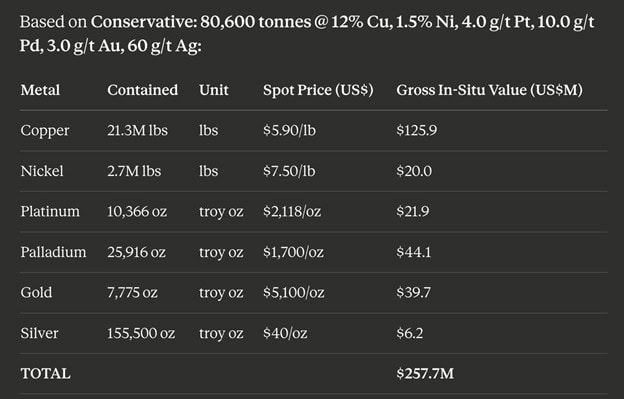
This is very early-stage so take everything with a massive grain of salt. But you can see why Jason thinks R2 adds “hundreds and hundreds and hundreds of millions of dollars” in value.
Pillar 3: Acquisitions — Until They Own All of Sudbury
NICU’s acquisition strategy remains aggressive but disciplined. In short, Jason wants to own all of Sudbury.
“Until we own all of Sudbury, we’re going to keep working on acquisitions. And then once we have all of that and it’s all up and running, well, we’re probably going to have to buy another mining camp somewhere else.” — Jason Jessup
Every acquisition to date has been accretive. The KGHM acquisition, which brought McCreedy West into the fold, temporarily put Crean Hill on the back burner — but it was the right capital allocation decision.
Jessup emphasized that Magna only does “smart deals,” viewing everything through the lens of a significant personal shareholder (Jason owns nearly 10% of the company and has said multiple times that he’s not selling until NICU reaches “multiple billions.”).
NICU says no to anything outside Sudbury despite receiving external proposals. All potential acquisitions are evaluated for synergy with existing infrastructure, making them bolt-on additions rather than new platforms requiring separate management attention.
Culture, Team, and Operational DNA
One of the more differentiated aspects of this interview was Jessup’s extended discussion on company culture.
Magna’s four core values were established back in 2019/2020 when the company had three or four part-time employees and two geologists. The values are: safety and environmental responsibility; honesty and integrity; relentless pursuit of excellence; and ownership through entrepreneurial spirit.
Here’s why culture and people matter. NICU grew from 25 people to 175 after the KGHM acquisition, and now stands at over 200. Integrating a workforce many times larger than your original team, while maintaining an entrepreneurial culture against a major-company legacy culture, is difficult.
“People are not a cost or a liability. People are an asset.” — Jason Jessup
The hiring philosophy is selective to the point of leaving positions unfilled rather than compromising on fit. Jessup, COO Jeff Huffman, and the HR manager are aligned on this approach. They look for “A+ players” who attract other A+ players they’ve worked with before. The Sudbury location provides a structural advantage in talent acquisition: unlike remote fly-in/fly-out operations, McCreedy West employees go home every night.
Sudbury has 300 lakes, is four hours from Toronto, has a university and two colleges, and supports 180,000 people with full amenities. It reminds me of IDR’s “we live here” philosophy. There is also a pool of experienced mining professionals who live in Sudbury but currently fly out for work elsewhere — candidates who would prefer to work close to home.
Nickel: Optionality, Not Dependency
The company’s polymetallic deposits allow it to effectively “turn on or turn off” nickel production depending on price, while copper and precious metals carry the base case. This optionality is embedded across the portfolio in two key locations.
- McCreedy West InterMain: The InterMain nickel zone has over 2 million tons of resource grading 1.2–1.5% Ni with 0.25–0.4% Cu. Many levels were already developed during the FNX era (2005-2008), so the restart capital is minimal — rehabilitating services, removing stored waste, and restoring ventilation. No 5,000 meters of new development required.
- Levack Contact Nickel Zones: Higher-quality nickel at 1.4–1.5% Ni with significantly more copper credits (0.7–1.0% Cu) plus precious metals and cobalt. Near-surface zones accessible via a potential surface ramp. Sequencing depends on nickel price: sub-$7/lb, focus copper/PGM zones first and use cash flow to develop nickel later; above $8/lb, the economics shift to parallel development.
On the macro picture … Indonesia controls approximately 60% of global supply and is reportedly considering cutting production by one-third.
Jessup’s thesis is that Indonesia intentionally flooded the market, shut down competitors (notably Australian operations), and will now seek to optimize pricing — high enough to maximize their revenue but not so high as to incentivize large-scale greenfield projects elsewhere.
The sweet spot for Magna is $8–10/lb nickel, a range where Sudbury operations are highly profitable (especially with byproduct credits) without incentivizing competitive supply.
Metal Price Environment: Tailwinds Across the Board
The metal price backdrop has shifted dramatically since the November 2024 interview. Every commodity in Magna’s production mix has moved materially higher.
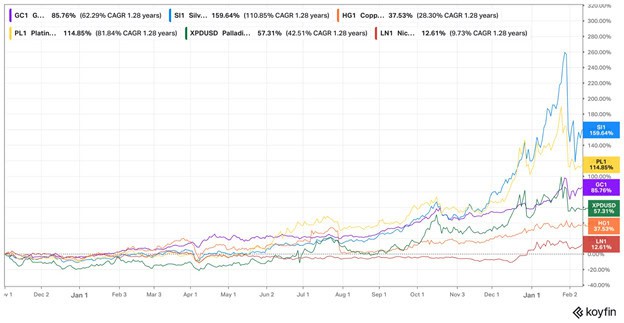
This environment is transformational for Magna’s economics. The R2 zone, carrying 29 g/t gold and 53 g/t silver with 29% copper and no precious metals royalty/stream, sees its in-situ value expand dramatically.
Crean Hill’s 43-101 resource becomes worth materially more at these prices. And the nickel optionality, which was previously a “someday” call option, is now approaching the money as Indonesian supply discipline pushes LME nickel higher.
Financing and Capital Allocation
At ~C$942M market cap and all-time high share prices, NICU has meaningful currency to fund growth without excessive dilution. Key takeaways on capital allocation:
- No immediate need to raise capital. Magna is in a comfortable financial position right now. Raises will be event-driven, likely tied to the Crean Hill pre-feasibility study or a new acquisition.
- Historically equity-biased, but debt is on the table. Once Levack and Crean Hill are generating cash flow, the company may introduce debt to fund further growth, using predictable cash flows to service it.
- Convertible debenture of $24M issued in 2025. Jessup looks forward to extinguishing this in 2027 when it becomes callable.
- Every financing has been accretive. Historically, the share price has been higher 8–12 months after each raise. Deals are typically oversubscribed. One raise at C$1.05 saw the stock close so high on announcement day that upsizing was nearly constrained.
- Crean Hill pre-production CapEx is manageable. The 2024 PEA estimated ~$65M — a small number relative to the current market cap. A pre-feasibility study will update this figure and may serve as the trigger for the next capital raise.
“Every dollar we raise and every dollar we spend, I want it to create value. If it’s not creating value, then you shouldn’t raise it.” — Jason Jessup
The NICU 18-Month Roadmap
I asked Jason what he’d want to have accomplished if this podcast were recorded again in 18 months. Here were his answers:
- Levack Mine producing and generating revenues (potentially approaching commercial production declaration).
- Crean Hill generating pre-production revenues and ramping toward commercial production.
- Podolski active with advanced exploration, a bulk sample, or early production from the North zone.
- A larger land and project position in Sudbury through additional acquisitions.
- TSX uplisting and inclusion in ETFs, unlocking passive buying flows.
- Expanded exploration program with more drills turning across the broader Sudbury portfolio.
The longer-term vision (four to five years) is four to five mines running simultaneously with significant cash flow, a scaled-up exploration program, and brand-name recognition as a Canadian mining company.
The Shakespeare mill permits serve as an insurance policy against processing dependency on Glencore’s Strathcona mill and Vale’s Clarabelle mill.
Catalysts and Risks
Near-Term Catalysts
- R2 zone delineation drilling results (2026 program) — every hole hitting so far, uptip extension potential.
- Crane Hill pre-feasibility study completion and updated capital cost estimate.
- Levac mine restart milestones: hoisting, development, first ore production.
- McCready West cash flow generation as the mine enters a mature operational rhythm.
- TSX uplisting and ETF inclusion driving institutional and passive fund inflows.
- Additional Sudbury acquisitions — Jessup explicitly stated more are coming.
- Indonesian nickel production cuts crystallizing, pushing LME nickel above $8/lb.
Key Risks to Monitor
- Execution risk across multiple simultaneous restarts and development projects.
- Culture integration challenges as the workforce continues to scale rapidly.
- Metal price reversals, particularly in copper and precious metals that underpin near-term economics.
- Mill processing dependency on Glencore and Vale until Shakespeare is operational.
- Labor market tightening in Sudbury if the broader mining cycle heats up (Jessup himself noted Sudbury is nowhere near 2006/07 levels of activity — yet).
- Key-man risk: Jessup is clearly the strategic driver. While the team is deepening, much of the vision and acquisition pipeline flows through him.
Bigger Than FNX: The Evolving Thesis
The most important moment of the interview was Jason’s reframing of the FNX Mining comparison.
When I interviewed Jason in November 2024, his goal was to “become the next FNX Mining.”
FNX was a substantial Sudbury success story — it built a multi-mine operation in the Sudbury camp before being acquired by KGHM in 2010 for approximately C$1B.
Jessup worked there and knows the playbook intimately.
But now Jason is thinking bigger … much bigger.
“If I said that [FNX] was our end goal now, it would be doing a disservice to our company and our people. We can do a whole lot more.” — Jason Jessup
And I kind of agree with him!
FNX operated in a different metal price environment, didn’t have the R2 zone’s precious metals kicker, and didn’t have the breadth of development pipeline that Magna now controls.
The current precious metals environment alone (gold at $5,000, silver at $108) transforms the economics of Magna’s footwall deposits in ways that weren’t possible during the FNX era.
So now it’s not about “can NICU become the next FNX?” Instead, the question is whether the setup supports a significantly larger outcome over a multi-year horizon, particularly if Magna executes on multi-mine production, the R2 zone develops into a material resource, and the acquisition pipeline continues to deliver accretive deals in Sudbury.
You’re entering, “can we build the next Teck?” territory. Which would be insane, of course. But the pieces are there for NICU to do it, and why not? Why can’t they build the next Teck?
The pieces are there: right assets, right jurisdiction, right metals price environment, and the right CEO.