This week, I explore IDR’s latest full-year earnings report, analyze its recent copper-silver acquisition (and why it’s a perfect fit), and pitch my back-of-the-napkin sum of the parts valuation framework.
After that, I give a quick review on our aluminum trade, why the floor for aluminum prices is higher than we think, the physical nature of aluminum smelting and why 4% of global aluminum supply is probably gone for the next year.
Oh! Before we dive into the report, I want to share our latest MO Portfolio Performance:
- March: -0.80%
- Q1 2026: +38.78%
- YTD (as of March 31): +38.78%
It’s amazing how much stress we experienced in March to generate a -0.80% return. Sometimes the best thing to do is nothing at all!
Idaho Strategic (IDR): Record Earnings & New Acquisition
Idaho-based gold miner, Idaho Strategic (IDR), delivered FY2025 results last week. Here are the highlights:
- 12,538 ounces produced (+5% YoY)
- 10.14g/t average grade (+5% YoY)
- $42.4M in Revenue (+65% YoY)
- $26.2M in Gross Profit (+102% YoY)
- $16.7M in Net Income (+89% YoY)
- $73M in Cash and Equivalents (record high)
Here’s something you don’t see every day from a junior mining company … IDR generated more interest income from its cash holdings than its full-year SG&A costs (see below).
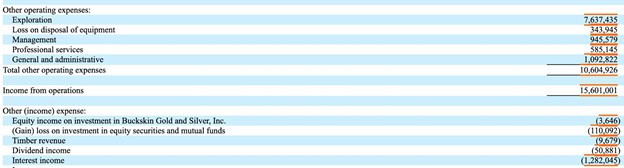
$1.09M in G&A against $1.28M in interest income … you just don’t see that in mining.
Here’s something else I realized today. IDR had a $60M market cap when I first wrote about them for the Collective (read here). Now, they have $13M more in pure cash in the bank than their 2023 market cap.
Anyways, back to current developments!
The company expanded its understanding of its REE land package (Lemhi Pass) and “sampled greater than 17.6% total rare earth oxides from the Cardinal prospect.” It then found a carbonatite with “strong REE mineralization” at its Lucky Horseshoe project. This was a big deal, as the world’s largest REE producers are all derived from carbonatite deposits.
I wrote in the #ideas-equities channel after IDR’s announcement that (emphasis mine):
“Today’s IDR news release showing the presence of carbonatite with strong rare earth elements (REE) mineralization is a BIG DEAL. It could drastically change the value of the company’s REE assets, much higher than previously thought.
There are two main reasons for this excitement:
- It was initially thought that most of IDR’s carbonatite ore was in the Northern Mineral Hill Property. This release confirms the presence of carbonatite at the southernmost Lucky Horseshoe property. This significantly expands the potential resource.
- The carbonatite found today is the primary lode source of REE mineralization at Mountain Pass in the U.S., Mount Weld in Australia, and Byan Obo in China – the three major REE operations globally.”
Just to give you an idea of the size of these carbonatite deposits:
- Mountain Pass: 18.9 million tonnes of ore grading 7.06% REO (as of 2020)
- Mount Weld: 18.9 Mt at 8.3% TREO
- Byan Obo: ~48Mt REO at ~6% grade (could be as high as 100Mt, but it’s China, so who really knows)
These are mega deposits that all formed from carbonatite mineralization.
The other cool thing is that IDR is doing what they said they would do: drill a ton. The company increased gold reserves by 53% from 19K meters of drilling.
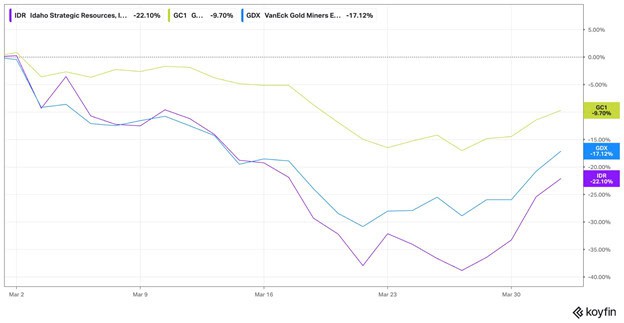
Now to the stock price. IDR trades at $33/share and is down 22% and 17% over the past 1M and YTD periods, respectively. It’s also lagged GDX, which has returned -17% over the past month (see below).
You can buy IDR for a $500M market cap with $73M in net cash and no long-term debt (or $427M EV). As I’ve written before, IDR has a pathway towards 20,000oz of annual production over the next 12-18 months. Let’s do some napkin math.
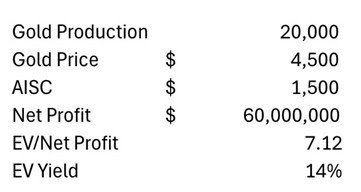
You’re paying 7x 20Koz/year run-rate profits at $4,500 gold and getting the rest of the assets for free. Funny enough, that’s exactly the multiple I pitched in my first write-up on IDR. Goes to show what $4,500/oz gold can do!
The REE assets alone could be worth multiples of the current market cap (I’ve written more about valuing those here). Then the company announced the acquisition of the Niagara Copper-Silver Project.
The Niagara Copper-Silver: More Value Within The Murray Gold Belt
I love IDR’s latest acquisition of the Niagara Copper-Silver project for three reasons:
- They have experience with the asset in 2008
- It’s 7km (4.4 miles) from their existing Golden Chest mine (and all existing infrastructure)
- It diversifies the company into a multi-metal developer and producer in a Tier-1 jurisdiction with the perfect mix of metals (gold, copper, silver, and REEs).
Collective member Will Thomson asked me a year or so ago, “if you had $400M and could create the best US-based mining company, what would it look like?”
I said, “I would just buy IDR. They have everything. Land, high-grade gold production, REE assets, hub-and-spoke potential within the Murray Gold Belt, and plenty of cash for acquisitions.”
So this copper-silver project makes a lot of sense.
The project has 154Mlbs of copper at 0.39% and 8.8 Moz of silver at 15.53g/t (or 263 M lbs CuEq) from limited drilling by IDR in 2008. Based on today’s metals prices, the project hosts ~$1.5B+ in in-situ value. IDR will drill the project this summer to expand the resource and add tonnage.
This is where valuation gets interesting.
IDR’s Sum of The Parts
We now have three major “parts” within IDR’s valuation framework:
- Gold production and expansion
- REE asset at Lemhi Pass
- Niagara Copper-Silver Project
There are lots of ways to skin this cat … but let’s back into an estimated “value ascribed” to just the gold production business, assuming relatively conservative values for the REE assets and the Niagara project.
First, the REE assets. Last year, I calculated a way-too-early estimate for Lemhi Pass at ~13.6 Mt. I then compared three other REE peers that traded between $4.50/TREO and $49/TREO.
Let’s assume Lemhi Pass is worth ~$7.50/TREO (Tier-1 jurisdiction, decent grades, no dilution to explore and expand the resource). That would be ~$102M in value at 13.6Mt.
Then there’s the Niagara project. Standard valuation for exploration-stage companies is 1-5% of in-situ value. At 3% in-situ, you get $45M in value. You could argue that the percentage is based on jurisdiction, historical grade, location to existing infrastructure, etc.
Here’s the final “residual value” of IDR’s gold business.
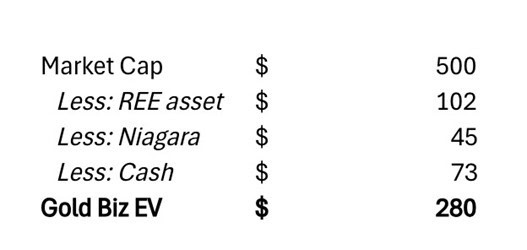
Another way to say this: you can buy IDR’s gold production business (growing from 12.5Koz/year to 20Koz/year) for 7.5x current production profits at $4,500/oz gold.
Let’s head to the charts.
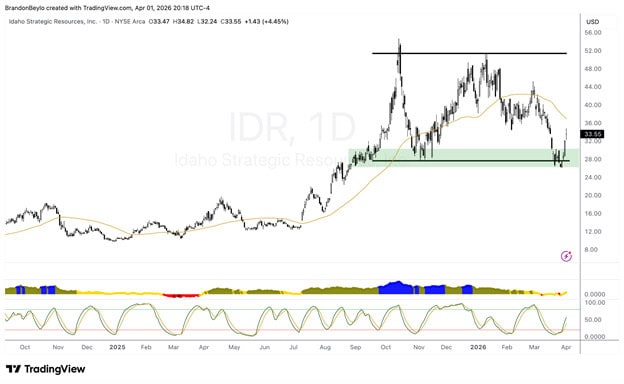
There are a couple things I want to flag.
- IDR found (and bounced off) its $28/share support level over the past week.
- The stock traded within a mostly Neutral Market Regime.
- Bressert Buy Signal Triggered on Monday (03/30) with follow-through on 03/31.
This is a great example of waiting for support/bottoms to add to or establish a position in a name you want to own for the long pull.
Aluminum News & Our Alcoa (AA) Trade
I wanted to write a quick note on our aluminum/Alcoa (AA) trade today (h/t @David Cardoso for asking the question!).
A few days ago, Alex Campbell wrote THE CASCADE which explained why the Strait of Hormuz issue isn’t just an oil story, but a chemicals, fertilizer, food, helium, sulfuric acid, and aluminum story.
Here’s what he wrote about aluminum (emphasis mine):
“Yesterday, Emirates Global Aluminium confirmed its smelter was damaged. 2.7 million tons per year, roughly 4% of global aluminum. Aluminum is energy turned solid. The smelters are in the Gulf because energy is cheap, and vulnerable because that advantage can be destroyed from the air. Smelters take 12-18 months to restart because the cells solidify. The IRGC published a retaliatory target list of six Gulf industrial facilities and appears to be executing it.”
Trump cannot tweet his way out of the physical destruction. Take the aluminum smelters. These are electrochemical processes operating at approximately 960°C in electrolytic cells containing molten cryolite. I had to look that up because I don’t know 75% of the words in that prior sentence.
According to Perplexity, the smelting destruction process works like this:
“Frozen ledge growth begins within 30 minutes; bath temperature falls below 900°C within 2–3 hours; cells completely freeze within 4–5 hours. The cathode linings — carbon blocks saturated with sodium over years of operation — crack irreversibly due to thermal stress during any cooling cycle.”
We also have historical restart timelines for context:
- Hydro’s Husnes smelter (Norway) took eight years to restart after a 2009 controlled shutdown
- Alcoa’s San Ciprian (Spain) has been offline since December 2021 with restart targeted for mid-2026 — 4.5+ years of downtime.
Even if Trump announced a complete ceasefire tonight, it would take a minimum of 6-12 months to restore what’s been lost.
So let’s assume 2.7 Mt of aluminum goes offline over the next year. ING Think already estimated a 200Kt deficit for 2026… but that was before the Iran War and 4% of the aluminum supply going dark. Oh, and all of this is against a backdrop of historically low inventories.
Aluminum prices are up ~40% YoY, which is good. But they’re still ~15% below their 2022 highs. Either way, the aluminum price floor feels much higher than for most commodities.
There are only a handful of ways to play aluminum: CENX, AA, or aluminum futures.
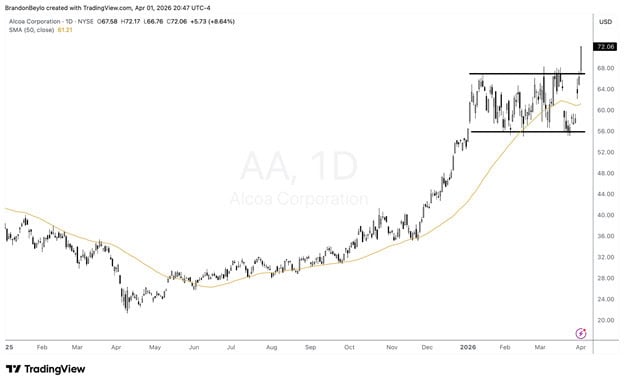
We picked AA because it had one of the best charts and gave us a buying opportunity on today’s breakout (see chart below).
Next Week: Solar Value Chain
I should be back on my solar thematic deep dive next week. I’ve spent the past week researching the value chain, uncovering a few interesting new stock ideas, and gathering a list of industry experts for a “Mr. X”- style Q&A.
There is no shortage of opportunity in this market. But there’s also no shortage of volatility. We’re trading very light until we gain conviction on the broader market regime and direction.
In the meantime, keep those heads on a swivel and stay frosty.