I view AI the way I view nutritional supplements like protein powder or creatine. They’re great additions to your dietary regimen and probably don’t hurt … as long as you have a solid nutritional foundation and don’t overdose on the supplements.
Gym “newbies” usually do the opposite. Their diet is 80% supplements and 20% real food. From an efficiency standpoint, it makes perfect sense. Supplements are easier to make and consume, and provide an optimal balance of macronutrients to maximize muscle growth.
Why make your food from scratch like some Amish farmer in rural Pennsylvania when you can chug a protein shake with 50 grams of protein in a fraction of the time? Who has time for real food anymore? Life is too busy … it moves too quickly.
The problem with that gym newbie diet isn’t that you miss vital micronutrients and nutrient diversity … you also forgo the intangible benefits of eating real food. Cooking a meal in the kitchen, smelling the fragrance, hearing the sizzle of steak in a cast-iron pan, or sharing a great meal with friends.
You trade the short-term inconvenience of not having exactly 50 grams of protein NOW, but at what long-term cost?
Just because you can get most of your calories from quick shakes, bars, and snacks doesn’t mean you should.
Here’s the big idea: AI and LLMs are like cheap supplements for our brains. Just because we can offload our thinking, writing, and research to Claude, Grok, or ChatGPT doesn’t mean we should.
True wisdom requires a foundational diet of real learning, the kind of learning that requires reading physical books, taking hand-written notes, and writing real thoughts onto pen and paper (or this laptop screen).
Yes, it takes longer, and yes, it’s harder. But that’s the point. Real wisdom, taste, and curation might be our last remaining edge against AI slop.
That said, AI tools, like nutritional supplements, do offer value. It’s up to us to ensure we’re using them as tools, not as complete substitutes for real knowledge-building.
This week, I explore my relationship with AI/LLMs and provide real-world tools to help you become a better investor, while keeping the hard work of real learning for yourself.
Let’s get after it.
Information Overload (& Tool-Shaped Objects)
The worst thing I’ve done this year is like a few X posts about “optimizing my workflow using Claude.”
Now I can’t scroll two tweets without someone describing the latest thing they’ve automated from their life or the one Claude prompt that eliminated hours of Excel work.
It all sounds great. It sounds efficient. You’re maximizing your time by eliminating parts of your day/work that you didn’t like anyway.
Take financial modeling, for example. Everyone’s obsessed with the fact that Claude can generate a 5YR DCF and a three-statement model in minutes. Sounds great, right? So I took the bait. I started making DCF models on our portfolio companies, watchlist ideas, and stocks I’d never seen before. Why? Because I could. Because Claude made it easier.
Here’s the crazy part … I don’t use DCFs in my investment process. I can’t remember the last time I built a DCF model for a portfolio company or a new idea. Instead, I look for ideas where I don’t need to build DCF models. Some of my best ideas are ones that I can value in two Excel cells or on the back of a napkin.
It wasn’t until this new, shiny technology promised that I could make a DCF in minutes, without any actual work on my part, that I thought I needed to make them.
Will Manidis calls these things “Tool-Shaped Objects.” I encourage you to read the entire essay, as it’s one of the best contrarian views on AI tools this year. Here’s Will’s big idea (emphasis mine):
“I want to talk about a category of object that is shaped like a tool, but distinctly isn’t one. You can hold it. You can use it. It fits in the hand the way a tool should. It produces the feeling of work— the friction, the labor, the sense of forward motion– but it doesn’t produce work. The object is not broken, it is performing its function. It’s function is to feel like a tool.”
My affair with Claude’s DCF model didn’t produce work, but it felt like work. The function of building complex DCF models in minutes is to feel like a tool … like you’re being productive.
“A woodworker who spends six figures a year on exotic hardwoods he will never build with is not investing in output. He is investing in scrap. The wood exists so that the tools have something to touch. The shavings and scraps are the product …
The problem begins when the tool-shaped object is designed to hide this from you. When the feeling of work becomes the product, sold as work itself.”
I wish I could say that I recognized this “feeling of work becoming the product” after using Claude for DCF modeling, but I didn’t. That feeling hooked me like a drug, and I started making more “feeling of work” products.
I spent hours chatting with Claude to craft the perfect prompt for analyzing a mining company’s drill results. “Maybe I should put it in markdown format … or XML … or YAML.” Literally hours talking with an LLM on text formatting instead of reading and thinking critically about the results. But it felt like work.
Back to Will’s essay (emphasis added):
“You can build an agent that reads your email, summarizes the contents, drafts a response, checks the response against a style guide, routes the response through an approval chain, logs the interaction, and reports the results to a dashboard. You can watch this happen. You can watch the tokens stream. You can see the chain of thought. You can monitor the system prompt. You can adjust the temperature. You can swap the model. You can add a tool. You can add six tools. You can add a tool that calls another agent that calls a third agent that searches the web and synthesizes the results into a memo that no one will read.”
If you’re not careful, you can spend an entire day (or week or month) doing things that feel like work, getting nowhere, and learning nothing along the way. I say that as someone who has lived it, who has wasted weekends and weeknights tinkering with prompts instead of reading good books and thinking critically about big problems or investment ideas.

How To Fix It: Back To The Future
Ryan Holiday is one of my favorite authors, whose writing includes classics such as Ego Is the Enemy, Stillness Is the Key, and his most famous work, The Obstacle Is the Way.
He recently wrote an essay answering this question: How do you succeed in a world of AI noise? Here’s one of my favorite parts of the article (emphasis mine):
“This is what people miss about AI. There’s a lot of talk about why we should be worried about AI making us or certain things obsolete. It’s going to make the humanities obsolete. It’s going to make books, artists, knowledge workers, and expertise itself obsolete.
But the opposite is true! To use these tools well—to not be used by them—you need exactly the things we’re told are becoming obsolete. A broad liberal arts education. Domain expertise. Critical thinking. A feel for what humans actually sound like. The ability to spot when something seems off.”
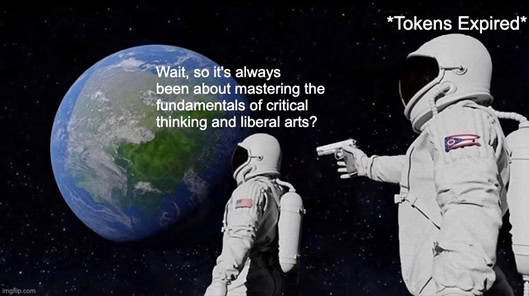
In other words, it’s always been about mastering the fundamentals of critical thinking and human interaction. Reading the classics, studying the foundational material of whatever you’re pursuing, and engaging with real humans to improve your understanding of material. It always has been …
Holiday continues (emphasis mine):
“We’re entering a world of AI slop. Not just on social media. It’s not just content creators who are sadly outsourcing their writing and ideating and scripting and pitching to these tools. It’s everywhere. Emails from coworkers. Press releases from corporations. Journalists, marketers, politicians, thought leaders—everywhere you look, people are quietly passing off AI’s “writing” and “thinking” as their own.
So the essential skill of our time isn’t prompt engineering or coding—it’s having a finely tuned bullshit detector. It’s knowing enough about how humans actually think and write to spot bullshit. It’s having read widely enough to recognize when an answer is hollow, even when it’s dressed up in confident prose. It’s understanding your domain well enough to know what questions to ask and, more importantly, which answers to reject.”
AI and LLMs are pornography for the productivity-addicted individual. It feels good in the moment. But wait a while, and it leaves you feeling empty, alone, and sad. I say that because I used to be addicted to porn. It was always easier than approaching the pretty girl at the bar, or even gathering the courage to go to a bar, for that matter.
Chatting with Claude or asking ChatGPT to conduct deep research on a new stock idea is easier than reading investor presentations, talking to other investors, reading annual reports, or sitting alone for hours, thinking about the company and its value proposition.
It’s the same addictive path that leads to ruin. I feel that way about AI and LLMs because I know what addiction feels like with other quick-fix habits.
So if I sound alarmist, it’s because I know what the endgame looks like, and it’s not pretty. I’m writing this for myself. If it resonates with you, great. If it doesn’t, you’re already ahead of the game because you haven’t felt the addictive pornographic pull of LLMs and offloading deep work to computer models.
Back to Holiday (emphasis mine):
“The irony of AI, this cutting-edge technology, is that it makes the oldest skills more valuable than ever. Reading. Thinking. Knowing things. Having taste. Understanding context. Detecting lies or nonsense.”
The good news is that there’s a happy medium. A place where we can leverage AI for good, without giving it domain over our minds and critical thinking.
Tools To Assist, Not To Do
The whole idea of this Long Pull is that AI and LLMs are tools that, when used correctly, provide tremendous value to your investment process. But, when abused and used as substitutes for real, hard work, they become pornographic addictions where no real work happens, leaving you dumber than before.
Here are two tools I’ve created to help my investment process without entering the realm of “feeling like work.”
Let’s get some technical jargon out of the way first. There are two ways to build “tools” in Claude: Skills and Project Instructions. Skills are for repeatable tasks you perform regularly. Project Instructions are the rules Claude uses when changing the input.
Finally, it’s important to treat these tools like nutritional supplements. Use them when you need to. But ensure you maintain the foundational work of critical thinking, deep reading, and writing.
Tool 1: Google Alerts Synthesizer
I have Google Alerts set for various event-driven and mining-related news items (see below).
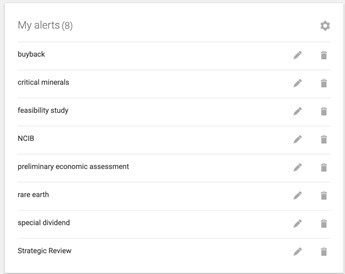
Sometimes, this results in hundreds of emails a day, and if left unchecked, balloons into a few hundred by the end of the week.
I created a Skill that reads all my unread Google Alerts, highlights the most important ones (based on tiers defined by what I consider most actionable), and delivers a curated memo summarizing the findings.
Here’s the description:
“Hedge fund analyst workflow for processing Google Alert emails and generating investment signal reports. FOCUS: Metals, mining companies, and commodities ONLY.
Filter out non-mining/non-commodity alerts. Use when the user wants to: analyze Google Alerts for investment opportunities, review mining sector news, track buybacks/NCIBs, special dividends, strategic reviews, PEA/feasibility studies, or critical minerals news. TRIGGERS: “analyze my google alerts”, “mining alerts report”, “check my alerts”, “investment signals from alerts”, “buyback alerts”, “special dividend alerts”, “strategic review alerts”, “PEA alerts”, “feasibility study alerts”,”critical minerals news”, “rare earths alerts”, “mining analyst report””
Please message me if you’d like the Skill file; I can send it via Slack DM or email.
You can read an example report from February 9th here. But check out some of the results, not bad, right?
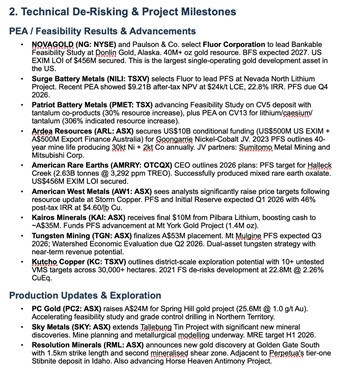
Remember, the point of these tools is to help you get to the critical thinking work more quickly, not to replace the hard work of critical thinking.
This tool provides me with enough information so I can then decide if “yes, this is worth taking a few hours and learning more about,” or not. But not so much information that I feel I don’t need any further research.
Tool 2: Koyfin Watchlist News Classifier
I have many watchlists in Koyfin, but my largest is “Metals and Mining.” It includes every mining company with a market cap above $5M. There are 1,500+ companies on that thing.
This makes it hard to stay on top of all the news that floods the newsfeed.
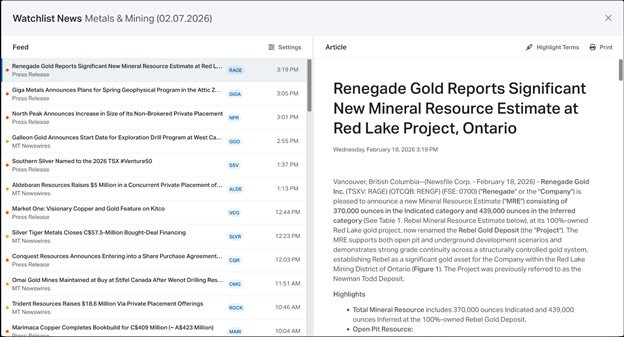
I created a Claude Skill that reads 24 hours of the news feed, highlights Tier 1, 2, and 3 articles, reads each article, and produces a report on the most interesting news releases found during those 24 hours.
Here’s the Skill Description:
“Scans Koyfin watchlist news feed, classifies headlines by investment signal strength, reads high-priority articles in full, and generates an institutional-grade PDF briefing for a senior metals & mining hedge fund portfolio manager.”
The cool thing is that you can instruct Claude on what to look for in a news release. For example, private placements are usually bland announcements. But what if the company financed without warrants and did so at a premium to market price? And what if insiders also subscribed to the financing? That’s way more interesting.
I also instructed Claude to highlight news releases focused on moving from development to production (the most profitable part of the Lassonde curve).
Ideally, I run this screen pre-market for the prior day if I didn’t have the time to scan the news releases myself. Here’s an example from February 17th (see below).
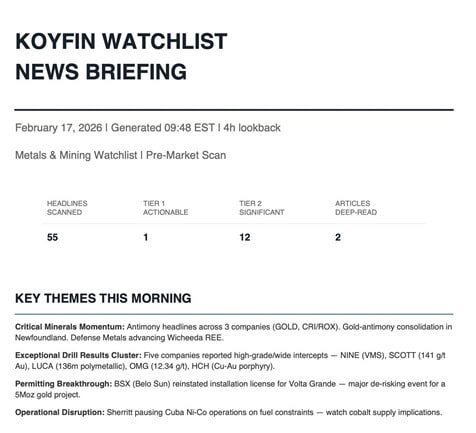
Each report includes sections on drill results, strategic events, financings, feasibility studies, and related topics. Check out the Strategic Events section below.

Again, Claude isn’t doing any of the deep work for me. Instead, it’s performing acts that any $100M+ hedge fund manager would push to junior-level analysts.
PMs wouldn’t give junior analysts final say in portfolio allocation or pulling the trigger on a new name, and that’s the point. Build each of these Skills and Projects through the lens of a junior-level analyst whose sole purpose isn’t to do your job, but to help you do your job better.
The more you view these AI/LLM tools as junior-level analysts, the more productive (and healthy) the relationship.
A Life Worth Creating
I didn’t expect this week’s Long Pull to turn into a philosophical discourse on the benefits and dangers of AI, but I’m glad it did.
These essays are real-time reflections of what I see in markets, how I interact with the world, and my daily struggles to improve as a business owner, investor, and creator.
I want a life worth creating. I want to write things that matter, trade like a Market Wizard, and build a business centered on real people sharing real stories about real life. I’m sure you want these things, too.
We at MO HQ are thinking deeply about AI and how we want to use it in our business and trading. We take this topic seriously because the consequences of not doing so are severe.
Let this be a charge to return to thinking deeply, reading foundational books, and engaging in real conversations … the stuff that really matters if we want to succeed in the Age of AI.
Until next week!