Harbour Energy (HBR.LSE) is one of the cheapest oil and gas producers on your screen: it has a 45% FCF yield. On the surface, it seems great, right? Who wouldn’t want to buy this?
Well, what if I told you that:
- Its two largest assets are in the UK and Norway.
- It pays an effective tax rate of 78% on profits.
- It has dramatically expanded its debt from an acquisition spree since 2014.
- Its largest shareholder doesn’t even want to own the stock.
- It’s listed on the LSE.
Now it looks like every other UK company horrible; something you’d never own.
And that’s why I love this idea.
Our job is to project 18-24 months out and invest in that world, not the present.
Fast forward 18-24 months and the HBR picture changes completely:
- Argentina, the United States, and Mexico replace the UK and Norway.
- Effective tax rates decline to ~63%.
- Net debt reductions allow for more buybacks and dividends.
- No more forced sellers putting an artificial lid on the stock price.
- It’s listed on a major US stock exchange.
If that reality happens, HBR will trade at much higher prices than today.
For example, HBR currently trades at $9/boe of proven reserves. Peers like Ithaca and Aker BP trade at $18/boe and $21/boe, respectively.
What would the market pay for a Tier 1 E&P with globally diversified assets in low-tax-rate jurisdictions, stable production, low breakevens, and a history of shareholder returns? Probably not a 45% FCF yield.
If we assume a 20% yield on 2028E pre-tax profits of ~$4.8B, we get ~$24B in shareholder value or ~$13/share versus today’s price of <$4/share (200%+ upside). That’s assuming $80/bbl Brent. The company states that every $5 move in oil adds $170M in FCF.
Talk about torque. Let’s dive in.
Production Steady, Mix Shifting
The first crux of this thesis is that production will stay around 500K/boed, but the mix will shift from its current high-tax assets in the UK and Norway to higher-growth, higher-return, lower-tax assets in the United States, Mexico, and Argentina.
This slide from the investor deck illustrates the transition from UK/Norway to US/Argentina/Mexico production (see below).

The company estimates that production mix will shift from ~35% US/Argentina/Mexico to ~50% by 2028.
Importantly, each incremental barrel produced outside Norway and the UK carries significantly lower tax rates (read: higher profits). So while production stays around 500Kboe/d, the incremental barrel becomes much more profitable (and valuable).
We don’t need HBR to increase production to increase cash flow.
This is part of our variant perception: investors obsessing over production growth will miss this stock, and they’re using the wrong metric to judge the opportunity.
It’s also worth highlighting HBR’s US and Argentina assets. HBR’s Argentina asset operates in the Vaca Muerta, a world-class O&G basin (long-time Collective members may remember our Vista Energy (VIST) pitch in the Vaca Muerta … that did pretty well).
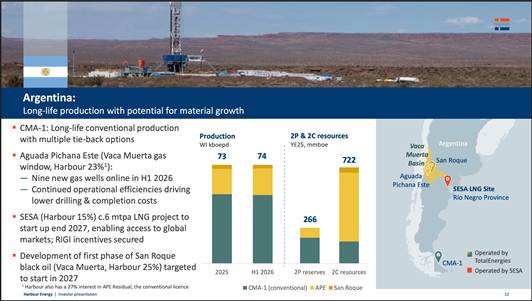
Then there’s the US Gulf of America assets. The company acquired these assets from LLOG Exploration company for $3.2B. Not only did it give HBR a foothold in the US, but it added high-margin, high-IRR barrels into its production mix (see below).

The company plans to increase US production at a 20% CAGR through 2030, with 18 years of reserve life as of today.
Acquisition Spree Done = Lower Net Debt.
HBR has spent most of its public life buying production with debt, paying down the debt, and then doing it all over again. Most investors don’t like ballooning net debt through volatile commodity price cycles. That’s how most commodity producers go bankrupt.
But check out the past six years of HBR’s Net Debt and Net Debt/EBITDAX below (via BBG).

Yes, net debt has exploded from ~$0 in 2023 to $5B in 1H 2026. But Net Debt/EBITDAX has remained stable around 0.6x. Which is incredible given how much production HBR has added since 2020.
HBR today (and the HBR in 18-24 months) prioritizes strengthening the balance sheet and returning cash to shareholders. As we mentioned earlier, a production mix shift will generate substantial profit growth … the company doesn’t need to acquire more barrels to increase profits.
Here’s a snippet from HBR CEO’s latest fireside chat with Barclays (emphasis mine):
“The company does not intend to alter its capital investment plans, with cash allocation focused on shareholder distributions and deleveraging. Harbour retains its framework of distributing 45-75% of annual free cash flow, and in the current environment we would expect that this translates to a payout of c$1.1bn of which at least $300m will be dividends. The remaining free cash flow over and above cash returns to shareholders is set to be used to reduce leverage.”
2028 Net debt estimates are already 6% lower than they were a month ago, and they still seem too conservative (see below).
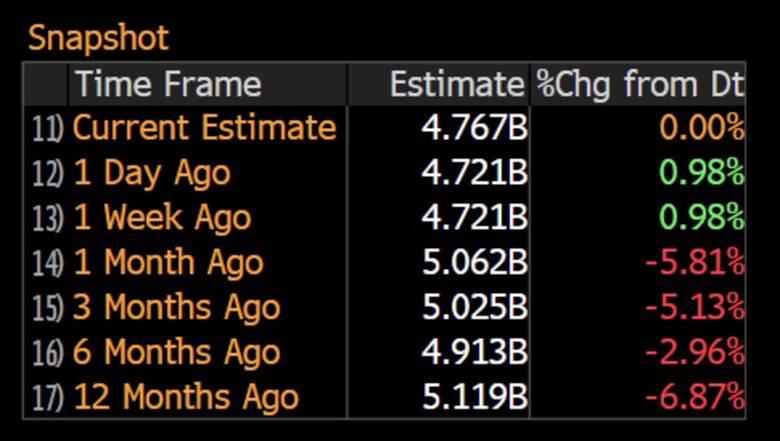
We believe net debt reduction (i.e., balance sheet strengthening) is another variant perception versus market consensus. Higher oil prices will translate into stronger debt reduction than analysts are currently estimating.
(Almost) No More Forced Selling
We use many relative-strength metrics when investing at Macro Ops, and so do other investors. And that’s not good for HBR. The stock is up ~45% YTD. Not bad, but XLE is up 45%, too. And crude oil is up 78%.
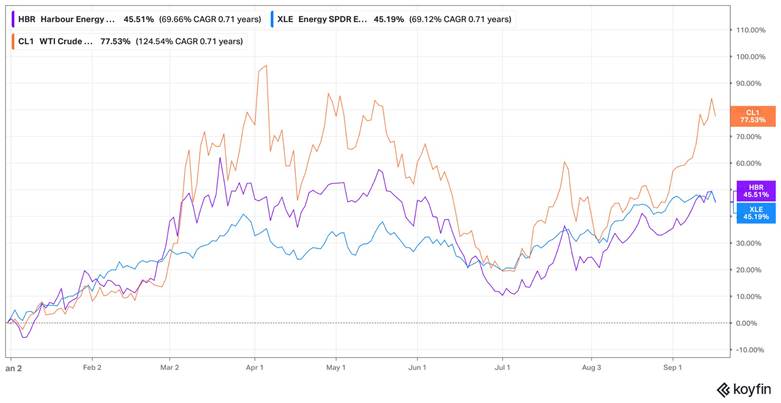
Without context, this looks like something we wouldn’t buy. Why buy a stock that’s underperforming the commodity when you could just buy the commodity?
But here’s the interesting thing. HBR has had a forced seller (BASF) that’s reduced its stake from 40%+ down to 16% during the year.
In other words, the stock’s largest shareholder has done nothing but sell the stock all year, and HBR is still up 45% YTD.
The good news is that BASF is close to unwinding its position, which should lift the glass ceiling on the stock price. Imagine what the stock could do without forced selling in one of the best oil bull markets of the past decade.
Hidden Value: US Listing
There is a reason why a lot of UK stocks look cheap. Nobody wants to buy UK stocks, especially on the LSE. In the past three years alone, many UK companies have listed on US exchanges and reduced their UK-based discount (FERG and CRH come to mind).
HBR’s CEO Linda Cook hinted at a potential US listing during her most recent fireside chat … from Barclays note (emphasis mine):
“Harbour highlighted that the integration of LLOG has been straightforward, helped by the quality of the team, the strength of the asset base and the fact that it was a single-country acquisition where Harbour previously had no operations. LLOG was described as having one of the strongest exploration track records in the Gulf of America over the past decade, strong relationships with partners and an attractive portfolio. Beyond the assets themselves, the transaction provides Harbour with a meaningful US operating footprint and a potential pathway towards a future US listing.”
Putting It Together: A 24 Month View
If we’re right about HBR’s future, the company will look materially different than it does today, and should be valued materially higher. By 2028, HBR could have:
- 50%+ of its production in Argentina, the US, and Mexico.
- A ~64% blended effective tax rate.
- Reduced net debt by $1.5B while paying dividends and buying back stock.
- A listing on a major US exchange.
- Substantially reduced hedging against its production profile.
Mature producers usually trade for ~3-6x mid-cycle cash flow. Premium players can capture 6-7x cash flow. What if we’re still in this massive energy bull market we’re in today? Where would HBR fall by 2028?
Let’s assume a 7x cash flow multiple on 2028E FCF of ~$2.8B (assuming $90 Brent). That gets us nearly $20B in shareholder value or ~$11/share versus $3.68/share today. This assumes no production growth and no increase in realized Brent pricing.
Meanwhile, the company will buy back stock, reduce debt, and pay dividends while shareholders wait.