This week, I met with Peter Marrone, CEO of Allied Gold (AAUC). Allied is one of the cheapest (if not the cheapest) gold producers in the market. I wrote about the company last month (read the pitch here).
Here’s the TL;DR on AAUC:
- The company trades at ~2x next year’s cash flow at $4,000/oz gold.
- They’re ramping production with a pathway to reduce AISCs from ~$2,200/oz to $1,200/oz.
- They own three world-class assets that would be worth 1-1.5x NAV in any other jurisdiction.
- They just started production at the Ethiopian mine, which, at steady state, is worth nearly the company’s entire market cap (get the two other assets for free).
We cut our precious metals exposure over the past two weeks, but AAUC remains on the watchlist as one of the first buys in the PMs space should we get the green light.
I had three objectives for the call:
- Understand Peter’s capital allocation thoughts looking out 18-24 months.
- Determine the severity of the Mali discount and get a “boots on the ground” view.
- Check my assumptions at each mine with management’s targets for 2027-2028.
This is mining, so nothing goes to plan. The good news is that AAUC is so cheap that a lot can go wrong and we still make money. Here’s another thing to remember. We assumed $4,000 gold in our cash flow models. If gold fell to $4,000, the miners would fall another 10-20%, giving us an even better entry point in AAUC.
Let’s get after it.
Capital Allocation: Dividends, Buybacks, & (Maybe) M&A
One of the call’s more intriguing highlights was asking Peter about capital allocation and whether they’d buy back shares, issue dividends, or buy another mine. Here was his response (emphasis mine):
“Well, I’m personally very rich. I’m one of these guys that people call ultra-high-net-worth. I don’t know what that means, but whatever it is, we’re in a world of trillionaires now, so I don’t know what hundreds of millions and billions means anymore.
But I don’t know, Brandon. Tongue in cheek, I’ll say to you that I’ve never golfed in my life, and I wouldn’t intend to. So I can take up my time of six hours a day on a weekend on Saturdays and Sundays golfing, or create something. I like the idea of creating something.
But really where it comes down to is we had this fit-for-purpose, exceptional management in Yamana. To say that management wants to do it again, and to say that if an opportunity presents itself they would do it again, and demonstrating that Yamana was not a one-off — we can do it again, and the management’s fit for purpose — was really important to me personally.
This Allied opportunity presented itself to me, and I thought: what a great way for me to invest my money and to bring that management of Yamana into the process, also investing its money, and demonstrating their competency and capability.”
I mention this because all the directors at AAUC own stock. A buyback would be great for them, but so would dividends (emphasis mine):
“This company was deliberately designed with management owning share positions. As shareholders, we like cash returns. Cash returns also impose a financial discipline on managements — you’ve got to manage your financial position effectively.”
Obviously, Marrone would love to buy back stock at 2x cash flow. But if the company ever received a fairer valuation for its shares, he would also entertain an acquisition (emphasis added):
“The second is: is there something else in the marketplace relative to your share price that can deliver a better return per share? Because we can buy it, make it more efficient, develop it, or if it’s in production, improve the production. We have experience of being able to do that. So that’s something that we’d be looking at.”
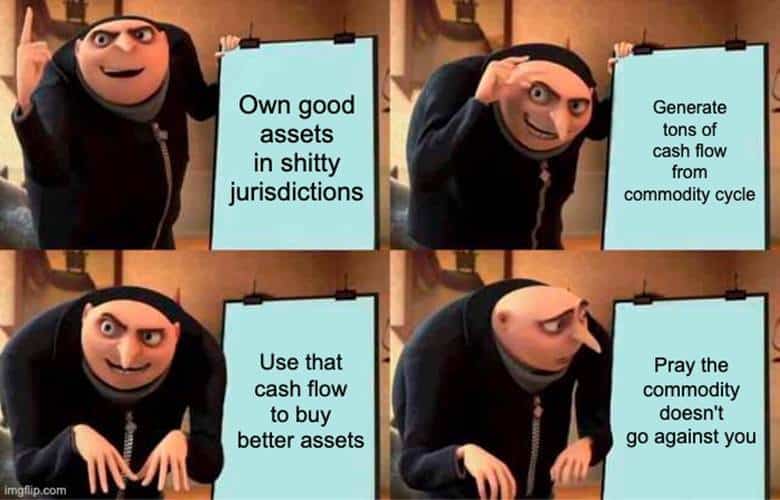
This reminds me of the Harbour Energy (HBR.LSE) thesis I wrote about last week. Take a company with an existing asset base in a not-so-great jurisdiction (HBR with high-tax North Sea assets … AAUC with Mali), use the cash flows from those assets to upgrade production mix over time, benefit from incrementally lower cost production for significantly greater cash flows.
I’ll let Gru explain it below.
If I had to guess on the pathways for capital allocation from here, it would be:
- Buy back stock with remaining excess cash flow after planned CAPEX investments in Sadiola (to improve AISCs) and Kurmuk ramp-up.
- Pay large dividends because all the directors own stock and want to get paid.
- Buy another producing asset, like Kurmuk, to improve production profile mix and reduce jurisdictional risk.
Next let’s discuss Mali and jurisdictional risk.
Mali: Not As Bad As It Seems
I didn’t hide my concerns about Mali with Peter. I even said that one of the reasons the stock traded so cheaply was due to the Mali jurisdictional hangover … and the fact that Barrick had its mine seized (read: stolen) by Mali government officials.
Peter gave an interesting answer to the Barrick situation specifically, saying that (emphasis mine):
“I don’t think the challenges in Mali would be as pronounced as the perception would be but for the Barrick public situation. And don’t get me wrong — it’s not as if the government has done itself a good service here in handling it the way that it handled it.
But we have to go back to before we became owners of these assets and took the company public. This was a private company operating in Mali in early 2023, late 2022. By the time mid-2022, 2023 comes along, the government of Mali introduced a new mining code. Before that, we know from the corporate record that there were discussions about changing the mining code to accommodate higher royalties.
Côte d’Ivoire is an excellent example, Burkina Faso is another example of how you can make this cooperative. Sit down with the government, have a discussion, and come to a resolution that works for them and works for you. Don’t draw silly lines in the sand.
What seems to have happened before we became involved is that the companies were not paying attention to how much resolve there was to get this done. The government of Mali wanted to change the code of conduct effectively on how you share in the profits. It wouldn’t be a different world if people had sat down and said, let’s discuss how to make this work.
Barrick was paying just over three percent in royalties. That’s an unbelievably low rate of royalties, considering that other companies were paying in the range of eight percent, nine percent, because of mining codes laid down closer to present date.
So what approach did we take? We took an approach of let’s be reconciliatory. We don’t agree with the approach that’s been taken, but this is a trust and transparency issue. We adopted a lot of the approach that we took from our South American understanding — what happened in South America many decades ago. The country wants to develop a mining industry, not just extractive, not just companies coming in and extracting. So we can disagree with the methodology, but we understand what they’re trying to achieve, so let’s work with them.
We entered into a protocol agreement that allowed us to be able to get our license, our permit, entering into the 2023 mining code that was formalized and decreed in 2024, whereas these other companies — Barrick in particular — drew a line in the sand and said we’re not going to agree. And I think that was a fundamental error.”
Another good thing about Mali is that the country needs mining. Peter mentioned that 30% of Mali’s revenues come from mining.
I’m still highly skeptical about the jurisdiction, but it seems like AAUC is doing things the right way (if there is such a thing in Mali).
The final piece of the meeting covered asset operations and expectations for future production.
Mine Estimates: A Pathway To 700Koz+ At Lower Costs
My initial napkin model assumed:
- 223,000oz/yr from Kurmuk
- 388,000ozyr from Sadiola + Agbaou + Bonikr
Peter has a much more bullish take (shocking I know). Here’s his outlook for production in 18-24 months:
- Kurmuk: 300,000oz/yr
- Sadiola: 250,000-275,000oz/yr
- Agbaou + Bonikr: 200,000oz/yr
- Total: ~775,000oz/yr
Call it 700Koz/yr to haircut Peter’s expectations. That’s still 89Koz/yr higher than my initial model, which is enough to significantly alter the valuation. But Peter also explained why Sadiola (the Mali asset) could have lower AISCs by 2028 as well (emphasis mine):
“The answer to your question [can we reduce AISCs at Sadiola] is yes, absolutely, and there are multiple paths for that. One is power — making the availability of power more efficient and less costly. Solar being an excellent example of that; more efficient diesel generation being another example, with newer generators.
The mine is a transitioning mine, going from oxide to fresh ore, but it is also a mine that has been around for a long time. There’s already been more than 8.8 million ounces of production from this mine. It’s gotten stale, employment-heavy, and these are some of the steps we intend to take in making the mine more efficient. So power, more efficiency in terms of manpower, but then ultimately getting more ounces of production so that the cost per unit decreases.”
My initial model assumed $2,200/oz AISCs for Sadiola + Agbaou/Bonikr. Assume we give Peter some credit on their ability to reduce AISCs at Sadiola. Maybe they get AISCs to $1,750/oz. Still high, but nowhere near current run-rate.
What would these changes in production and AISCs do to the math? Check it out below:
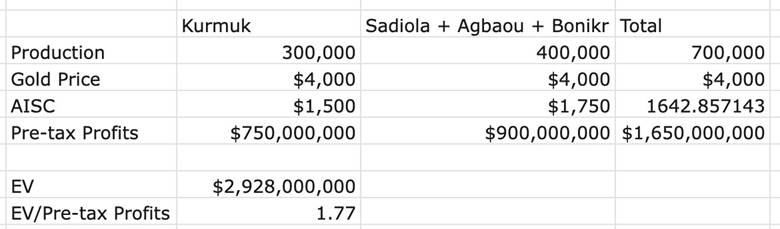
I cannot find a cheaper gold producer.
Why Is The Stock Cheap?
The last topic I asked Peter about was the stock price and why he thought the stock still traded at a massive discount to peers given the production growth and AISC reduction plans.
He responded with an interesting comment on the turnover in the shareholder base. In short, a ton of M&A/arb traders entered the stock when Zijin Gold announced the takeover bid earlier this summer.
The deal fell through, and since then, the company’s seen a rotation from “newer M&A traders” holding shares back towards more longer-term “legacy” mining investors.
“Brandon, the actual real issue is that we’re transitioning from legacy shareholders to intermediate shareholders as part of the deal that we discovered to our community, and now we’re transitioning back into the legacy shareholders. And so it’s just a process that we’re going through.
If you look at our shareholder profile before the deal and now, a lot of the legacy shareholders that were there are not there yet, especially some of our larger ones. And we’re right now re-engaging with them. Look — they liked it enough to be invested at thirty-five to thirty-nine dollars per share, selling in the forties when the deal was announced. They must love it in the low thirties.”
This makes sense, and I believe it’s something that will correct in the coming months, especially if the company trades back to its lows and gold stays above $4,000/oz.
Conclusion
That’s all I got for this week. Let me know if you enjoy these CEO Conversations. I want to make them a more routine part of my weekly/monthly writing.