This week, I dissect the April 2026 RS Inflection Report to identify today’s market inflection leaders, as well as spot potential future RS Composite leaders.
At the end of each month, I present the top five-performing Industry Thematics based on the RS Composite and RS Inflection Screeners results. Then, I share the best charts / actionable setups across the top three themes for collective research.
The goal is simple. I want to say:
- Here are the strongest thematics over the past year, and here are the best/most actionable setups within those thematics (RS Composite).
- Here are the strongest thematics over the past 1-3 months; maybe they’ll become the next Relative Strength leaders, and here are the best setups within those thematics (RS Inflection).
I improved these Trifecta Lens Pulse Reports last December and shared my logic on the changes here. I’ve since added another layer: LLMs (Claude/Perplexity). The result is a more informed RS Inflection Report based on the actual screeners I run each month to identify RS Inflection trade ideas.
Here’s a quick portfolio update before we dive in (as of 05/13 close):
- May 2026 (to-date): +5.79%
- Q2 2026 (to-date): +15.16%
- YTD 2026 (to-date): +59.82%
Alright, let’s get after it.
Top Five RS Inflection Leaders Heading Into May
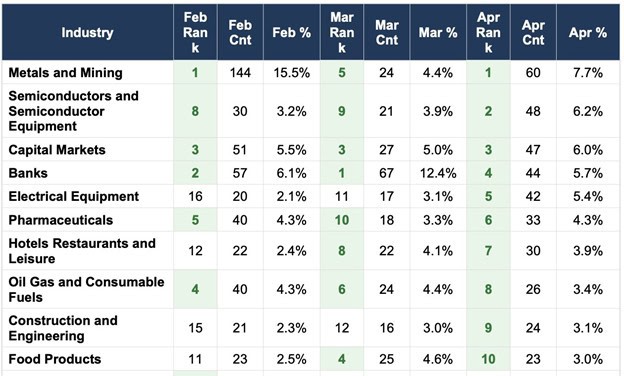
Here are the top five industries and their trailing two-month rankings:
My initial thoughts seeing this list:
- Metals and mining maintains strong leadership over the past three months; never dropping below the top five. It is our Horse.
- Semiconductors/semis equipment jumped seven spots from March to April and doubled its share of the screener since February (3.2% to 6.2%). Strong rise in share alongside the highest 3M RS of any Top 10 industry. 35 of 48 names are new entrants — fresh leadership, not the same set of mega-caps.
- Capital markets remain surprisingly stable at the 3 spot since February (seems like a sleepy top three candidate, right?).
- Electrical Equipment with an 11-position jump from February (16 -> 5) on the back of data center/power themes.
- Pharmaceuticals remain strong and have more of my attention this month.
RS Inflection breadth has expanded since February beyond just metals and mining stock (see below).
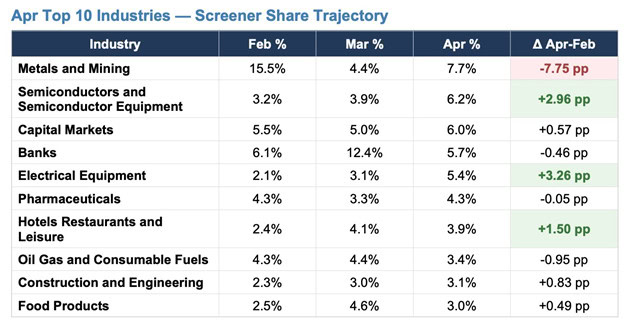
Metals and mining ceded Screener Share to semiconductors, electrical equipment, and hotels/restaurants/leisure stocks despite maintaining its number one spot.
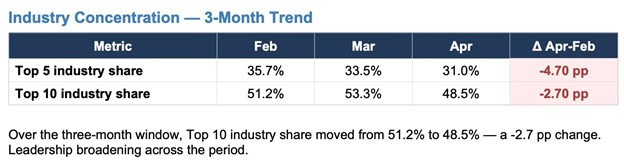
Here’s another data point highlighting the widening breadth within the RS Inflection report:
Let’s dive deeper into the top three industries.
Metals and Miners: Energy-Related Metals Heating Up
Gold dominates (34/60), followed by copper (24) and silver (22). Critical mineral exposure is present but concentrated in a small number of names: cobalt (5), tungsten (4), lithium (3), nickel (3), rare earth (3), tin (3), graphite (1).
The persisting six (Arianne Phosphate, DAN; New Pacific Metals, NUAG; and a handful of others) are mostly small-cap juniors that held their RS through March. The April composition skews heavily toward gold/copper/silver names with critical-mineral exposure concentrated in single-digits. Median market cap of $263M confirms this is a small-cap–driven industry signal, not large-cap mining majors.
Here’s the top ten RS names within Metals and Miners by Composite RS (3M + 1YR blend).
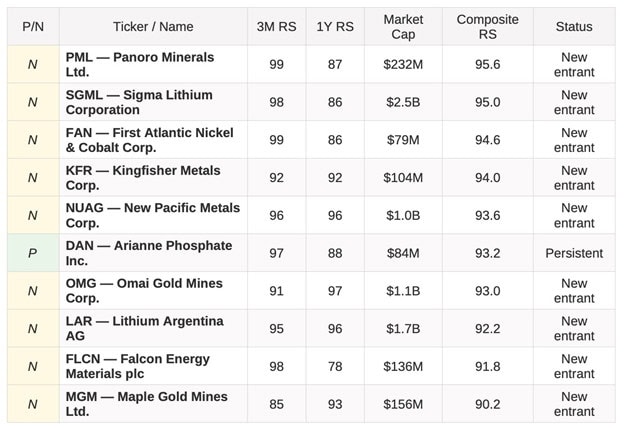
The good thing about this list is it focuses on the metals I want to buy: copper, lithium, and nickel.
PML has one of the best monthly charts in this list (see below).
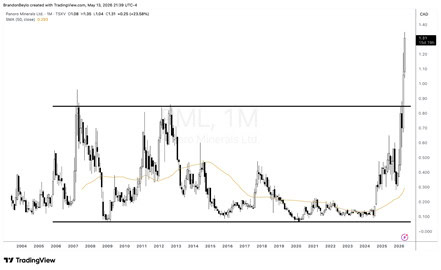
The point is not to just focus on the above ten names, but on the commodities within those ten names. It’s why we’ve added LAC, IVN, and NICU to the portfolio. We want to own more lithium, copper, and nickel.
Onto semis.
Semiconductors/Semiconductor Equipment: More Than An AI Trade
Semiconductors’ top names aren’t just AI.
MaxLinear (MXL), Silicon Motion (SIMO), Intel (INTC), Soitec (SOI), Wolfspeed (WOLF), STM (STMPA), GlobalFoundries (GFS), AIXTRON (AIXA), Diodes (DIOD) — the top of the list is a mix of analog, memory controllers, foundry, and silicon carbide.
The AI-pure-play names that dominated 2024-2025 are conspicuously absent from the top of this list. Whatever’s driving the RS in semis right now is broader than the leaders most investors are watching.
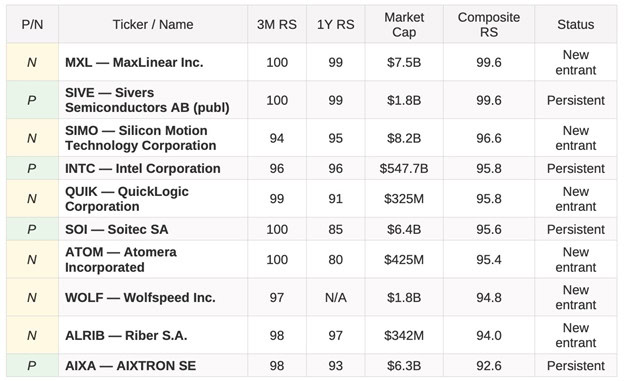
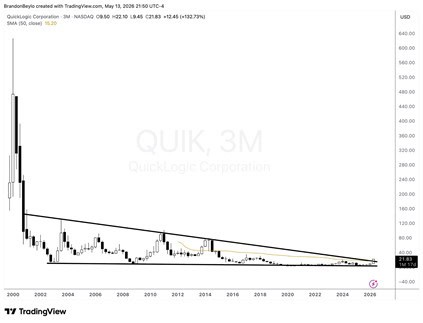
QuickLogic (QUIK) is my favorite chart in this space. Check out the three-month long-range chart below.
According to Koyfin, the company offers embedded Field Programmable Gate Array (eFPGA) intellectual property and specialized FPGA devices used in various applications; and end-to-end artificial intelligence/machine learning solution with accurate sensor algorithms using AI technology.
I have no idea what any of that means. But my guess is that there are enough AI-related keywords to arouse enough investors, and maybe you get a larger company announcing some “Strategic Partnership” with this small company.
The chart looks ready.
Capital Markets: Asset Managers & A Cheap Exchange
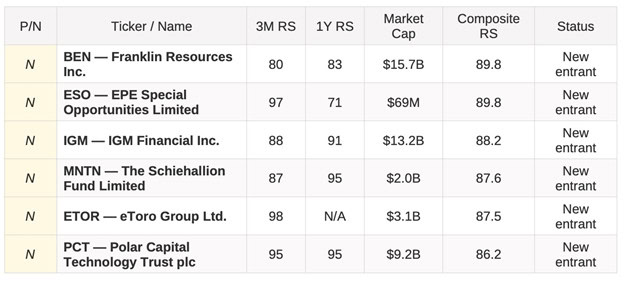
Capital Markets stocks are mostly asset managers and investment trusts, not exchanges.
Top names include Franklin Resources (BEN), Schiehallion Fund, Polar Capital Technology Trust, Pacific Horizon Investment Trust, Acadian Asset Management, IGM Financial, and SuRo Capital.
The Budapest Stock Exchange (BET) tops the list as the lone exchange. eToro (ETOR) and Wealthfront (WLTH) represent the digital-broker leg. Median market cap of $1.1B confirms this is small- and mid-cap territory, not the BlackRocks of the world.
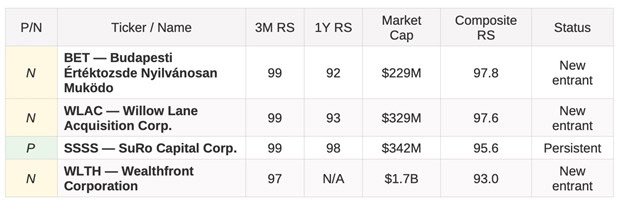
The Budapest Stock Exchange (BET) is easily the most interesting idea on this list (and probably the entire report).
Unfortunately it’s highly illiquid and almost impossible to buy on the FWB, but I’m going to try.
Normally, exchanges trade around 20-25x earnings. They are stable businesses that grow with transaction volume and volatility. They’re also a decent proxy on country-specific GDP (the more prosperous the country, the more liquidity and trading on the exchanges).
The company has a $223M market cap with $30M in net cash and generated ~$21M in cash flow over the past year. That means BET trades for <9x profits or a 50%+ discount to the average exchange valuation. The company grew revenues by 15% last year with 36% EBITDA margins.
RS Spread Indicator: Where To Find The Next Leaders
One of my favorite charts is the RS Spread Indicator. It measures the difference between the short-term return scores (3M) and the long-term returns (1YR). The wider the spread, the greater the chances of finding a new inflection theme.
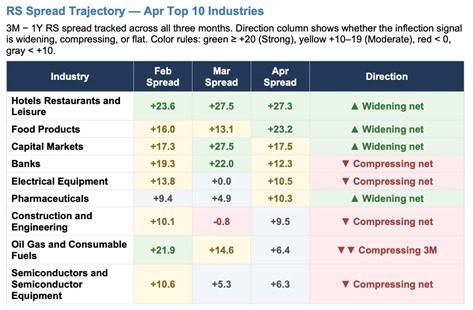
Four industries showing increasing RS Spreads:
- Hotels, Restaurants, and Leisure (HRL)
- Food Products
- Capital Markets
- Pharmaceuticals
Take HRL, for example. It had a 3M RS score of 87.3 with a 1YR RS score of 60.
This is the RS Inflection Report in one picture: show me the industries/thematics that have the strongest inflections over the prior quarter that have not outperformed over the prior year.
Hotels, Restaurants, and Leisure + Food Products
I wouldn’t have thought to look at HRLs and food products, especially given the impending food inputs inflation (corn, wheat, soybeans, sugar, rice, you name it). But I’m seeing a lot of interesting charts.
ShakeShack (SHAK)
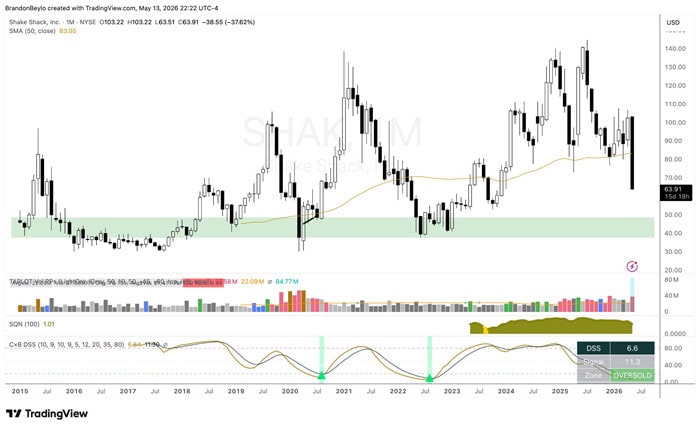
I’d get interested once price reached the green zone and triggered a Bressert Buy Signal.
Puma SE (PUM.XTE)
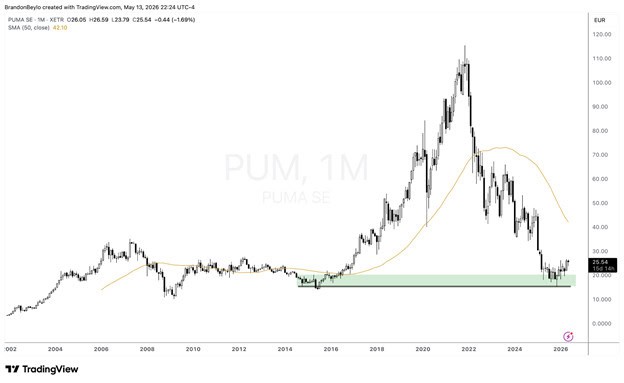
World Cup coming up as a potential catalyst. Stock is down 70% over the past five years but finding support here going back to 2016. The last time PUMA was this low it proceeded to return 4x (EUR 25 -> EUR 110) in six years (not bad!).
Krispy Kreme (DNUT)
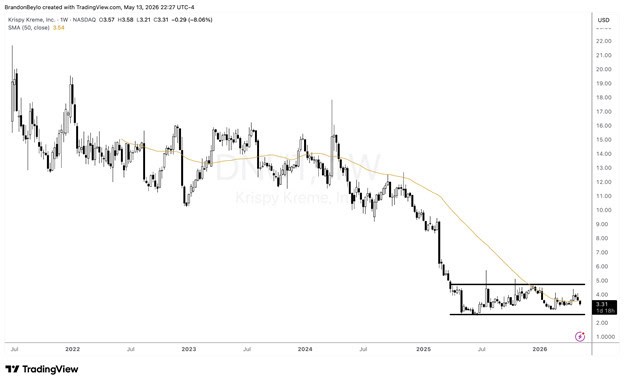
People still eat donuts, right? I wonder how much of this stock decline is from GLP-1s. Either way, interesting consolidation here around all-time lows and worth monitoring for an upside breakout.
Conclusion: Why I Love These Reports
I love these RS Inflection Reports because they help me identify stocks I wouldn’t otherwise find in my day-to-day investment process. I’ve spent so much time in metals and mining and commodity plays that I’ve overlooked semiconductors, electrical component companies, pharmaceuticals, and HRL/food product stocks.
That’s the value of this report. It’s how we found and bought Wendy’s (WEN). And it’s how we’ll deploy our AI/data center profits going forward.
Remember: Recycle profits into new ideas that could become future Composite Leaders.