Each week I try to spend a bunch of time calling portfolio managers. Some are friends I already know, but often I cold-call PMs I’ve never met because they’re invested in a company I’m researching.
I got a Bloomberg for the first time in July, and since then my life has felt a lot like this.

So far, I’ve been floored by investors’ generosity with their time. Of course I’ve received a few “no’s,” but most investors I’ve messaged have happily spent 30min-1hr discussing current holdings, new ideas, and how they see markets.
The beauty is that I can share these interactions with you (keeping everything anonymous), so we can learn together and find new insights or perspectives.
This week’s piece explores three conversations I had last month with three different portfolio managers. Each of them approaches markets differently, which makes for even better insights.
We’ll cover stock ideas, investment philosophies, and trade management.
Big thanks to Claude for helping condense these hour-long conversations into easy-to-digest reading!
Let’s get after it!
Investor A: SMID-Cap Growth
We’ll call this investor Doug. Doug spends most of his time in SMID medtech. He likes the space because, “there’s been a bad macro narrative pinned on the entire space when its really just been a few company-specific blowups.” This leaves a few quality names thrown out with the bathwater. Doug also avoids healthcare services and insurers.
Portfolio Construction and Investing Style
Doug owns ~40 positions across three main style buckets:
- GARP-type names
- Undiscovered and Off-the-beaten Path
- Traditional Business Inflection
He described his philosophy as:
“We try to just be really opportunistic and not really have so much a style box. So many people are kind of stuck in these style boxes and it doesn’t give them the flexibility to move around, and we kind of think that’s our advantage.”
Medtech Ideas: VCEL, AORT, UFPT, & WAY
Vericel (VCEL)
- What it is: A biologic for knee cartilage repair. A small amount of the patient’s cartilage is taken, grown in a lab, and reimplanted. He calls it the only way to fully heal cartilage and says doctors make a lot of money doing the procedure.
- Why the opportunity exists: It looks expensive on a P/S basis. His answer: margins and cash flow are very good, roughly a 5% free cash flow yield.
- The inflection point: Capex has been elevated to build a new facility and should now drop to something “really small,” which should lift free cash flow.
Artivion (AORT)
- What it is: A very niche medical device company operating in small markets with little competition.
- What went wrong: A key stent graft was sold under a humanitarian device exemption (HDE) rather than full FDA approval. As full approval neared, many hospitals chose to wait rather than deal with the HDE paperwork, creating a temporary hole in sales.
- The setup: “Everything looks good there, but the stock hasn’t recovered yet.” The thesis is that a one-time, approval-driven air pocket has been treated as a lasting problem.
UFP Technologies (UFPT)
- What it is: A maker of subcomponents for medical devices, including the plastic drapes that cover Intuitive Surgical’s robot arms before procedures. You had not heard of it; he called it “really under the radar.”
- The overhang: Intuitive began insourcing the drape product about two years ago. That business was about 30% of UFP’s sales and has not grown in two years, which weighed on the stock.
- Why now: In his view, Intuitive has done as much insourcing as it is going to. He expects that business to grow around the mid-teens from here. UFP is also on other robotic platforms, and the rest of the business grows about 10%.
- Robotics angle: About a third of the business is tied to various robotic platforms.
Healthcare Software: Waystar (WAY)
This one actually popped on a few of my “left for dead” screeners. WAY got thrown out with every SaaS company during the SaaSpocalypse. Here’s Doug’s thesis:
- Regulation as moat: Healthcare is highly regulated, so he does not think hospitals will replace revenue cycle management (RCM) with home-built AI tools. Hospitals do not want the risk.
- Own AI capability: Waystar has invested heavily in its own AI
- High switching costs in this part of healthcare.
- Valuation: ~12x EBIT against a two-year average of roughly 24x, about one standard deviation below average. He noted capex is elevated because the company capitalizes much of its AI spend.
- M&A optionality. “I wouldn’t be surprised if it went private again.”
Then Doug pivoted to Dutch Bros (BROS), which Will McLane and Max Howard pitched on my podcast. I have a rule that whenever two different people pitch me the same company, I do some initial work.
His pitch was that the results have been really good, especially as they lap pricing and add food to their product offering. Doug compared it to Cava (CAVA) in terms of unit economics and returns on capital.
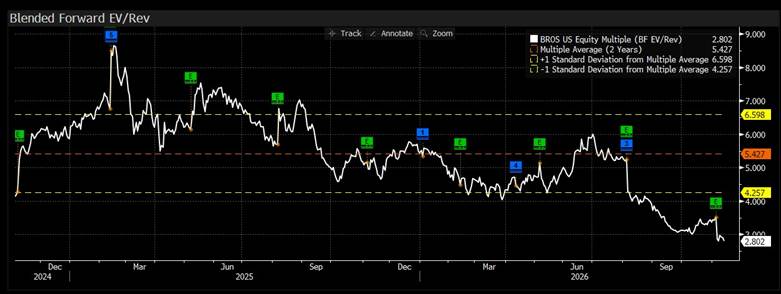
The stock actually looks attractive here. BROS is growing top-line revenue by 30% annually and trades at 2.8x NTM sales, which is 2std below its two-year average. (see below).
It’s tough to get really excited about BROS when there’s a coffee shop every half mile near where I live. But you can’t argue about the revenue growth, founder-led culture, Gen Z fanatical customers, and attractive unit economics.
I’d be interested if any Collective member has done work on this name and wants to compare notes.
Alright, onto the next PM.
Investor B: 30YR Defense Investor
This next investor, who we’ll call Dan, is a 30YR veteran that’s spent most of his career investing in the defense, aerospace, and industrial industries.
I initially called him to discuss Amentum (AMTM), but we ended up chatting for over an hour about a bunch of other stocks, which we’ll discuss below.
Dan is a concentrated investor with ~25 names in the portfolio. His first and most important question before investing is, “is there a catalyst that I can understand?”
Amentum (AMTM): What Made Me Not Invest
I was on the fence about investing in AMTM when it traded back into the $17-20/share range. My hang-up was the lack of revenue growth and margin expansion potential, as well as exit multiples investors would pay for (what I hypothesized) would be a low-growth, low-margin business.
Here’s Dan’s pitch.
The core framing: Amentum is a steady, low-margin, cash-generative integrator that the market alternately over-hyped and over-punished. Dan then highlighted the main points of his thesis:
- Not a high-margin defense company. “People tend to get caught up in that.”
- The real core is smaller than the headline.Investor relations frames a ~$10B core; he puts the real embedded government systems integration work at about $7.7–8B.
- ~40% is “butts in seats, guards and gates.”A 4–5% margin, recompete-driven business that “pays the bills.”
- Bad contracts rolling off. About $150M of what he calls zero-margin (not negative) production/development work is being exited.
- Why he likes the structure. He likes Reverse Morris Trust (RMT) setups because the complexity makes many investors wait. The RMT’s two-year anniversary passed on September 30.
Dan then offered five key issues weighing the stock down:
- DOGE hangover. Investors are still applying the DOGE narrative to the group.
- NASA insourcing. NASA brought roughly a $350M Kennedy Space Center contract in-house. Management is spinning it as keeping a ~$50M piece at higher margins.
- Credibility. Management initially sized the impact at about 1% and later had to raise it to 3%. “You sat with the customer.” He sees a credibility gap they must close this quarter.
- Private equity overhang. Lindsay Goldberg and American Securities still hold stock. He doesn’t expect them to be sloppy sellers, but he sees the overhang as part of the discount.
- Group de-rating. The whole government services group de-rated, with company-specific problems at peers
My other problem with AMTM was the return drivers. There were only two ways to make money from this trade: buying back stock and/or deleveraging.
Those are great and can work really well. But out of all the stocks we could own in the world, why limit ourselves to one that can only make us money by not reinvesting in its business?
NCR Voyix (VYX): Payment Software
VYX is one of Dan’s favorite ideas. The company does enterprise Point of Sale (POS) services for very large customers (i.e., not mom-and-pops that would normally use Toast or Square).
Here’s Dan’s thesis in eight bullet points:
- Management: he rates the CEO highly (previously EVO Payments, and before that Global Payments). Says his firm is “very close with him” and that management believes the business turned the corner this summer.
- Mission-critical: if enterprise point-of-sale goes down, the customer has no fallback. He sees essentially one other alternative.
- Sticky base: about 400 customers make up 80% of revenue and “can’t really go anywhere.” Roughly 5,000 support staff globally.
- Pricing: has never raised prices and is only now starting.
- Balance sheet: came out of the spin at 4.2x leverage. After selling digital banking and doing some buybacks, it is around 2x, which he thinks they will run it at.
- Mis-categorized: it was pitched as a software company just as software fell out of favor; it is really services plus software.
- Catalysts: free cash flow accelerating in the back half, and growth metrics finally reported properly.
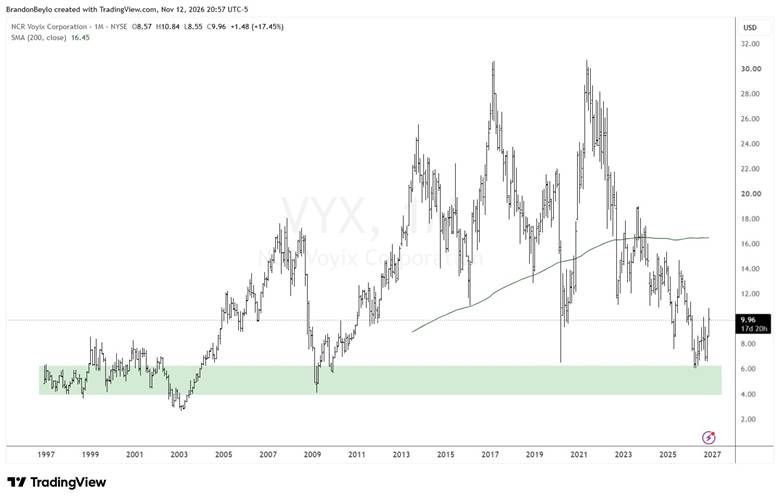
- Valuation: “Dirt cheap.” Upside “easily mid-teens” (likely $/share), downside about $6.
The stock trades near its lows, but it’s not historically cheap.
Mirion Technologies (MIR): Picks and Shovels on Nuclear Build-out
I had MIR on my watchlist but didn’t dig in because I thought it was too expensive. So it was cool to hear Dan pitch the company. He admitted the company isn’t “super cheap” at these levels. But it’s worth having context/diligence on the name in case we get a better entry price.
Dan sees a razor/razor-blade radiation detection business whose value is in forward free cash flow conversion. Here’s the high-level pitch:
- Ubiquity: MIR operates in about 95% of nuclear plants. Radiation monitoring is a regulatory requirement, so the dosimetry badges are “rinse and repeat.”
- Nuclear medicine tailwind: radiotherapeutics, radiodiagnostics, and oncology all need monitoring.
- Contracted within operations: part of EDF’s large contracts and “not coming out”; involved in plant life extensions, SMR front-end safety equipment, Amentum and the national labs.
- Acquisition: the Paragon deal added instrumentation assets that he says his firm once looked at buying outright.
- Insiders: the CFO bought about 20,000 shares at ~$15; he says the CEO and CFO are the largest individual shareholders.
- Balance sheet: fine; the convertible was issued at much higher prices, so the debt is cheap. It is also raising prices.
- Valuation: attractive around $15 if you believe in nuclear; downside $10–12. His firm walked away in the $20s and re-engaged on the pullback.
Investor C: Veteran Technology/Consumer Investor
I’ve known Investor C, who we’ll call Mike, for a few years. He made a ton of money for his LPs during the post-COVID market mania. But he also gave a lot of it back in the years that followed.
This was my favorite conversation of the month because it highlighted a successful investor’s ability to reinvent themselves, add new rules and protocols, to continually improve returns.
On AI and Disproving Negatives
Mike invested heavily in software up until ChatGPT destroyed every software business known to man. He exited nearly all of his software positions because the bets went from “how big can this market be?” to “how much of the market can the company keep?”
In other words, instead of owning a stock for positive reasons (“wow look at how big this company can get!”), you own it for negative reasons (“man, I hope AI doesn’t eat this business before it can capture at least some of the market.”).
Let’s get to a few of Mike’s favorite investment ideas today.
Nebius: Exceptional Execution
Of the roughly 80 founders he met in his first eight weeks in Silicon Valley, he kept hearing one name: Nebius. His view is that it is more than a neocloud, with strong AI software, and can break away from the pack (he contrasted it with IREN and Applied Digital).
- Execution business. Turning crypto-mining sites into AI cloud is not just swapping rigs. According to Mike, most bitcoin miners trying to convert “just haven’t been able to deliver.”
- Talent origin. Much of the team came from Yandex, which built a hyperscaler inside Russia. After the invasion of Ukraine, its engineers scattered to Israel, New York and Silicon Valley.
- Delivery. Projects on time, on schedule and under budget; he cited an example of electrical crews wiring a data center in days rather than the typical four weeks.
- Ground truth from founders. When he looks for compute for his own founders, Nebius is the only provider he has seen deliver reliably.
I don’t know. I look at these crypto miners and data center charts and want to puke. Maybe that’s a sign I should buy some of them (blood in the streets, right?).
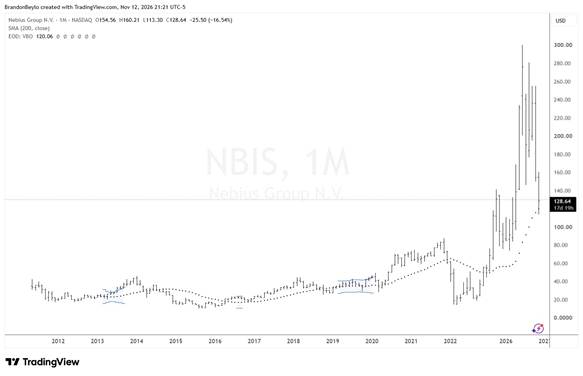
That said, the NBIS monthly chart looks good. It’s pulled back nearly 60% from its highs and is finding support at the midline.
Crane (CXT): Space Picks and Shovels
I loved this pitch because earlier last month I discussed space/defense stocks with Dan. So space was already on my mind.
The problem with nearly every space company is that they’re either too expensive, have no revenues at all, or make vaporware.
CXT is a real business that generates ~$1.9B in revenue with 40% gross margins and 22% EBITDA margins. The company’s growing revenues in the high single-digits annually and trades at a respectable 10x EBIT.
Mike pitched CXT as the opposite of a speculative space stock. The company is “a high quality supplier with a space and satellite kicker.”
Origin of the idea: On a China trip he kept meeting LEO companies; space and orbital data centers are a priority in China’s 2026–2030 five-year plan. Back home he studied SpaceX’s ecosystem and found three suppliers: Crane, Diploma (UK) and Moog.
Diploma and Moog:“the goats,” phenomenal compounders, but expensive. These are great comparables
The Main Pitch:highly engineered, sole-source proprietary aircraft and defense parts. A small LEO business (satellite propulsion, flow control, shuttle landing gear, launch-pad components for Blue Origin and SpaceX) plus nuclear power plant parts. It traded around 15x earnings in the spring, which he thought was early in the cycle for nuclear and space.
AI In The Investment Process
I’m always curious how other investors are using AI in their investment research process. And I loved Mike’s answer.
For a new idea he runs parallel agent streams, then has them combine into a go/no-go:
- Diligence on the business itself
- Competitive intelligence
- Financial modeling
- An “ecosystem control test”
- Management narrative
Limits. Not yet prescriptive enough to set entry and exit prices, sizing or KPIs. “As a first cut, almost like having a fleet of junior analysts, it’s pretty amazing.”
I created a team of Grok Bots after this call to replicate Mike’s setup. Before that, I had a swarm of agents covering tons of industries and thematics. Now, I have them all focused on one company at a time.
Risk Management & Philosophy on Losing Money
This was the biggest change in Mike’s investing process. Before this year, Mike focused on “owning great businesses” and “not caring about charts or the tape or whatever the price was in the short term.”
All of that changed when he started dramatically losing money and underperforming.
Mike made two major changes:
1. He stopped buying bad businesses and only bought things that were large, high quality, and liquid.
“There are about 50,000 stocks in the world. The task is to find 10–15 where you can be right and make money. Why hunt for a diamond in the rough in a neighborhood nobody wants, when you have to be right about both the neighborhood and the house, and the best addresses sometimes go on sale too?”
2. He implemented a 15% drawdown rule for cutting risk.
Here’s what Mike’s new rules look like:
- Entry: Buys the full position at once.
- First stop: -15% from cost basis he cuts the position by 50%
- Second stop: -15% from first cut he cuts by another 50%
- Exit: -15% from the second cut he cuts completely
According to Mike, “a stock down 15% means you are wrong, offside, or the flows are against you, and it usually goes lower. There is no sense fighting a bad tape.”
I love this idea. The other reason I love it is that it came from Mike’s maturation as an investor. Instead of obsessing over being right, Mike just wants to make money (and not lose it!).
“As a younger person, I weighed the primacy of being right over making money. Now, as an older person: do you want to make money or do you want to be right? Your job is to make money. Your job isn’t to be right.”
Conclusion
I hope you guys enjoyed this piece. I look forward to doing more of them in the coming months as I cold-call more portfolio managers and investors.