Throughout my 20s and 30s, I spent family holidays locked in a guest room, “getting ahead”—fanatically backtesting strategies, analyzing trade logs, consuming video courses at 2x speed.
I told myself it was the necessary sacrifice for the high-level of achievement I desired.
From today’s vantage point, I can see it was something else.
Last fall, David Senra’s appearance on the Tim Ferriss podcast gave me the vocabulary for what it actually was. Senra runs Founders, a podcast distilling biographies of history’s greatest entrepreneurs into practical lessons. After 400 biographies, he’s identified a pattern in what drives extreme performers: what he calls Dirty Fuel versus Clean Fuel.
Dirty Fuel presents as fear, shame, insecurity, the need to prove oneself.
Clean Fuel as curiosity, pride in craft, joy in work, the desire to build something meaningful.
Both fuels can power obsession. Both can produce results. But only Clean Fuel creates sustained excellence, performance longevity, and a life worth living.
Obsession is the engine. What fuels it determines the life you get.
Those guest-room holidays were obsession burning Dirty Fuel. Below conscious awareness, I felt I had to prove myself through performance metrics—or pure work ethic if those metrics weren’t corroborating my own impossible standards.
No amount of backtesting or study was going to satisfy. The horizon of “good enough” perpetually recedes.
I’d squeeze every ounce of expectancy from a system, feel the inner critic pipe up anyway, and reset the whole venture: new timeframe, new asset class, new setup criteria. The work was never done because the real unrest was never truly about the work.
In 2022, I recognized what was fueling my obsession. Since then, shifting the fuel source has been a practice: quiet, ongoing, and intentional.
Now in my 40s, I carefully consider any urge to swap the face of a loved one for my laptop screen—during the winter holidays, dinner with my wife, an afternoon walk with our two dogs.
I remain obsessed with this work. What fuels that obsession could not be more different.
Here’s how this shift has presented in practice.
Last year, I completed the latest iteration of my equity breakout system. It required immense amounts of data collection, pattern recognition, trade log analysis. I surgically defined the timeframe, asset category, and setup criteria for my highest-expectancy trades.
When I reviewed the final statistics—Profit Factor, Calmar Ratio, Expectancy—there was a genuine sense that I’d squeezed the last ounces out of this approach.
The statistics were excellent by every measure.
Running on Dirty Fuel, that familiar inner critic would have surfaced anyway: not good enough. And I would have torn it down and started over.
Instead, running on Clean Fuel, I sat with what I’d built and asked with genuine openness: What else wants to be seen here?
What emerged surprised me.
A number of my system’s winning breakout trades had formed short consolidation patterns—high bases and flags—while trending toward their measured move targets.
Looking closer, my failed breakouts rarely exceeded a 1R Maximum Favorable Excursion (MFE) before stopping out within days of entry. Successful breakouts, by contrast, ran for weeks, sometimes months.
Curiosity asked: “What if I defined a sub-universe of opportunities within my own active breakout positions: only those that had already surpassed 1R MFE and been held longer than a week? What if I screened for high bases and flags within those positions, using the sustained breakout as a favorable regime filter for the shorter-term setup?”
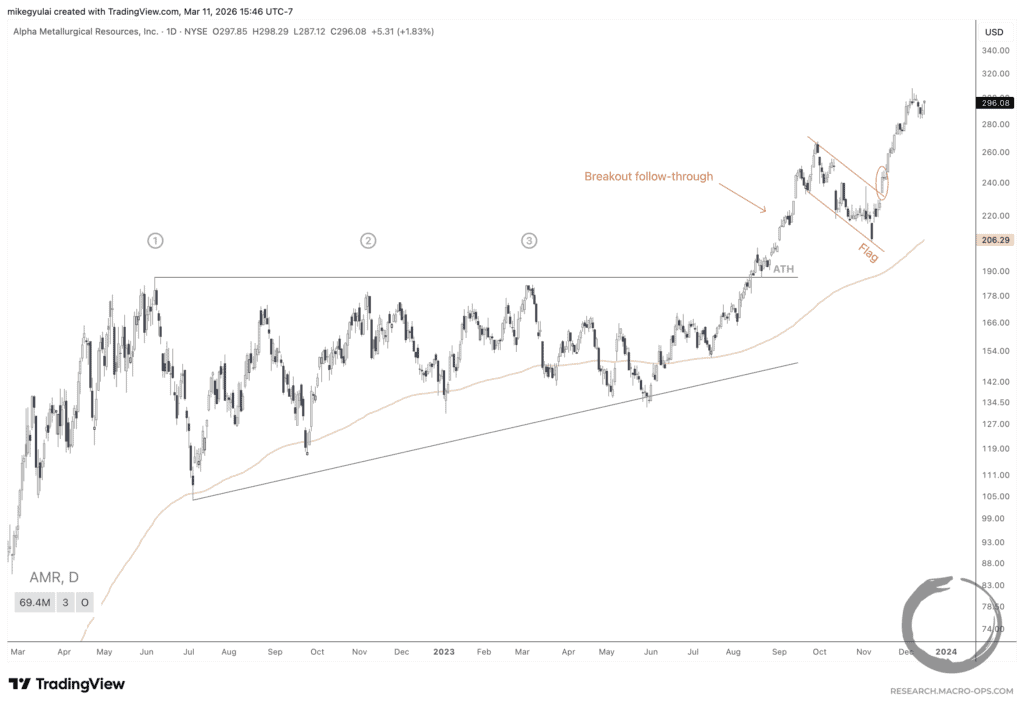
AMR, 1D, December 2023
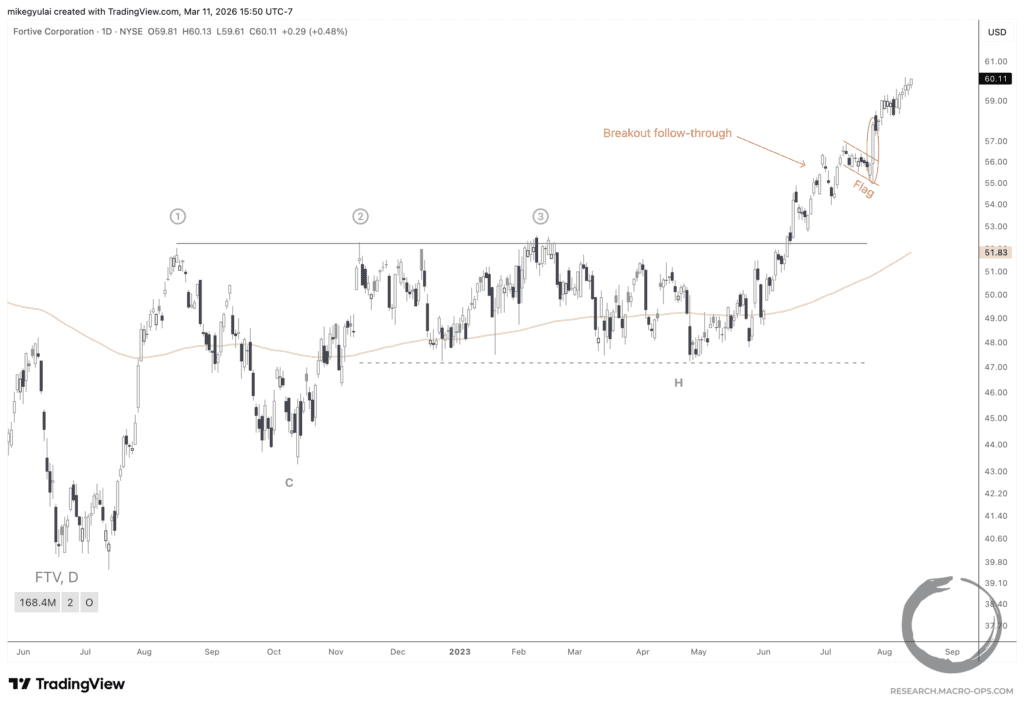
FTV, 1D, August 2023
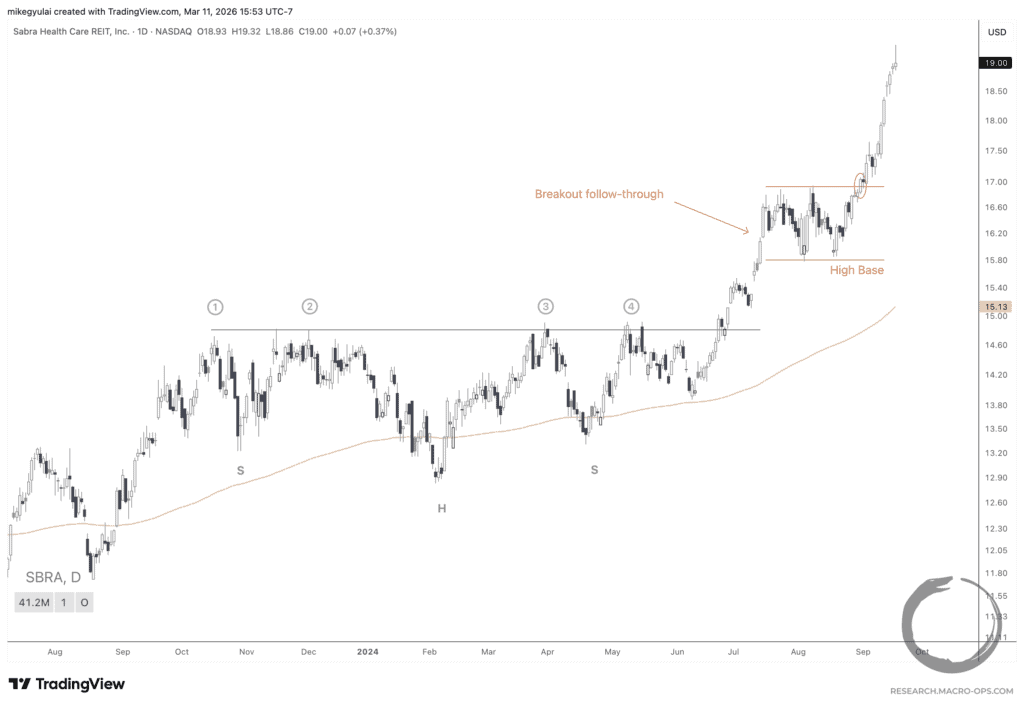
SBRA, 1D, September 2024
What revealed itself was a new opportunity hiding in plain sight: a way to add to winning breakouts using tightly defined risk, compounding gains on trends that had already proven themselves.
As these opportunities emerged in real time, I shared them with The Collective:
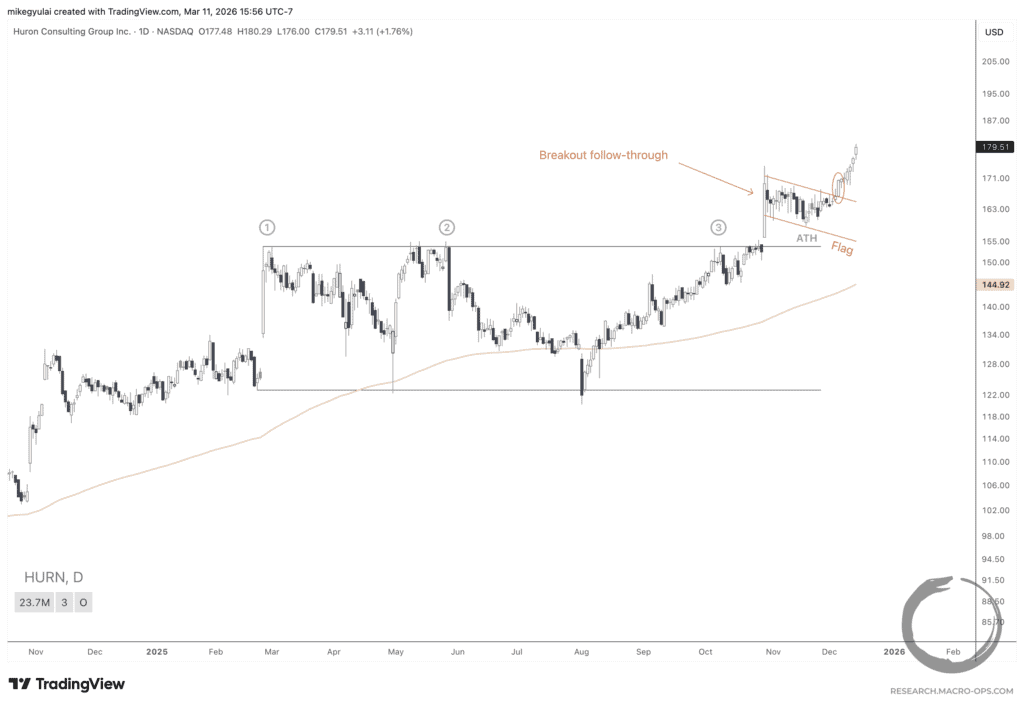
HURN, 1D, December 2025
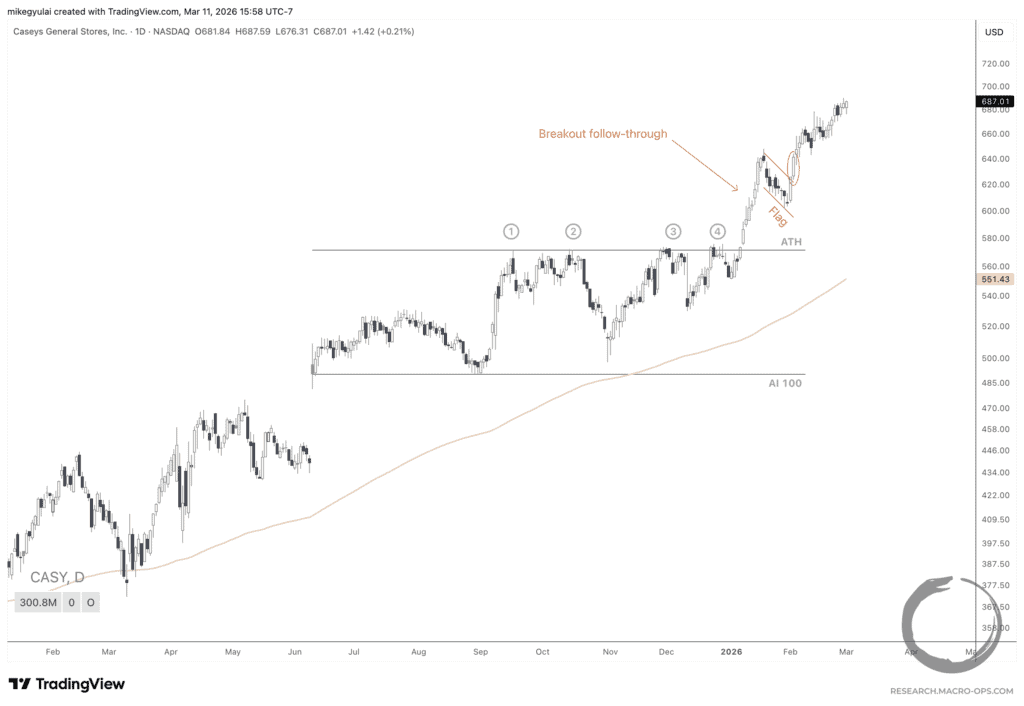
CASY, 1D, February 2026
This is what Clean Fuel looks like in practice. Not turning against what is. Not resetting in pursuit of a receding horizon. But observing with patient curiosity to see what else wants to be seen in what already exists.
Dirty Fuel would have burned the system down and started over.
Clean Fuel found an entirely new edge inside the one I’d already built.
When I shared Senra’s framework with The Collective last fall, the response was immediate. Members finally had a vocabulary for why strong performance had at times felt turbulent and disjointed … and at other times expansive and aligned.
In the Macro Ops Collective, we don’t just pursue outstanding returns. We pursue sustained excellence, performance longevity, and a life worth living.
If you’re ready to upgrade the fuel source powering your obsession, I invite you to join us.
Enrollment is open until this Sunday at midnight.
I look forward to seeing you inside.