If you’re on the fence about Trendlock, this email walks through exactly what you get, what to expect, and whether this is right for you.
No sales pitch. Just the facts.
What Trendlock Is
A momentum-based ETF rotation system that sends you one signal per week.
Every Sunday at 6PM Eastern, you get an email telling you which position to hold for the coming week.
It only trades 4 ETF’s, either SSO (2x S&P 500), QLD (2x Nasdaq), UWM (2x Russell 2000), or BIL (cash).
You execute the trade. Takes 5 minutes. Then you’re done until next Sunday.
The system rotates into whatever shows the strongest momentum characteristics at that moment and stays there until conditions change. When momentum deteriorates across the board, it rotates to cash.
What You Actually Get
1. Weekly Email Signals
Every Sunday at 6PM Eastern. One position. One action. Clear and unambiguous.
“Hold SSO” or “Rotate from QLD to BIL” or “Move from cash to UWM.”
You execute that evening or Monday morning. The system isn’t trying to time intraday moves. Executing Monday at 9:30am instead of Sunday at 6:05pm makes no material difference.
2. Full Performance Dashboard
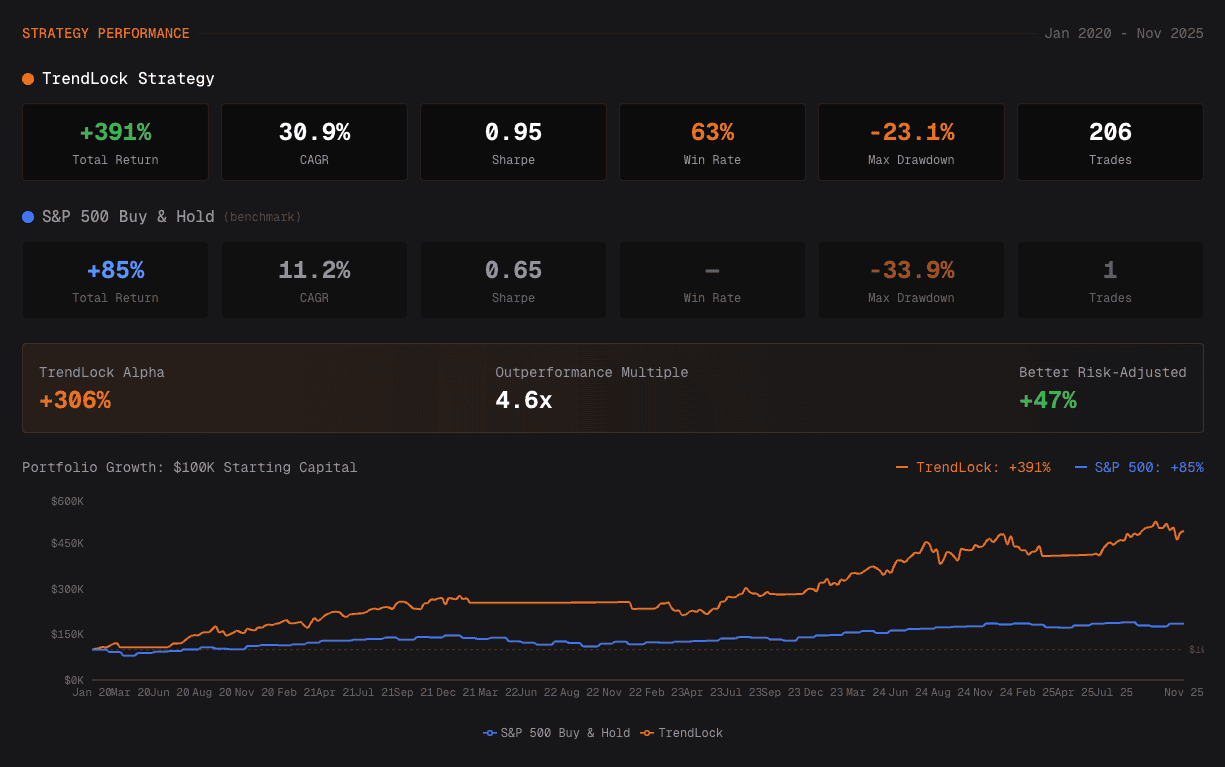
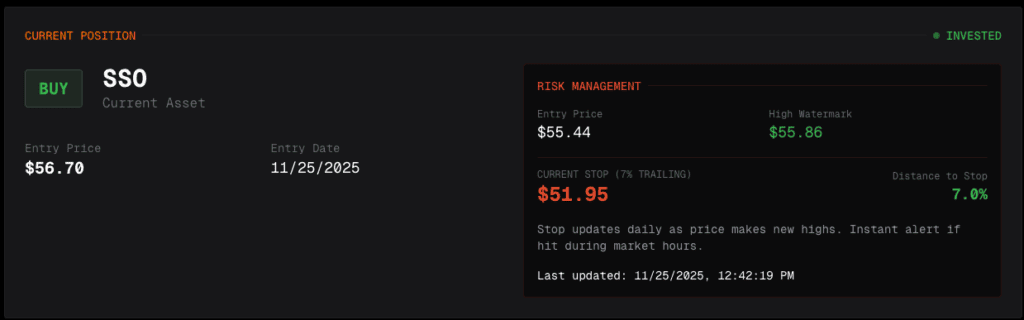
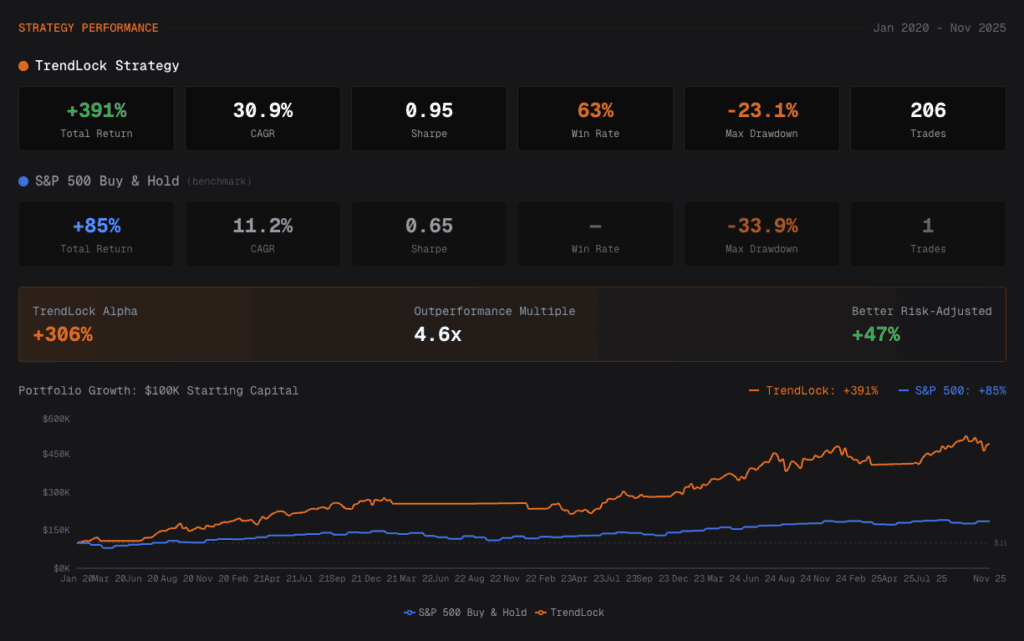
You can see every position, every rotation, every entry, every exit. The dashboard updates in real-time as positions move. You see exactly what I see.
4. Regime-Specific Performance
The system has been tested across multiple market environments:
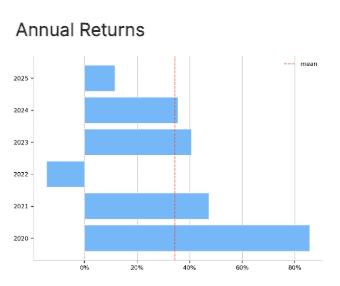
COVID crash and recovery (2020): The system rotated defensive early, avoided the worst of March, captured the V-shaped recovery.
Meme stock mania (2021): Stayed invested through the momentum phase, rotated when conditions shifted.
2022 bear market: Went to cash multiple times as momentum deteriorated, avoided holding leveraged positions through sustained downtrends.
2023-2024 AI boom: Captured the uptrend in tech, rotated between QLD and SSO as Nasdaq leadership ebbed and flowed.
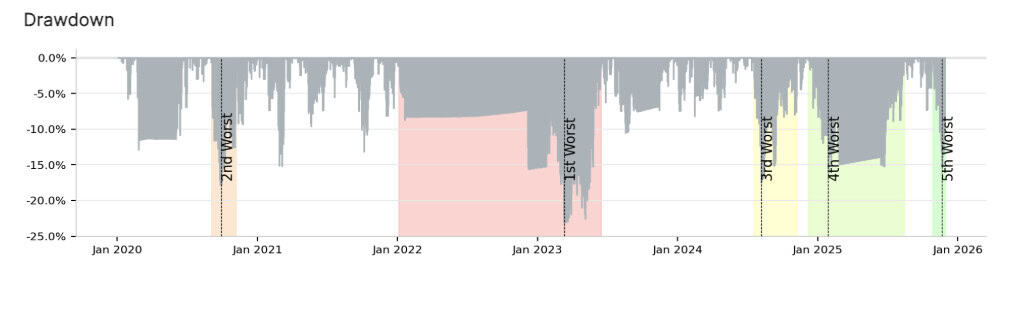
You can see all of this broken down in the dashboard.
What to Expect (The Reality Check)
This is not a magic money printer.
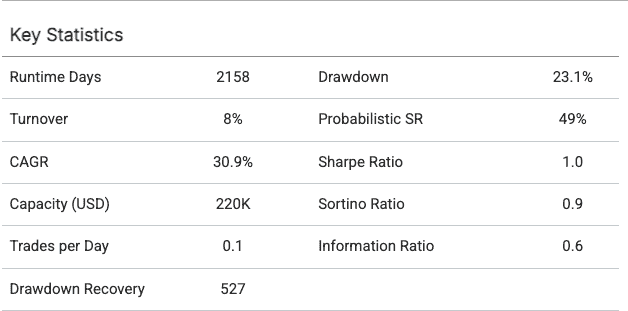
You will sit through drawdowns. The maximum historical drawdown is 23.1%. That means at some point, if you’re running $100K, you will watch it drop to $77K and you will question everything.
You will sit underwater for extended periods…while your buddy who bought and held NVDA is up 20%.
You will experience whipsaw. The system will rotate you into a position, it will immediately go against you, then it will reverse. You will wonder if the system is broken. It’s not.
That’s momentum trading, it gets a bit shaky at the turns or points of inflection…if it’s happening know that it’s orders of magnitude worse to investors who are trying to guess what to do next.
You will want to override signals. The system will tell you to go to cash right before a massive rally. Or it will tell you to buy right before a sharp selloff. You will be convinced you know better. We don’t.
The system works if you execute every signal exactly as given.
The 29.4% CAGR assumes you follow every signal for nearly 5 years without deviation. Miss signals, skip rotations you don’t like, add discretionary positions on top, or adjust position sizing based on your “gut feel” and you’re running a different system with unknown returns.
Who This Is For
This works if you:
- You can dedicate yourself to systematic execution every week
- Struggle with emotional decision-making (selling bottoms, buying tops, sitting in cash during rallies)
- Don’t have time or interest in daily chart analysis
- Can handle watching a 23% drawdown without panicking
- Can execute the same signal every week for years without getting bored
- Want to remove discretion from the equation
This doesn’t work if you:
- Need to feel “active” and engaged with your trading
- Can’t stomach extended underwater periods
- Want to understand the “why” behind every signal before executing
- Need consistent month-to-month returns
- Are looking for low-volatility, bond-like performance
- Want to tinker with the system or add your own ideas
The Operational Details
Execution: You need a brokerage account that can trade ETFs. Fidelity, Schwab, Interactive Brokers, TD Ameritrade, whatever. Standard margin approval helps but isn’t required.
Position sizing: The system assumes you’re 100% invested in whatever the signal says…that’s the portion of your account you are running this in.
Let’s say you have $100k account, but you want to only use $50k for this strategy be sure to use the position sizer on the dashboard and input the account size of the allocation to this strategy…not the entire account size.
If you want to run this more conservatively, you can allocate less capital or use unleveraged equivalents (SPY/QQQ/IWM instead of SSO/QLD/UWM).
Tax considerations: The leveraged ETFs generate short-term capital gains. If you’re running this in a taxable account, be aware of the tax drag. The system works better in an IRA or tax-deferred account.
Time commitment: 5 minutes per week. You read the email on Sunday. You execute the trade. You’re done.
What It Costs
$197 per month or $1,773 per year (three months free).
First cohort is limited to 100 members. After that, enrollment closes until Q2 2025.
No setup fees. No performance fees. No hidden costs. You pay the monthly or annual rate and you get the signals.
How to Know If This Is Right for You
Ask yourself this: Can you execute the same signal every Sunday for two years straight, including through a 23% drawdown, without deviating once?
If the answer is yes, this will work for you.
What Happens Next
First signals go out this Sunday, November 30th, at 6PM Eastern.
If you join before then, you’ll get the first signal along with access to the full dashboard and complete track record.
If you’re still on the fence, here’s what I’d suggest: Look at the monthly returns. Find the worst three-month stretch. Ask yourself if you could sit through that without bailing.
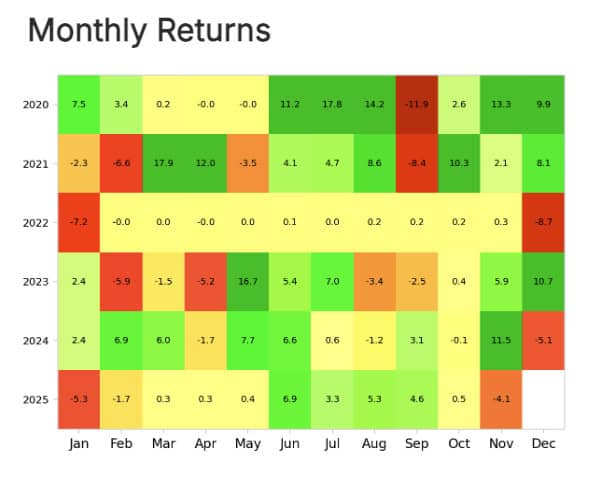
If you can, join here.
If you can’t, don’t.
P.S. If you have questions I didn’t cover here, hit reply. I’d rather answer them now than have you join and be surprised later.