William Knox D’Arcy went to Tehran in 1901 and walked out with exclusive rights to prospect for oil across 480,000 square miles of Persia (nearly three-quarters of the country) for sixty years.
In return, Iran got £20,000 in cash, £20,000 in shares, and a promise of 16% of net profits. The British controlled the accounting. By 1947, Anglo-Iranian Oil Company was booking £40 million in after-tax profit while Iran collected £7 million.
That concession, and the dozens that followed across Iraq, Kuwait, Bahrain, Qatar, and Abu Dhabi, created the architecture of the modern Middle East.
Foreign powers secured the resource before host nations understood what they had. When those nations eventually tried to renegotiate, they found the structural lock-in was already complete. When they tried to nationalize, they got coups. When they finally organized collectively through OPEC, they reshaped the global economy. The whole arc, from concession to confrontation to cartel, took about seventy years.
That arc is now happening in Africa, at an accelerated pace, with critical minerals instead of oil.
The Iran Template
The Middle Eastern concession era worked because three conditions held simultaneously.
First, the host government was desperate. They were broke, fragile, and willing to trade long-term resource wealth for short-term cash or security.
Second, the concession terms didn’t really make sense, and that was by design. The foreign companies controlled all the accounting. Profit was whatever the companies decided was profit.
Third, the external power embedded itself structurally, merging commercial interests with state power until extraction became a matter of national security rather than mere commerce.
Iran checked all three boxes.
The Shah was broke and sandwiched between British and Russian spheres of influence. By 1914, the British government had purchased a controlling stake in the oil producer, deployed military forces to guard the oil fields, and made Persian oil the fuel of the Royal Navy. But as long as Iran got their split of the profits, everything was good, right?
The pattern then replicated across the Gulf. The 1928 Red Line Agreement divided the former Ottoman Empire among a cartel of Western oil companies, with a “self-denial clause” that prevented any member from independently seeking concessions in the region. Iraq, Kuwait, and the Gulf sheikhdoms signed concessions they couldn’t meaningfully evaluate, for resources whose future value they couldn’t fathom, with companies backed by governments whose military power they couldn’t resist.
By the time these countries achieved full sovereignty, the architecture was in place.
History Doesn’t Repeat … It Rhymes
Now look at the Democratic Republic of Congo.
In 2005, China signed a $6 billion agreement with the DRC. China would fund hospitals, railways, roads, and schools. In exchange, Chinese companies would get mining concessions. By 2008, the deal was formalized through Sicomines, a joint venture giving Chinese firms a 68% stake in a massive copper-cobalt operation in Kolwezi.
The DRC got much-needed infrastructure. In return, China got a monopoly on the Congo’s critical mineral supply chain. And they did it two decades before the US entered the picture.
Why could China make such a deal? Go back to Iran in the 1900s. The DRC met all three criteria for mineral exploitation:
- The Congo was desperate, emerging from a war that killed millions with a national budget smaller than many Western cities’ budgets.
- The terms were opaque: a subsequent audit found that Chinese companies had extracted nearly $10 billion in profits while the DRC received just $822 million in infrastructure.
- Chinese companies seized ownership of 15 of the country’s 19 primary industrial copper-cobalt mining concessions, dominating not just extraction but the entire downstream chain through refining and battery production.
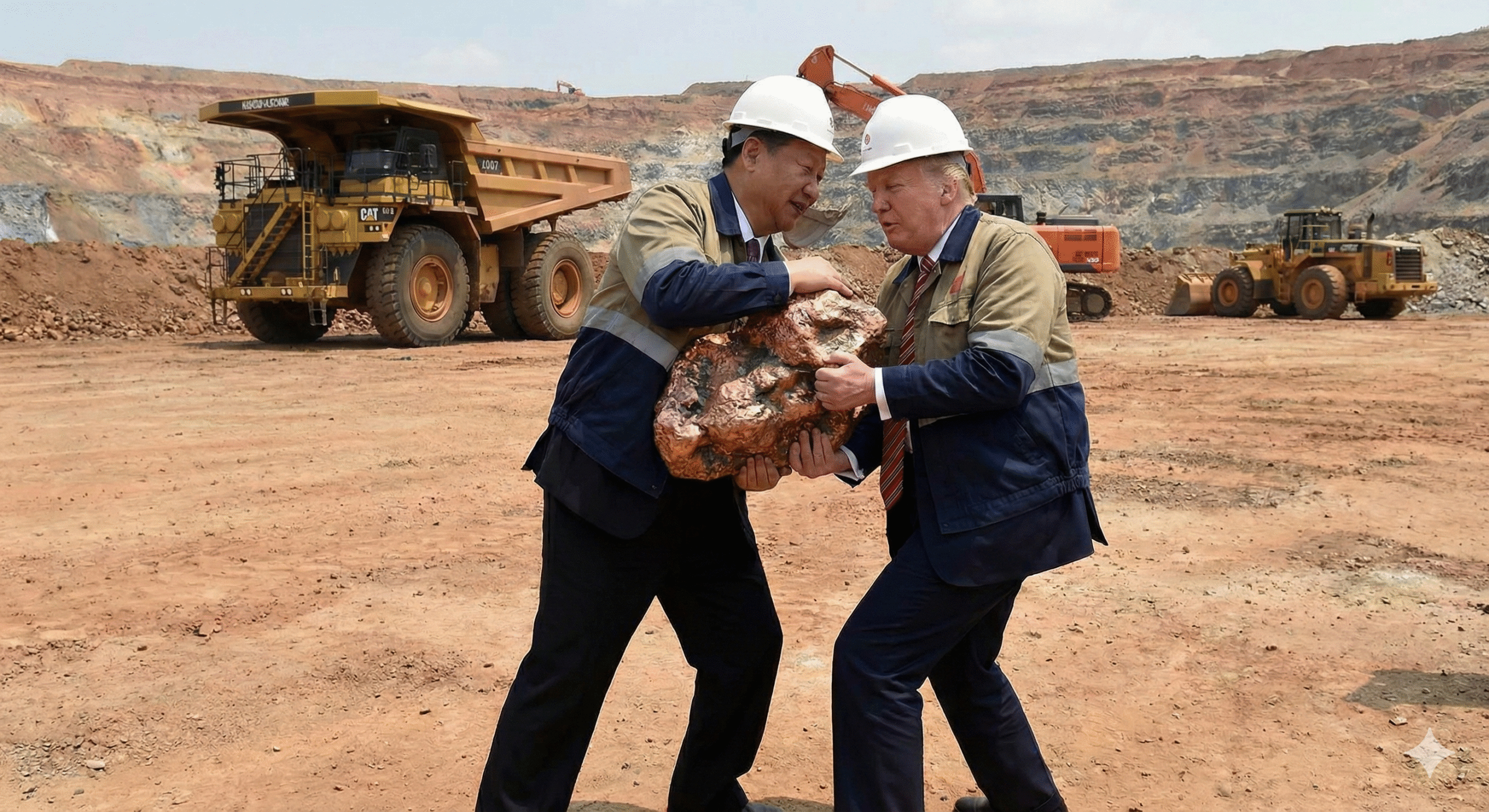
China used the infrastructure as collateral against the DRC … collateral it knew it could eventually seize. It’s the same playbook as Britain in 1910 … but instead of oil and Iran it’s copper, cobalt, and the DRC.
The Critical Difference: US vs. China
In 1910, allied countries “competed” for oil in the Middle East. Britain, France, and the US arm-wrestled for more oil, but they were all roughly on the same side. Think of it like a pack of lions killing a buffalo. Each lion fights for a piece of meat, but they all work together to kill dinner for “the pack.”
The opposite is happening in Africa with China and the US. There are two main reasons why each country wants Africa’s metals:
- So the opposing country can’t have them.
- So they can protect themselves from a potential kinetic attack from the other country.
China built a twenty-year head start through patient, state-backed investment in infrastructure. Chinese firms now control roughly 80% of the DRC’s cobalt output and 60–90% of global cobalt refining. The five largest Chinese mining companies in the country can draw on credit lines from Chinese state banks totaling $124 billion.
It wasn’t until this past year that the US did something about it’s twenty-year delay of game.
In December 2025, Washington signed a Strategic Partnership Agreement with the DRC that grants American companies a right of first offer on critical mineral deposits, gold assets, and exploration zones. In exchange, the DRC gets security cooperation against Rwanda-backed M23 rebels.

You can see the difference in how each country exploits other country’s resources. China builds new roads and schools, and the US promises to kill all the bad guys.
Infrastructure + Defense = Tier-1 Jurisdiction?
This also creates an interesting question around the investability of African jurisdictions in this new US vs. China mineral grab. On one hand, Africa becomes more unstable as China and the US fight for dwindling critical mineral supplies. On the other hand, Africa kind of becomes more stable if China builds infrastructure and the US provides defense services against rebel forces?
It’s like “the enemy of my enemy is now my Tier-1 jurisdiction requirement.”
Take Alphamin Resources (AFM) for example. Every quarter there’s a press release about rebels closing in on AFM’s mines and potential mine shutdowns due to rebel firefights. What happens to AFM’s valuation if the US sends a more permanent military presence to fend off the rebels? What’s the appropriate P/NAV multiple at that point?
Probably higher than it is now.
Could Africa Create a Minerals OPEC?
There is a version of this story where Africa follows the OPEC playbook. The DRC and Zambia have announced a joint battery council. Zimbabwe has banned raw lithium exports. There’s been talk of a mineral-producing nations’ cartel. If African states coordinate, they hold staggering leverage over production: the DRC alone controls 70% of global cobalt production.
However, that won’t happen because of China’s refining and processing position.
The DRC controls 70% of global cobalt production, but China dominates cobalt refining and processing, along with basically every other critical mineral. And that’s the main difference between the Middle Eastern OPEC and anything Africa could create.
Sticking with the Middle East OPEC example … how much leverage would the Middle East have with OPEC if another country controlled nearly 100% of oil refining and processing? Not much.
The Other Option: Just Pay Whatever Price For The Mines
The other option China and the US have is to just pay the highest price for all the DRC mines they can buy. Last week, the US bought some of Glencore’s DRC copper and cobalt assets for ~$9B implied valuation.
This is where the fun begins. Because what’s the right price to pay for DRC assets if the goal is national security against the most significant global adversary? Robert Friedland likes to say that the Chinese don’t use NPV models because they think in terms of long-term National Security.
What happens if the US does the same? How high could these bids get?
I’m not saying to shove 100% of your portfolio into African junior miners (but imagine the thrill). I am saying that the rules and potential right tail outcomes for these African assets has changed. And it’s worth following.