Broad Market Thoughts
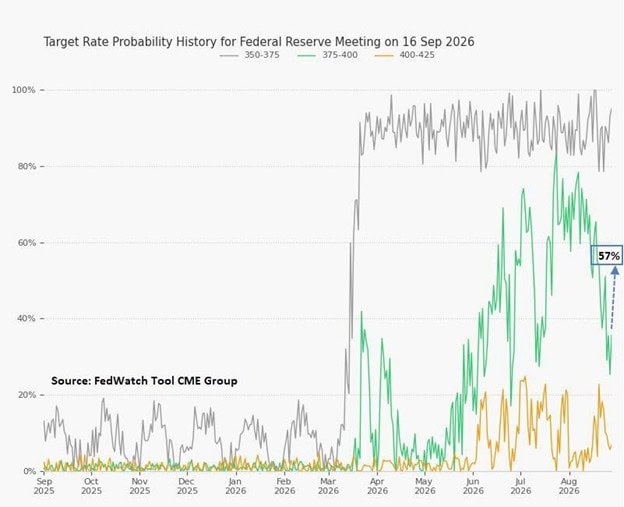
Kevin Warsh delivered his first Jackson Hole speech today, and assets like bonds, the dollar, precious metals, and equities suggested that investors interpreted his comments as hawkish. As the chart below shows, the implied probability of a rate hike at the September meeting stood at just 35% before the speech but has since jumped to 57.5%.
Whether the Fed ultimately hikes in September remains an open question. A weak employment report next week could quickly push those expectations back down, underscoring how much the outlook still depends on incoming economic data.
Regardless of what happens at the next Fed meeting, the seasonally weaker period of the year is approaching. While the broader backdrop for equities remains constructive, the combination of elevated rate uncertainty and unfavorable seasonality leaves open the possibility of a lackluster environment for the next few months.
Speaking of Kevin Warsh, investors have had little to complain about so far. Through his first three months as Fed chair, the S&P 500 has gained 4.5%, ranking third-best among new Fed chairs since 1951.

Research this week
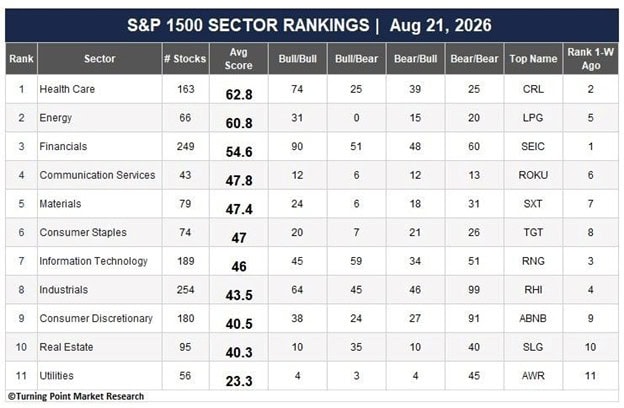
The key takeaway from Monday’s comprehensive review of S&P 1500 stocks was the continued strength of health care, which jumped to the top of the rankings. Additionally, for the second week in a row, energy posted the largest week-over-week improvement, moving from fifth to second.
Wednesday’s report highlighted an unusually persistent rally in the S&P GSCI Agriculture Index, which advanced for eight consecutive sessions. Similar streaks have been rare, and historically, they have been followed by higher prices over the subsequent four months in all but one case.
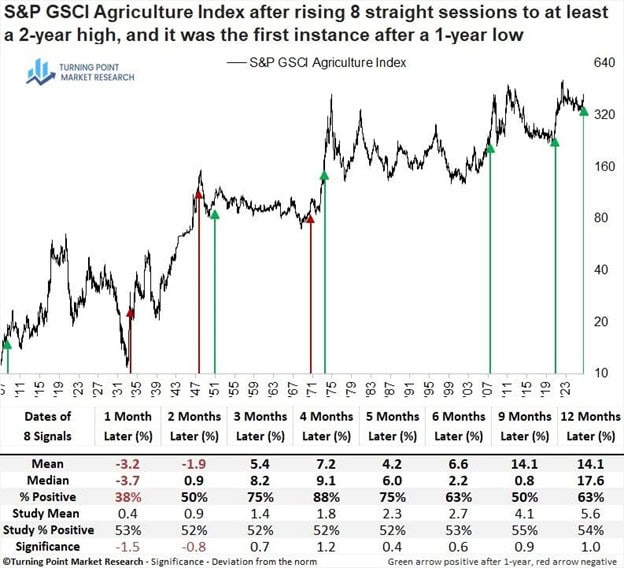
Seasonality remains supportive for agriculture. The 57-year seasonal composite for the S&P GSCI Agriculture Index typically bottoms in July and trends higher through year-end. From the August 27 close, the index has historically risen over the next 63 days 70% of the time.

Dual trend analysis
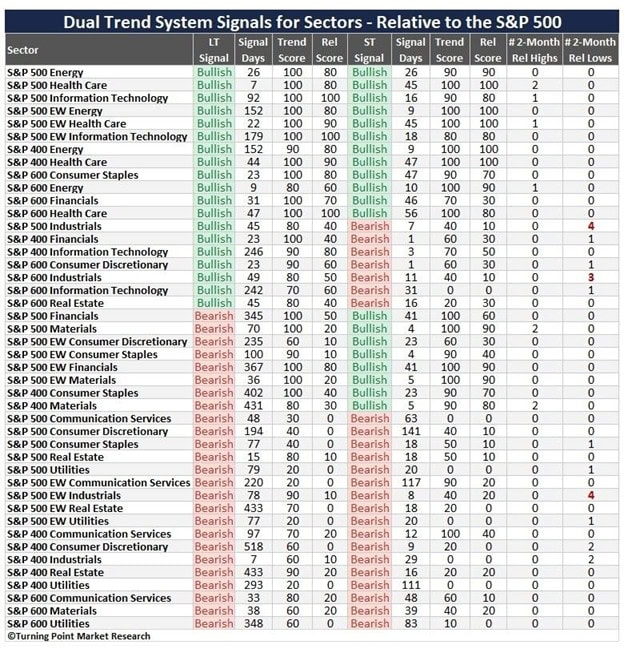
Over the past week, both industrials and financials lost a net of 14 Dual Trend buy signals, with most of the weakness coming from the short-term model. Net gains were limited across sectors, with energy leading with a modest six new signals.
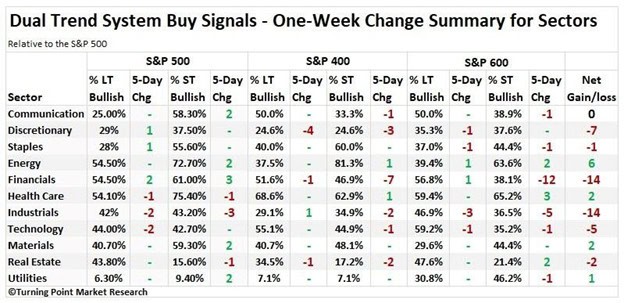
Materials strengthened over the past week, as the S&P 500, S&P 500 Equal Weight, and S&P 400 Materials sectors all shifted to a bullish short-term Dual Trend status. In contrast, Industrials lost relative strength, with several groups recording multiple two-month relative lows.
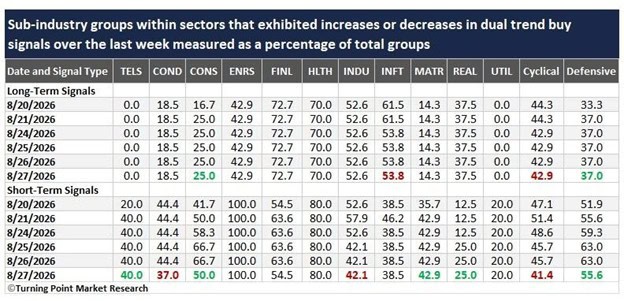
The broader weakness in cyclical stocks and sectors is also evident across sub-industry groups, with consumer discretionary and industrials losing ground and dragging down the composite cyclical measures across both short- and long-term signals.
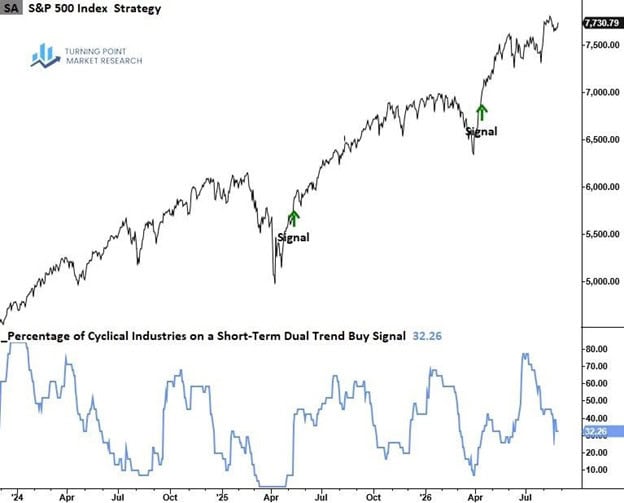
The deterioration in short-term cyclical trends has been evident for nearly two months, with the measure shown in the chart below—using a different group of sub-industries than the table above—peaking in early July. Higher crude oil prices and interest rates are likely culprits.
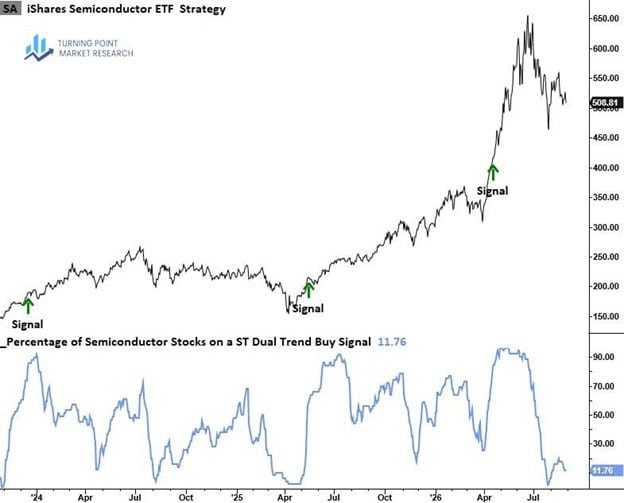
Nvidia delivered its strongest post-earnings reaction since May 2024, but the move has failed to generate follow-through today. The SOXX ETF could even close at a three-day low, erasing the entire gain from Nvidia’s earnings report. Meanwhile, the percentage of semiconductor stocks on a short-term Dual Trend buy signal offers little evidence that the group is gearing up for another major run as it ticked down this week.
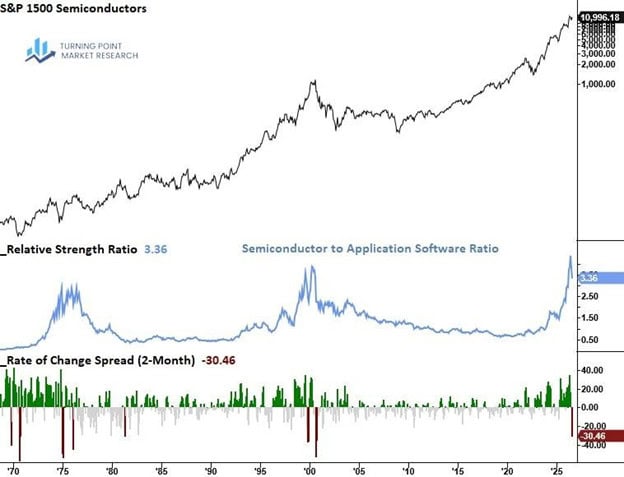
As semiconductors have come under pressure in recent months while software stocks have rallied, the two-month rate-of-change spread between semiconductors and application software has fallen more than 30%, marking its sharpest decline since the Dotcom era.
Portfolio update
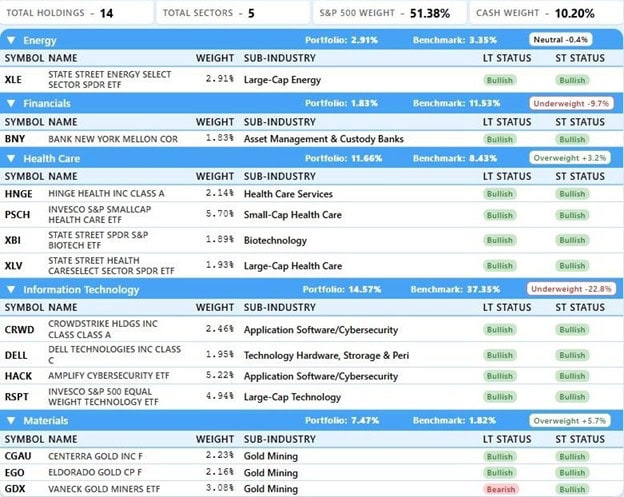
As highlighted in Monday’s report, health care moved into the top sector ranking, supporting a boost in the sector’s portfolio weighting. The position in Hinge Health was increased, while a new position was initiated in a biotech ETF. Meanwhile, Howmet Aerospace shifted to a bearish short-term status. With the aerospace and defense sub-industry also bearish on the Dual Trend model, and weakness persisting across industrials, the position was sold.
Cash currently stands at 10%, leaving the portfolio with a bullish bias.
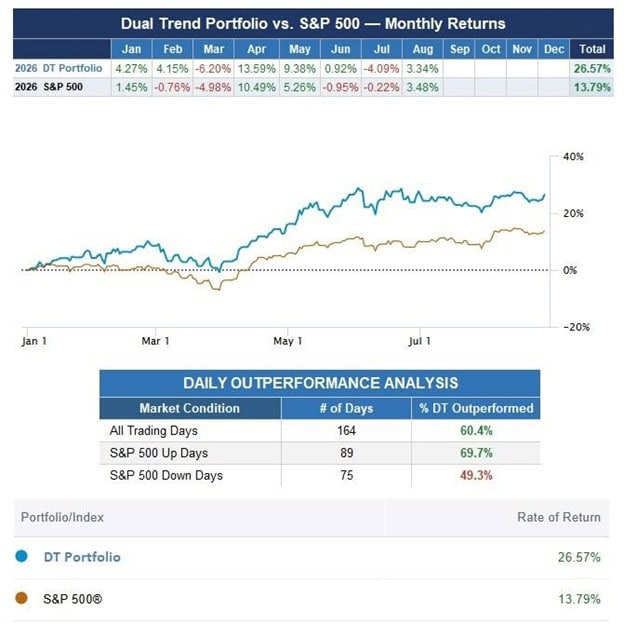
Through Thursday’s close, the Dual Trend portfolio had gained 26.57%, outperforming the S&P 500’s 13.79% return.
Final thoughts
Investors appear to be interpreting Kevin Warsh’s Jackson Hole remarks as hawkish, with the immediate market reaction being higher Treasury yields and a stronger dollar, alongside weakness in stocks and precious metals. As history has repeatedly shown, monetary policy can profoundly affect asset performance, so it’s essential to stay flexible and adjust positioning as the evidence evolves. While I remain comfortable with most of the positions in the Dual Trend portfolio, a continued rise in the odds of a September rate hike—and the potential pressure that could put on risk assets—would likely make the gold-mining positions among the first to be reduced, despite their bullish technical profiles and active thrust signal.