Broad Market Thoughts
The big news this week has been the rise in long-duration Treasury yields, particularly the 30-year yield, which reached its highest level since 2007. Elevated rates have not created a significant problem for the broad market. Still, they have impacted certain sectors and industries, particularly consumer discretionary and housing.
Another potential consequence of higher rates is unusual market breadth. On the NYSE, bond proxies and other rate-sensitive stocks have contributed to an elevated level of 52-week lows. This is worth highlighting because social media has become fixated on a technical indicator known as the Hindenburg Omen.
The Hindenburg Omen is similar in concept to the High-Low Logic indicator, which is a component of the TCTM Risk-Off Composite—both attempt to identify a split market environment in which 52-week highs and lows are elevated simultaneously, signaling an unhealthy market backdrop.
Split markets can and do occur. The concern rises when 52-week lows begin expanding across a broad and diverse group of indexes and exchanges in these environments. The table below examines 52-week lows across a wide cross-section of the market. With the notable exception of the NYSE, new lows remain subdued, suggesting the current split market does not warrant significant concern for now.
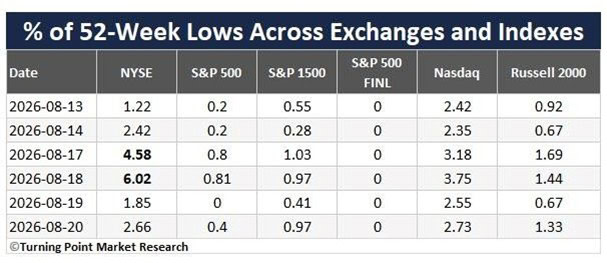
Unlike the environment leading into the Q1 2025 correction, none of the measures I follow—including the TCTM components—are currently signaling a problematic expansion in 52-week lows.
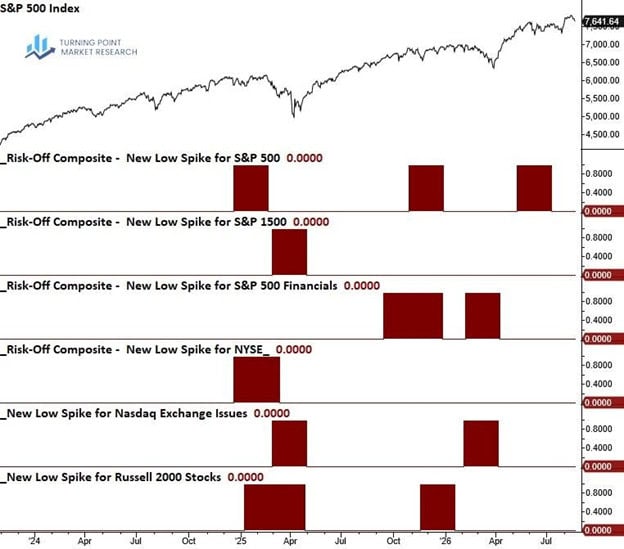
The TCTM Risk-Off Composite also fell to 0% this week, suggesting that whatever weakness exists remains relatively isolated rather than indicative of a broad market participation problem.

Research this week
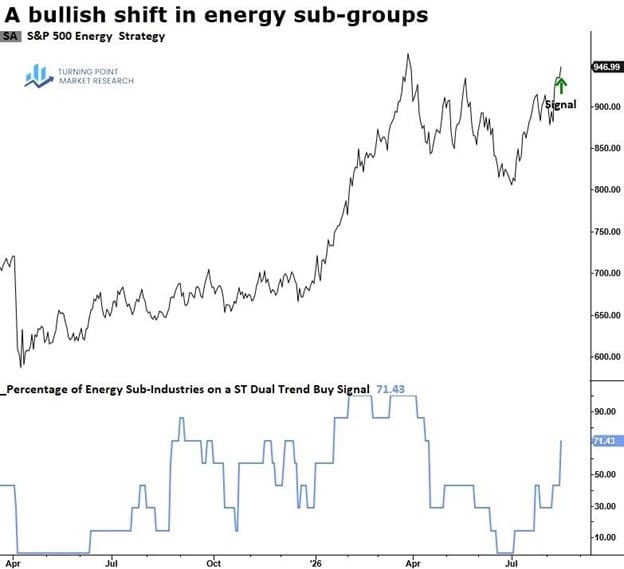
Monday’s report provided a comprehensive review of S&P 1500 stocks, with the key takeaway being the energy sector’s move from 10th to 5th in a ranking system. The improvement reflected a meaningful strengthening in both trend and relative strength conditions. At the same time, the percentage of energy sub-industries on a short-term Dual Trend buy signal surged, generating a broad sector alert suggesting the rally in energy stocks was likely to continue—and so far it has.
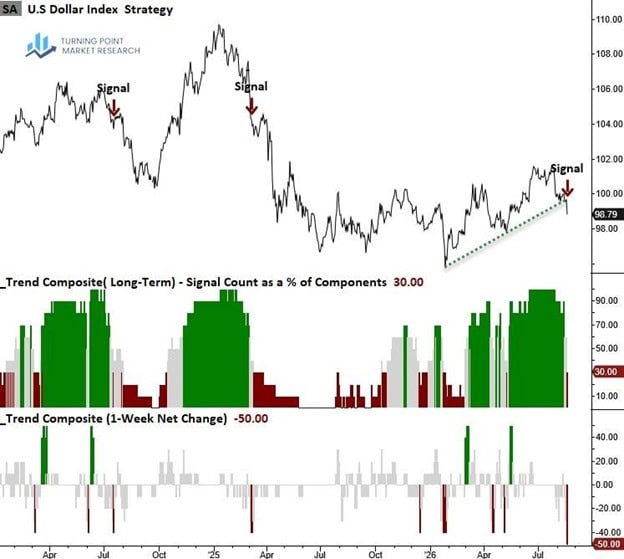
Thursday’s report pointed to a bearish trend shift in the Dollar Index, raising the odds of a new downtrend in the DXY. Among the assets analyzed, precious metals had the most bullish profile across both short- and long-term time frames.
Dual trend analysis
Over the past week, financials, industrials, and consumer discretionary experienced the largest net declines in Dual Trend buy signals. Most of the deterioration came from the short-term system and reflected weakening relative strength rather than a deterioration in trend. Energy, a sector highlighted on Monday, stood out with a notable increase of 29 new buy signals.
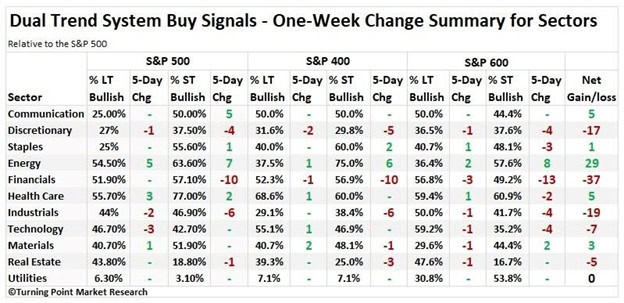
Like the bottom-up stock trends, cyclical sectors lost momentum as energy strengthened.
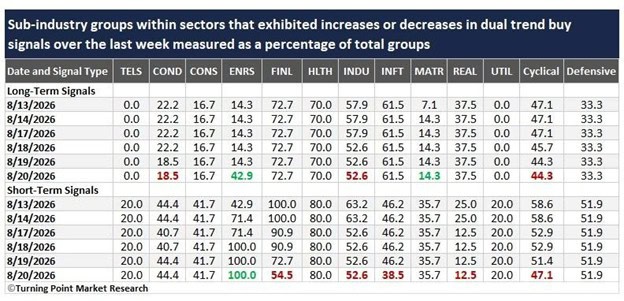
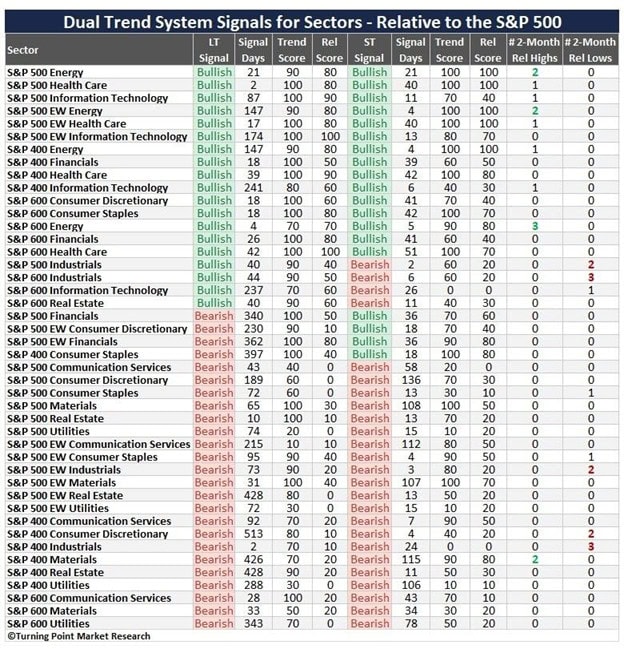
Over the past week, several industrial sectors turned bearish, while multiple energy sectors shifted to bullish.
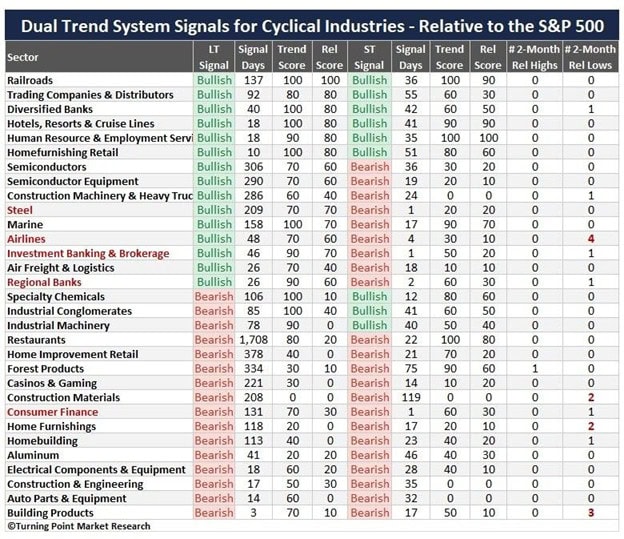
Within the cyclical sub-industry universe, financials saw several groups shift to bearish short-term signals over the last week, potentially as higher rates began to weigh on their trends. Airlines, recently among the stronger groups, also moved into a bearish condition, likely reflecting higher oil prices.
Update on Semiconductors/AI trade
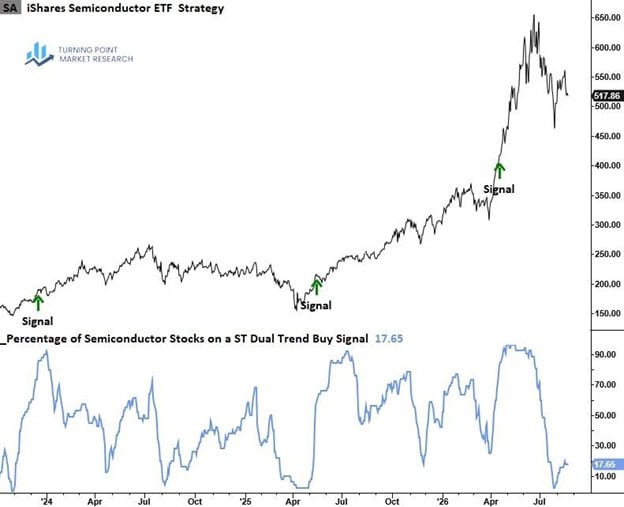
As discussed in previous reports, until a significant number of semiconductor stocks shift to a bullish short-term Dual Trend condition and trigger a broad group buy signal, similar to the recent signals in gold miners and energy, it is difficult to get excited about semiconductors or the broader AI trade. For now, patience is warranted.
Portfolio update
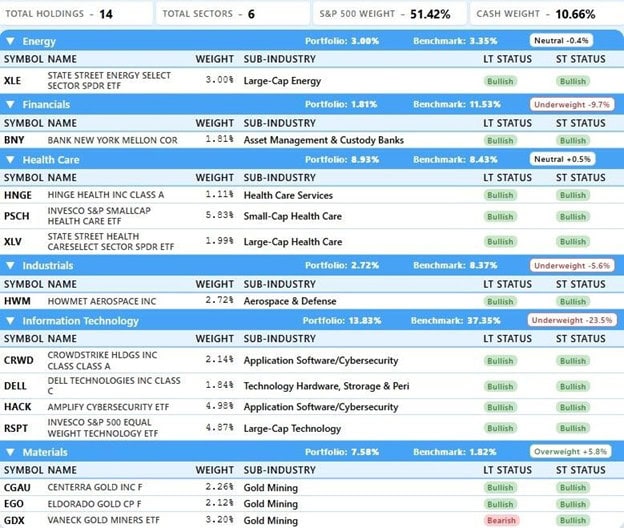
The DT Portfolio continued to favor areas showing improving technical strength this week, initiating positions in Eldorado Gold, S&P 500 Energy, Gold Miners, and S&P 500 Health Care. Meanwhile, the portfolio exited positions in Morgan Stanley, Materion Corp., and Teradyne.
Cash rose to 10% from 5% the previous week, reflecting a modest reduction in exposure but not a shift away from the portfolio’s overall bullish bias.
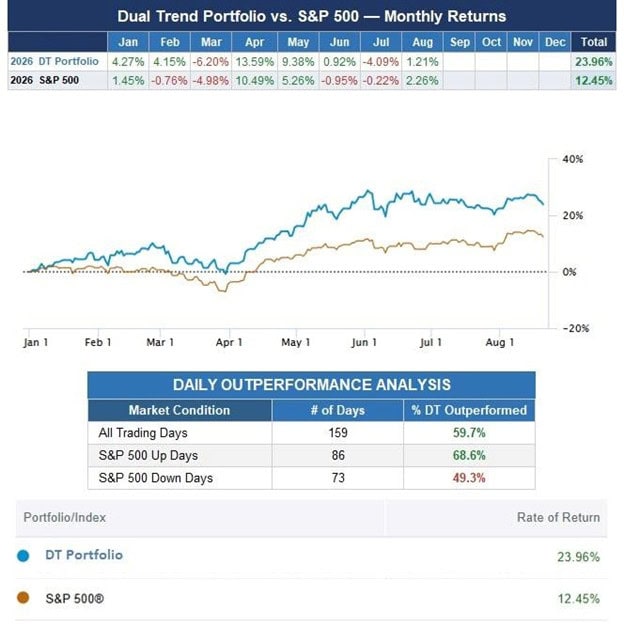
Through Thursday’s close, our Dual Trend portfolio had gained 23.96%, outperforming the S&P 500’s 12.45% return.
Final Thoughts
From my perspective, the overall market backdrop still looks pretty good. Yes, elevated long-duration yields are starting to create some problems, but those problems are still concentrated in specific areas rather than spreading across the broader market. The 0% reading in the TCTM Risk-Off Composite supports that view, as there is currently no sign of the broad deterioration in market breadth that would suggest rates are becoming a major problem for equities as a whole. The bigger question is how much upside remains in the S&P 500. With leadership continuing to rotate between sectors and industries, and a seasonally weaker period of the year approaching, I would be hesitant to expect the market to accelerate higher from here. A constructive backdrop can coexist with a choppier market, and that is the more likely setup.