Key points:
- A trend-following composite for the Dollar Index fell sharply
- Similar trend shifts produced a consistent downward bias in the DXY
- Precious metals were a standout performer among several asset classes
A weak-dollar regime now looks increasingly likely
On Wednesday, Treasury unveiled plans to double its liquidity buyback operation, a move that came at a timely moment. The announcement came as the 30-year Treasury yield touched its highest level since 2007, providing a catalyst for a reversal in rates.
The reaction extended beyond Treasuries, with the Dollar Index (DXY) declining sharply in a move reminiscent of the selloff that followed the recent yen intervention involving the U.S. and Japan. Taken together, these two events have contributed to renewed dollar weakness, pushing a trend-following composite down 50% over five sessions and increasing the odds that the dollar is transitioning into a downtrend.
Dollar weakness can have broad implications across asset classes, particularly for precious metals and mining equities, which surged on Wednesday.
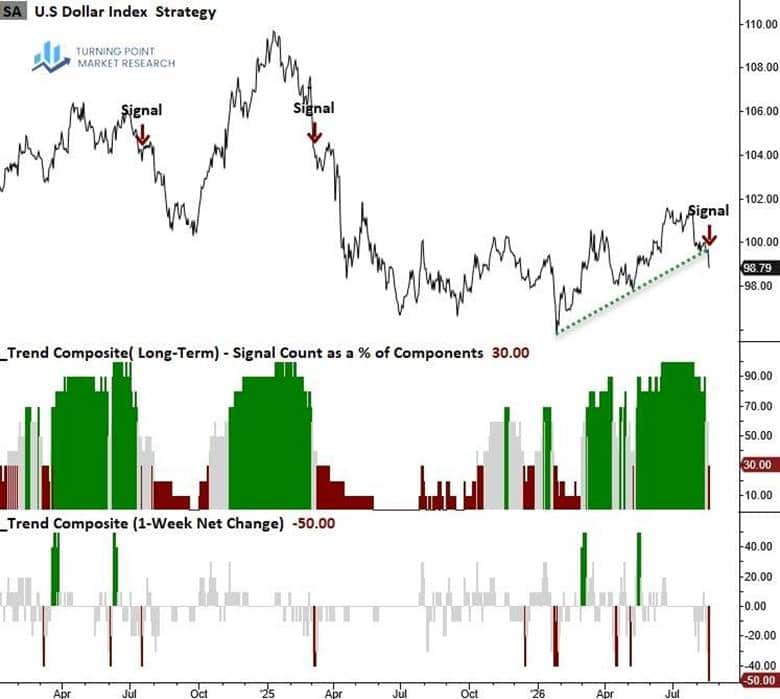
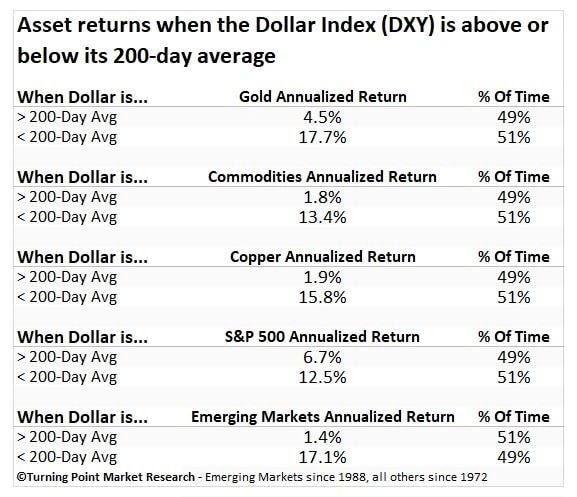
One component of the trend composite is the 200-day moving average, which the DXY crossed below on Wednesday. As the table below illustrates, commodities—and gold in particular—have historically performed well when the dollar trades below its long-term average.
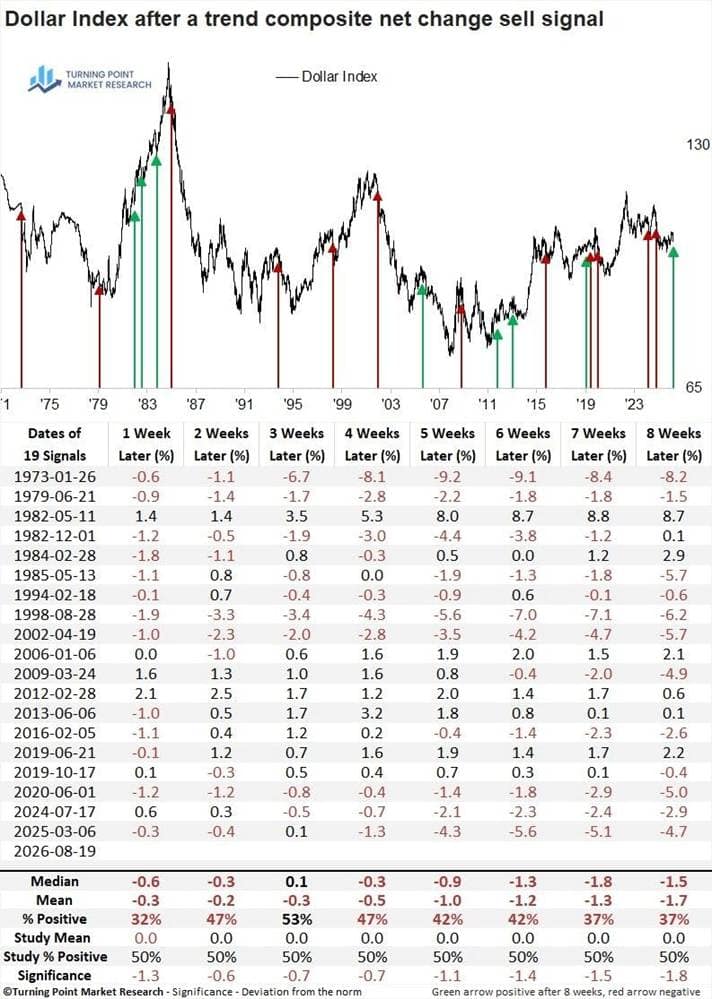
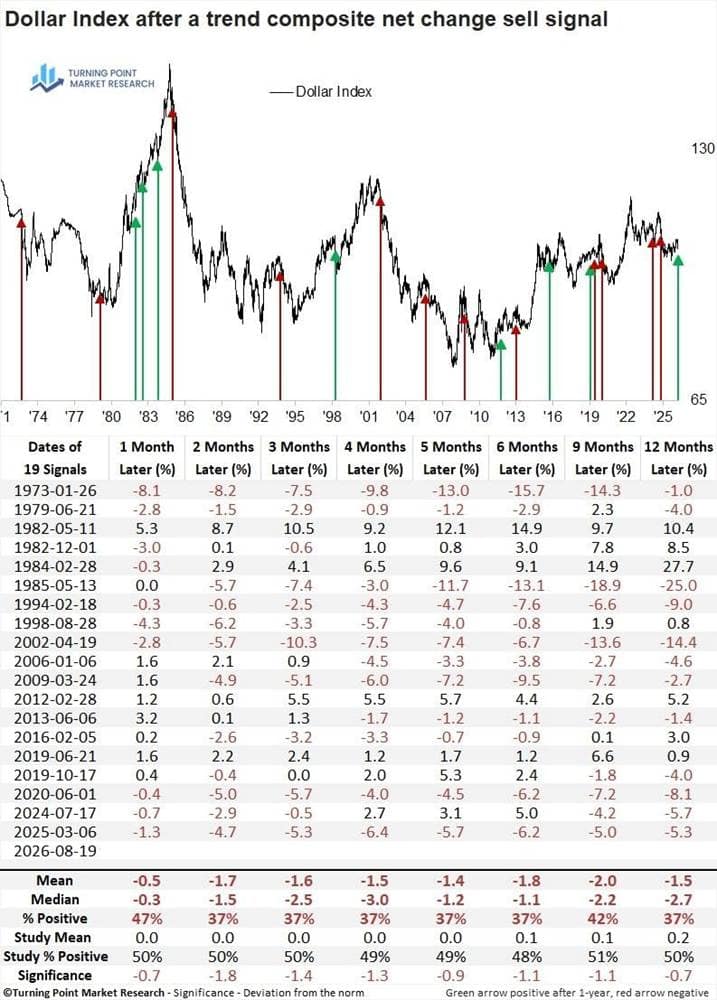
A 50% decline in the DXY trend composite over five sessions has occurred only 11 other times since 1973. Given the limited sample size, the analysis below focuses on signals in which the composite declined 40% or more over five sessions following a reset to 100%, capturing a transition from bullish to bearish conditions.
While none of the forward time horizons reached statistical significance, several came close, and the results point to a consistent downward bias in the dollar over the subsequent eight weeks.
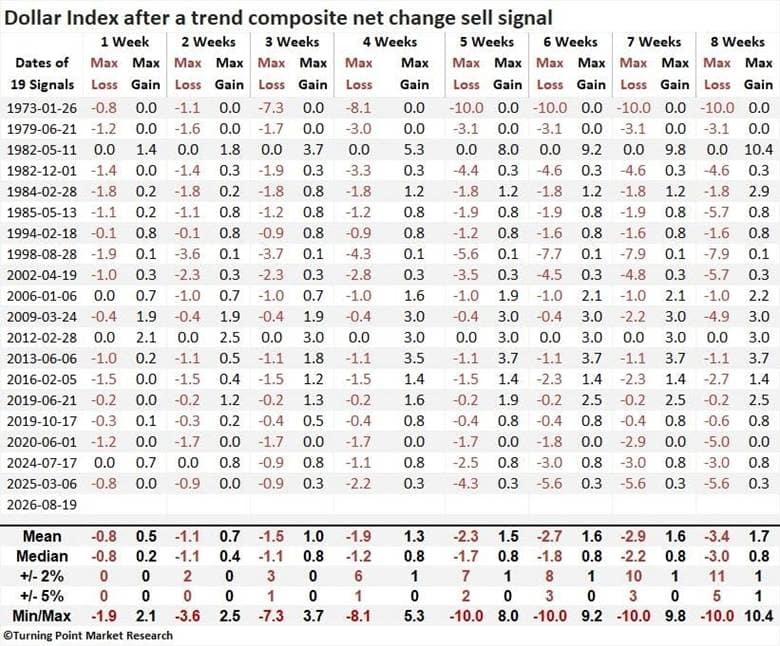
Over the next few months, the dollar posted a maximum loss of at least 2% on 11 occasions, compared with just one instance of a maximum gain of the same magnitude, suggesting an unfavorable risk/reward profile.
Across longer time horizons, the Dollar Index also maintained a consistent downward trajectory.
U.S. stock indexes were somewhat mixed across the one- to seven-week horizons but turned positive by the eight-week mark. Interestingly, emerging markets—which typically benefit from a weaker dollar—displayed weak results. Precious metals delivered the standout performance across asset classes, posting positive returns across every time horizon.
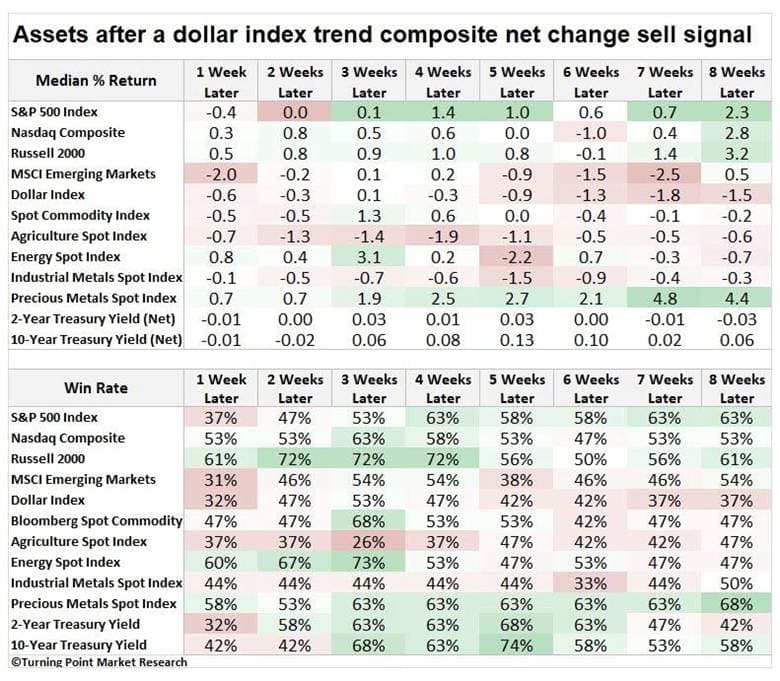
Over longer time horizons, the impact of a weak-dollar regime becomes even more apparent, with stock indexes exhibiting strong returns and win rates. This historical tendency also extends to commodities and precious metals.

A surge and bullish trend alignment for gold miners
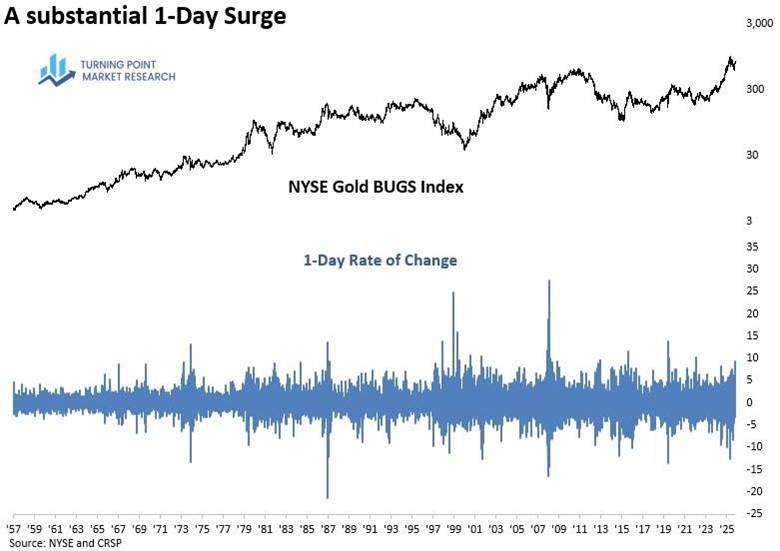
The NYSE Gold BUGS Index surged 9.33% on Wednesday, its largest advance since November 2022 and the 32nd-largest daily gain in the past 70 years. While large one-day gains like this have often led to further upside over the next few weeks, a pause typically developed thereafter.
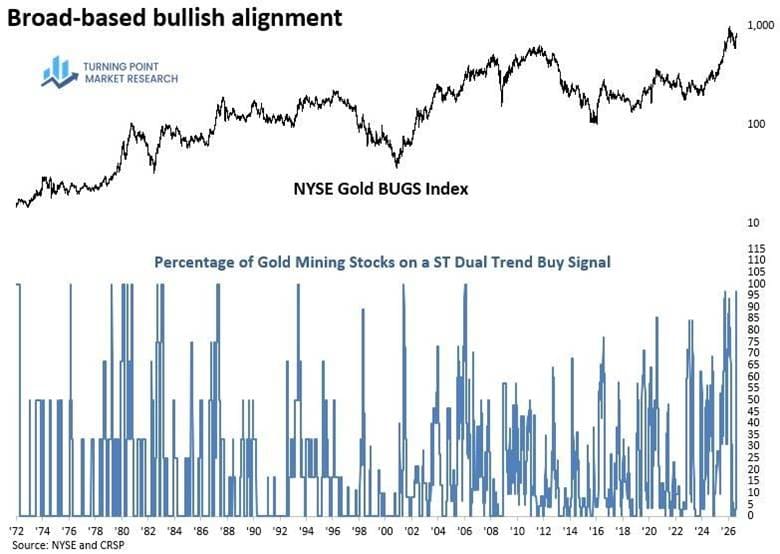
The surge in gold mining stocks pushed the percentage of stocks on a short-term Dual Trend buy signal to 96%. The lone stock not aligned with the bullish signal has since been removed from one of the gold mining ETFs used to construct this universe. Excluding that stock would bring the breadth indicator to 100%, a level last reached in January 2006. Readings of 100% have all been associated with uptrends.
If you recall, a recent report on gold miners highlighted the shift from below 10% to above 50%, a signal that has historically produced a 100% win rate five months later. This favorable outcome looks increasingly likely following Wednesday’s session.
What the research tells us…
Although policy-driven markets are not ideal, and the Treasury’s liquidity buyback operation is unlikely to have much impact on yields, it is difficult to bet against former hedge fund manager Scott Bessent in the near term. If the dollar continues to weaken, precious metals appear to offer the clearest opportunity, particularly now that their trend has shifted from bearish to bullish.
The dollar has weakened significantly over the last month, so much so that a long-term trend-following composite fell sharply over the past week. Historically, similar trend shifts have marked the start of a downtrend in the dollar, with important implications for other asset classes, including stocks, commodities, and precious metals. Stocks have been somewhat mixed over the near term following similar periods of dollar weakness, but the longer-term results have been much more favorable. On the other hand, precious metals have tended to rally consistently across short- and long-term horizons.