Broad Market Thoughts
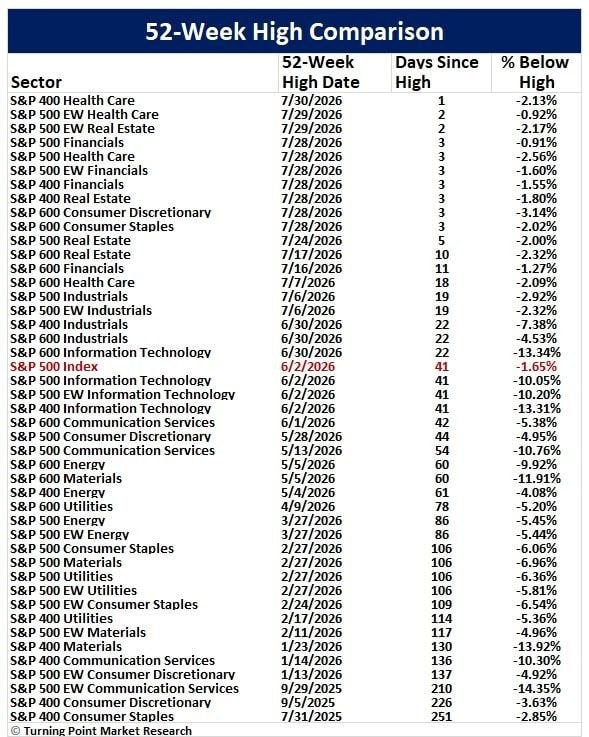
Despite significant volatility beneath the surface—particularly among individual technology stocks—the broader market remains relatively quiet. The S&P 500 continues to trade within a multi-month consolidation and sits only 1.65% below its record high, as seen in the table below. As we have discussed extensively, the index has remained resilient because sector rotation continues to offset weakness in former leadership groups.
This rotational environment has made the market increasingly difficult to navigate. Leadership changes frequently, and strength in one group is often accompanied by weakness elsewhere, limiting broad upside participation and reducing the potential for sustained follow-through. With the market near record highs but lacking broad-based momentum, we remain comfortable exercising patience and allowing the tape to provide additional evidence before becoming more aggressive. Perhaps the seasonally weaker August–September period will create that opportunity.
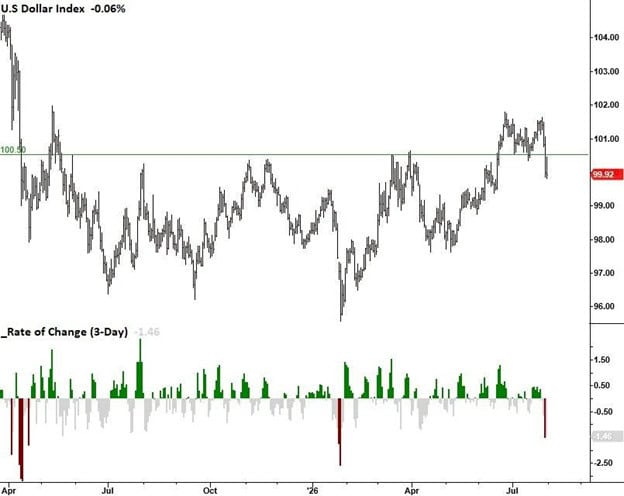
The Dollar Index (DXY) declined sharply following this week’s Fed meeting, yet gold has barely changed—a lackluster response that offers little encouragement to those looking for a bottom.
Research this week
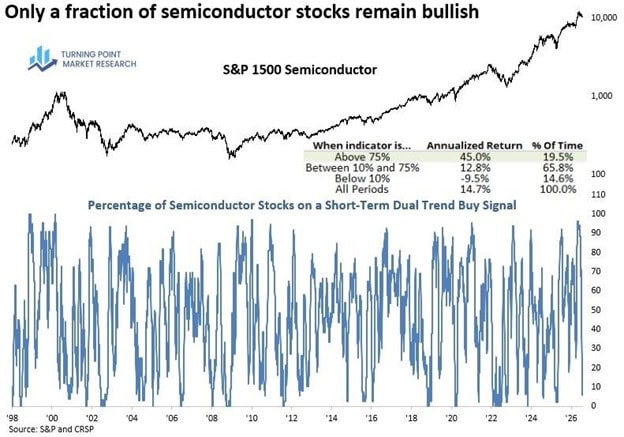
Tuesday’s report provided a comprehensive analysis of the semiconductor space. We highlighted the group’s significant deterioration on a shorter-term basis and noted that, despite becoming oversold, history suggested this was typically not an ideal environment to buy the dip. Moreover, given the group’s record relative gains over multiple long-term timeframes, an extended period of leadership fatigue remains a meaningful risk.
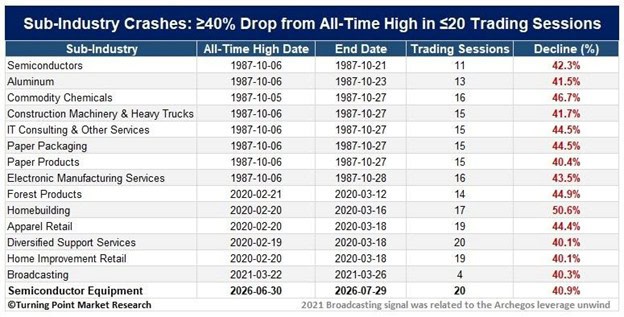
Thursday’s conference call provided additional evidence that the semiconductor complex may be approaching a washout scenario. We highlighted that the semiconductor equipment group had declined more than 40% in just 20 trading sessions from an all-time high. This extremely rare occurrence has only happened 14 other times in more than 65 years across 100+ sub-industry groups. We later learned that a highly leveraged AI-focused hedge fund contributed to the recent selling pressure as it was forced to unwind positions, adding a forced liquidation component to the decline, similar to the ViacomCBS plunge in 2021, which involved another highly leveraged fund.
Additional perspective on semiconductors
On Thursday, the AI complex rallied sharply as relief that forced selling from a leveraged hedge fund had largely run its course. On the day, 75% of semiconductor stocks gained at least 5%, breaking the group’s downside momentum.
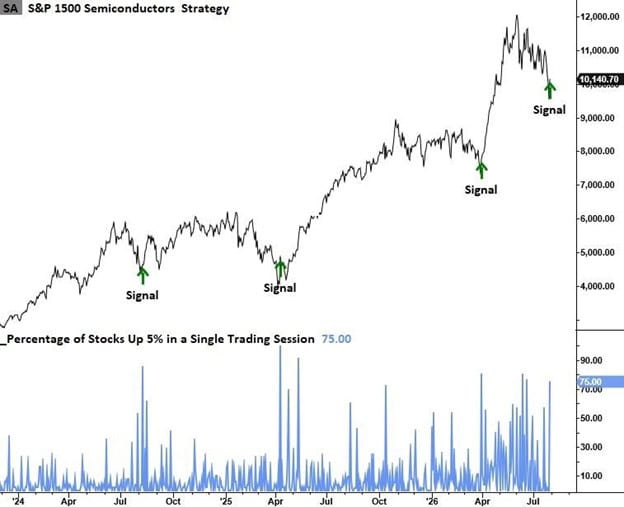
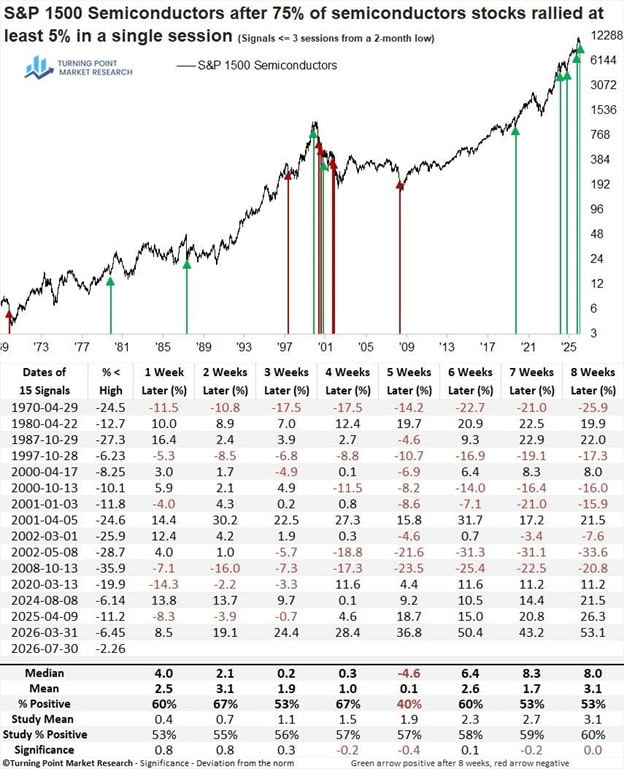
Assessing these one-day thrust signals when the semiconductor sub-industry group was within three trading days of a two-month low identified 15 prior instances, most of which occurred during the 2000–02 bear market. Overall, these signals did not produce an especially bullish outlook, although the four most recent cases generated very positive returns. Importantly, the latest signal occurred with the S&P 500 just 2.26% below its record high—the shallowest drawdown of any instance. Consequently, this signal emerged against the backdrop of a broad market that is not oversold.
Bottom line on Semis: I will let the Dual Trend System guide my actions and remain patient until the signals warrant a change.
Dual trend analysis
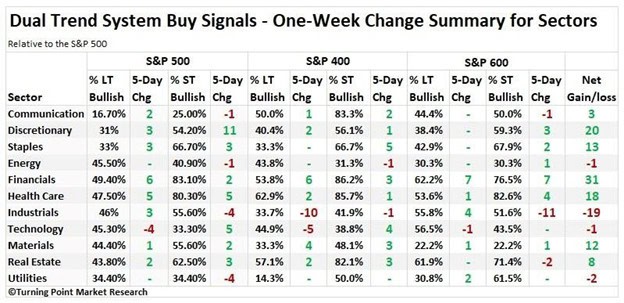
The biggest improvement in stock trends over the last week came from financials, which led all sectors with a net gain of 31 Dual Trend buy signals. Consumer discretionary also saw nice improvement, adding 20 signals, while healthcare gained 18. Industrials moved in the opposite direction, registering the largest decline with a net loss of 19 Dual Trend buy signals. Much of the weakness was concentrated in mid- and small-cap industrial indexes.
Bottom Line: Trend conditions continue to improve across numerous non-growth groups, highlighting expanding market participation and reinforcing the view that recent weakness reflects rotation—not systemic risk.
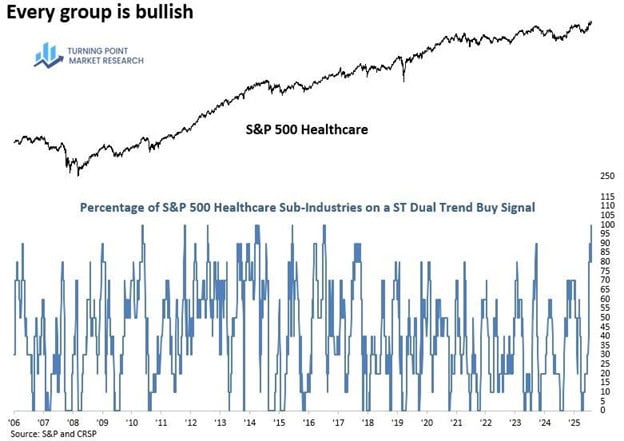
Consumer discretionary, consumer staples, and health care experienced broad improvement across both short- and long-term dual trend buy signals. Health care stood out, with the percentage of sub-industry groups on short-term buy signals rising to 100%. Meanwhile, technology’s long-term signal breadth declined, although its short-term signals held steady.
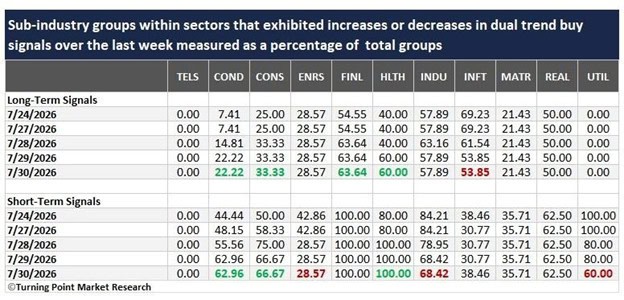
Every healthcare sub-industry group is now on a bullish short-term Dual Trend signal—the first time this has occurred since 2017. Could this broad-based strength signal a meaningful change in character for the sector?
Portfolio update
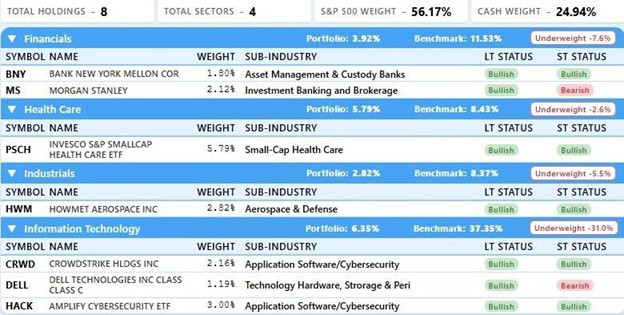
Portfolio activity was heavier than usual this week as we further reduced exposure to our AI-related positions, which maintained bearish short-term Dual Trend conditions.
On Monday, we sold our remaining allocation to the iShares Semiconductor ETF (SOXX) and used a portion of the proceeds to increase our weighting in the S&P SmallCap 600 Healthcare ETF (PSCH). On Tuesday, we fully exited Quanta Services (PWR), further trimmed Dell Technologies, and sold the remaining balance of our Comfort Systems (FIX) position. On Wednesday, we exited our entire position in Caterpillar (CAT). On Thursday, we again increased our allocation to PSCH.
The portfolio’s higher cash allocation and more concentrated number of holdings reflect our cautious view of the current market environment. As conditions improve, we anticipate putting more cash to work and broadening our exposure.
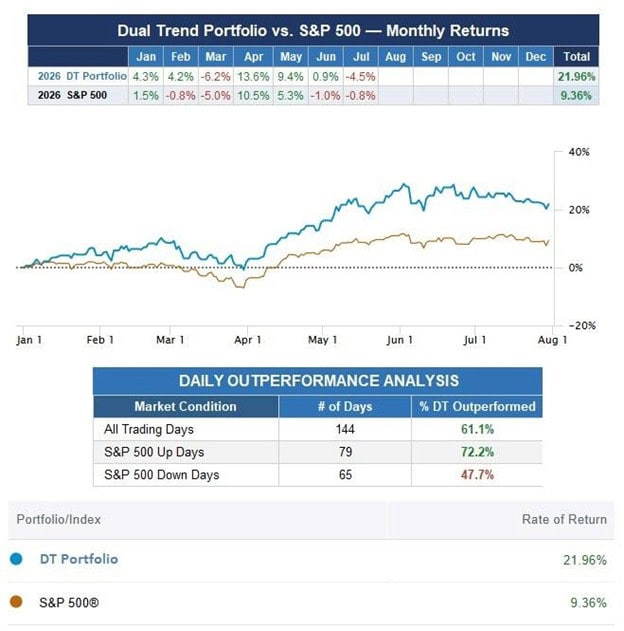
Through Thursday’s close, our Dual Trend portfolio had gained 21.96%, outperforming the S&P 500’s 9.36% return.
Final Thoughts
While our indicators remain constructive, some modest deterioration has emerged, particularly within the short-term Risk-On/Off system. Given the S&P 500’s ongoing consolidation and uncertainty surrounding renewed tensions with Iran, Federal Reserve policy, and the sustainability of AI-related capital spending following a period of record-setting performance for these stocks, we believe a somewhat more cautious posture is warranted and that a more attractive opportunity to deploy capital lies ahead—one that could offer a more favorable risk/reward setup ahead of a potential year-end rally. For now, patience is advised.