This week, I interviewed “Mr. Biotech PM”, a biotech/healthcare-focused manager at a generalist family office. We spent over an hour exploring Mr. Biotech’s idea-generation process, management-vetting techniques, position-sizing approach, valuation, and the corners of the biotech industry that offer the most exciting investment opportunities.
I can’t think of a better follow-up to my Peter Mantas Podcast Notes. I’m having a blast diving into a space I know so little about. It reminds me of a few years ago when I first started learning about metals and mining. All of that jargon – true width, specific gravity, bulk density – now sounds like my native tongue.
I know I’ll get there with biotech … eventually. Because man, the rewards are well worth it.
Before we dive in, I want to highlight the Five Big Ideas from my conversation with Mr. Biotech:
- Biotech wins are made at the intersection of validated mechanism, dislocated market cap, and a near‑term catalyst calendar.
- Management vetting is the single highest‑leverage activity in the space — relationships, not screens, generate edge.
- Oncology (specifically PI3K/mTOR and KRAS), select gene therapies, cell therapy, and value‑based care are the four most attractive sub‑themes.
- Build the portfolio as a barbell — ETF base layer (XBI, ARKG) under five to ten asymmetric single‑name bets.
- AI is a research force multiplier for competitive landscape mapping, but it cannot replace specialist judgment about what is real versus vaporware.
Excited yet? Let’s get after it.
The Operating Philosophy
The Biotech PM frames the entire job in one phrase: find asymmetric risk/reward in a structurally levered and risky space, then refuse to swing at every binary.
Phase‑three data readouts are not the only place edge is created — in fact, the PM argues, that is the worst place to look for it. By the time the market is laser‑focused on a single binary card‑turnover, the asymmetry has already been priced.
Four non‑negotiables
- Asymmetric setup. Multiple ways to win, limited ways to permanently lose capital. The PM is explicit: “you’re going to be right sometimes, you’re going to be wrong sometimes — you don’t need to swing at every phase‑three card turn.”
- Avoid near‑term binary risk. Prefer companies with clinical validation already in hand — either their own mid‑stage data or a competitor‑proven mechanism — so the next catalyst is a step‑up, not a coin‑flip.
- Deep management relationships. “There’s a lot of bullshitters” in biotech, just as in mining. The PM has cultivated direct‑to‑CEO relationships over the years across hundreds of mid‑cap and small‑cap biotech companies. Trust is not a soft factor — it is diligence.
- Balance sheet and capital discipline. Cash runway through the next two or three catalysts is the floor, not the ceiling. Companies that need to raise into a weak tape get punished. Management that turns down capital when they have open‑label data is the strongest possible internal signal.
Where Mr. PM is looking for asymmetry
Mr. PM is not searching for unknown chemistry. Betting on novel chemical entities solving problems whose biology may or may not be addressable is, in their words, “an almost impossible game for the smartest people on Earth.” Instead, the search is for better mousetraps: drugs that act on a mechanism already clinically validated by a competitor, in a company whose market cap has not yet caught up to that validation.
“You need validation. Betting on new chemical entities to solve problems that may or may not exist, that their mechanism may or may not address — that is incredibly risky no matter how smart you are.”
The biotech / natural‑resource analogy
The mapping is intuitive once you draw it out: phase 1 is the discovery hole, phase 2 is the pre‑feasibility study, phase 3 is the feasibility study, commercialization is production, and the “picks and shovels” are the tools, sequencing, and bioreactor businesses that supply everyone.
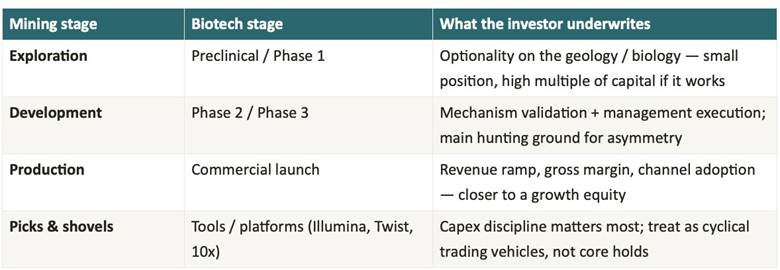
Mr. Biotech and Brandon converge on a portfolio that is overwhelmingly weighted to the development stage — where validation already exists, and dislocation is largest — with starter exposure to commercial‑stage themes via ETFs.
Mr. Biotech’s Research Process
Mr. Biotech PM runs a process that most generalists structurally cannot replicate, and it begins with raw access. They meet with five to twelve publicly traded biotech companies every week. That meeting calendar is the top of the funnel. Everything downstream — sentiment work, technicals, competitive landscape mapping — is in service of either preparing for those meetings or pressure‑testing what was learned in them.
The trifecta: fundamentals, technicals, sentiment
The PM and Brandon converge on the same framework that Macro Ops uses across natural resources: fundamentals, technicals, and sentiment must all line up. None alone is enough.
In biotech specifically, that triangulation looks like this:
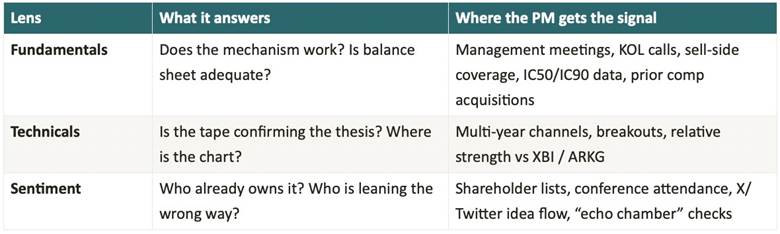
Idea generation, in priority order
- The meeting calendar. Five to twelve management meetings per week. Idea flow comes from the prep work — “who else is treating this cancer, who else is in this pathway” — and from chasing references in the meeting itself.
- Sell‑side coverage. Better than retail assumes. The PM specifically calls out that healthcare sell‑side coverage is one of the few segments where the research product is still useful.
- Specialist X / Twitter. Useful for surfacing the next layer of accounts to follow, with a strong warning about echo‑chamber risk. The PM treats X as a leading indicator of consensus, not as a source of edge.
- Charts. A bombed‑out multi‑year base that is starting to break out is, by itself, enough to put a name into the meeting queue.
Management vetting — the highest‑leverage activity
“Trust is a huge thing.” The PM’s strongest moat is a cultivated, multi‑year relationship network with biotech CEOs and CFOs built during their prior buy‑side seat. The same pattern Brandon describes from mining holds: the best ideas tend to be the CEOs you know personally and respect.
“We try to only get engaged in companies where we really have comfort with management. Particularly in biotech — because, just like the mining space, there are a lot of bullshitters.”
A bullish internal signal: management turning down capital
One of the strongest pieces of intra‑process intel the PM uses is unusual but powerful: a small‑cap biotech sitting on open‑label data — meaning management can see how the data is trending — and actively turning down ATM raises and lead orders.
When the CEO of a sub‑$200M company says, “I have no need to sell stock at $14,” that is the closest thing to insider buying that the public markets give you in clinical‑stage biotech.
The Sub‑Thematic Map
The PM’s mental model of biotech is not “drug companies.” It is a constantly moving map of sub‑themes, each with its own competitive landscape, regulatory tailwinds and headwinds, and capital cycle. A generalist asking “is biotech investable?” is asking the wrong question. The right question is which two or three sub‑themes are currently mispriced, and what is the cleanest small‑cap expression of each.
Mr. Biotech’s Favorite Thematics
Oncology — PI3K/mTOR and KRAS
Oncology is the dominant pocket of innovation right now and the PM’s largest sleeve. Within oncology, two targets stand out: PI3K/mTOR and KRAS. Both were considered untouchable for decades and both have produced multi‑bagger winners in the current cycle.
- PI3K/mTOR. Historically validated as a cancer pathway but historically toxic — older drugs “drop a nuke” on a single PI3K target, hammering the alpha node and accepting brutal side effects to chase a downstream effect. A new generation of pan‑PI3K + mTOR inhibitors hits all four PI3K “lanes” plus both mTOR escape routes simultaneously, delivering best‑in‑class efficacy and best‑in‑class safety. One pioneer in this category went from a ~$300M market cap to roughly $4.5B as the data printed.
- KRAS. The other oncology darling. Revolution Medicines is the “poster boy.” The PM also calls out additional KRAS readouts and a flagship PI3K/mTOR dual inhibitor as the most important oncology data prints of the calendar year.
Cell therapy — true platform plays
Cell therapy is the PM’s preferred way to own a real biotech platform. Unlike many tool‑maker “platforms” that never produced their own drug, leading cell‑therapy platforms have a self‑replicating pluripotent stem cell line, in‑house manufacturing, and the practical know‑how to differentiate those cells into retinal, spinal, and other targeted tissues at scale.
The PM’s view: when society knows how to make a particular cell type, a true platform can make it at scale, and the lead asset already has multi‑year durability data.
Value‑based care — the healthcare flywheel
Strictly speaking, this is not biotech — it is a services / value‑based care (VBC) model. The PM is explicit that this slice is core: a value‑based oncology services chain with “MLRs 15 points better than peers,” strong economics on each new clinic, a defensible model, and a credible path to cash flow break‑even and roughly $1B in revenue over two to three years.
The PM treats this as a three‑plus‑year hold and avoids “getting cute” around it. Adjacent VBC names worth tracking but not owning: Agilon, Astrana, Evolent, Brightspring, Alignment Healthcare, Privia, and Clover.
Gene therapy — selectively bullish
Gene therapy “has caught a bid,” but the PM is careful. A lot of it will never be used commercially, even if approved, because oral pills already control the disease. The investable cases require three things to be aligned: the right target, the right rare disease, and a competitive landscape that will still be empty in ten years.
Psychedelics — riding the regulatory wave
Psychedelics “have caught a major bid,” largely because the political backdrop now reads as favorable. A name in the space had a fresh positive readout on the day of the conversation. The PM treats psychedelics as an opportunistic sleeve — a real theme, but more cyclical and more headline‑driven than oncology.
Where Mr. Biotech is More Cautious
- Tools / “tech‑bio” platforms. Sequencers, synthetic DNA, single‑cell platforms — Illumina, Twist, 10x Genomics. The PM characterizes these as trading vehicles rather than core holdings. They were going to be “the hyperscalers of biotech” during COVID and largely have not delivered against that promise. Their capex is heavy, their cycles are violent, and they only become investable when management gets spending under control.
- Rare disease drug companies. In and out of favor depending on what the agency is signaling. Not a permanent allocation.
- Late‑stage data card‑turners. The PM will own them only when the underlying mechanism is already validated elsewhere — never as a pure binary.
Three Illustrative Case Studies
Across the conversation, the PM walks through three concrete positions that illustrate the playbook in action — Kazia Therapeutics (KZIA), Lineage Cell Therapeutics (LCTX), and The Oncology Institute (TOI). Names are preserved here as case studies in process — not as endorsements or recommendations. Any reader should do independent work before acting on any of them.
Case 1 — Kazia Therapeutics (KZIA): an oncology “better mousetrap”
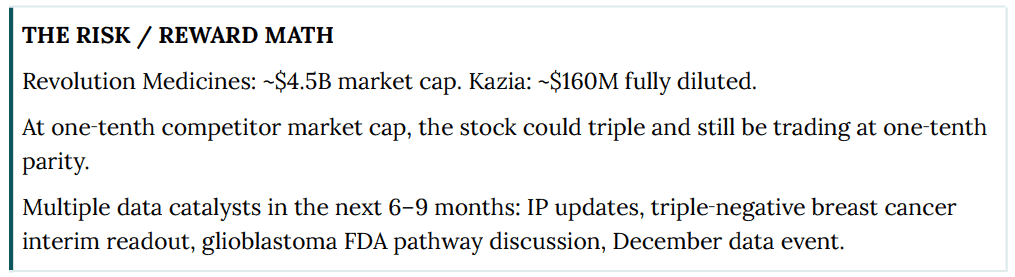
Kazia Therapeutics (KZIA) is the PM’s highest‑conviction single name. A sub‑$200M market cap oncology company developing a pan‑PI3K/mTOR inhibitor — the same mechanism that Revolution Medicines has already taken from a $300M market cap to roughly $4.5B by proving best‑in‑class efficacy and safety. Kazia’s drug hits the same four PI3K lanes and both mTOR escape routes. Why Mr. Biotech is Bullish
- Mechanism is validated. The competitor’s success means the pathway works. This is a “better mousetrap,” not a science experiment.
- Drug format advantage. A daily oral pill, versus the competitor’s 4‑to‑6‑hour weekly infusion. Plus the drug is brain‑penetrant — opening unique access to brain metastases (roughly 25% of metastatic breast cancer patients) and glioblastoma.
- Safety underwriting is unusually clean. Over 500 patients dosed across prior brain‑cancer programs. The PM’s own safety bar is met.
- Balance sheet through 2029. Cash runway is roughly three years at a monthly burn near $1M.
- Management turned down capital. They have rejected an estimated $40–$50M in offers from tier‑1/tier‑2 biotech investors while sitting on open‑label data. The CEO has explicitly said they have no need to sell stock here.
- Optionality. Two preclinical protein‑degrader assets — a category where three large pharma acquirers paid roughly $1B+ for private preclinical companies in 2026. The CEO has signaled intent to monetize.
Case 2 — Lineage Cell Therapeutics (LCTX): a partnered cell‑therapy platform
Lineage Cell Therapeutics (LCTX) is a true cell‑therapy platform whose lead asset — a retinal stem cell therapy partnered with Roche/Genentech — has the potential to be the largest eye drug in human history if peak‑sales models bear out. The lead program targets dry age‑related macular degeneration with geographic atrophy (dry AMD/GA), the leading cause of blindness in the US. Phase 1 data did something existing approved drugs do not: it reversed disease, healing the retinal wound rather than slowing its expansion. Durability of three years has been observed so far.
Why the structure is unusually attractive
- Big‑pharma subsidization. Roche is funding the development path: up to ~$700M in milestone payments plus a tiered royalty starting in the teens and reaching the upper 30s.
- Repeat endorsement. Roche has highlighted the program at its Pharma Day and ophthalmology day, and continued referencing it at a recent investor conference.
- Pipeline optionality. Four to five additional pipeline programs receive minimal market credit at the current price.
- Stock is in “investor fatigue.” The phase‑3 transition was expected earlier; the partner instead bought a delivery technology and integrated it. The catalyst is delayed, not cancelled.
- Quality buyer in the cap table. A respected buy‑side specialist put roughly $22.5M into the name at a depressed price.
- Conservative peak‑revenue model. Even at worse penetration rates than incumbent injectables, the lead drug alone models toward roughly $12B in peak revenue.
Case 3 — The Oncology Institute (TOI): a value‑based oncology services flywheel
Not a biotech. The Oncology Institute (TOI) is a value‑based care provider operating a network of community oncology clinics that delivers materially better outcomes at materially lower cost than the fragmented status quo — MLRs roughly 15 points better than peers. The investment is a flywheel: bring on more clinics, harvest improving unit economics on each, drive the system toward cash‑flow break‑even and roughly $1B of revenue in two to three years, and let the market figure out how to value a profitable services business with a real moat.
Why this slot exists in the portfolio
- Different risk vector than clinical biotech. No binary readouts, no FDA dependence — the underwriting is unit economics and clinic ramp.
- Defensible moat. Provider relationships, payor contracts, and outcomes data are extremely difficult to replicate.
- Long horizon. Three‑plus‑year hold. The PM is over 10% on this name and explicitly avoids trading around it.
Two Tactical Reads: GLP-1s & Gene Editing
GLP‑1s — the contrarian read on oral vs injectable
Brandon flagged Novo Nordisk: down 70% from highs, trading near a 10x earnings multiple, with the just‑approved oral semaglutide formulation in the UK and a new buyback authorized. On the surface, those signals stack: optically cheap, growing, profitable, insiders/board returning capital. The PM agrees with the setup — “you’re not going to get killed on it here” — but offers an important contrarian wrinkle on the oral story.
The convenience argument for oral GLP‑1s is so obvious that the market is already pricing it. The PM’s nuanced view: in roughly 99% of drug categories, oral beats injectable. GLP‑1 may be the rare exception. Three reasons:
- GI tolerability. Oral formulations show meaningfully worse GI side effects than the weekly auto‑injector. Patients who feel acutely sick from a pill skip doses; patients who skip doses lose efficacy.
- Psychosomatic effect. Patients are actively administering and immediately associating that act with feeling unwell — a known driver of adherence failure.
- Once‑weekly vs daily adherence. A weekly injection is one decision; a daily pill is seven. The PM directly compares this to the well‑documented adherence problem in oral birth control.
The PM’s read: people inside the space currently prefer the competing oral, not Novo’s — but the broader category preference may still tilt back to injectables for the patient profiles who care most about efficacy and tolerability. Net‑net, Novo at this valuation is real, but the “oral is automatically better” thesis is not the slam dunk the tape suggests.
Gene editing — Beam vs Intellia, in one trade
On a generalist‑favorite head‑to‑head between two leading base/prime‑editing platforms, the PM is unusually direct: Beam over Intellia. The reasoning is simple and worth surfacing because it generalizes.
| Beam | Intellia |
| Better indications targeted | Worse indications |
| Roughly 50% more expensive on a market cap basis | Cheaper on the surface |
| Cash position is supportive of the higher multiple | Less cash, weaker pipeline |
| Chart: multi‑year channel, attempting breakout | Chart: similar but secondary |
The PM has spent roughly 50 hours of dedicated work on gene therapy. That depth is precisely what the generalist barbell strategy is meant to outsource — and it is why owning ARKG as the base layer already provides exposure to “all the gene editors” without forcing the generalist to pick a winner.
Competitive Landscape Diligence (and the Role of AI)
A core deliverable in every biotech thesis is a clear answer to one question: who can eat my company’s lunch? The PM has a reproducible workflow that pairs well with a generalist using AI as a force multiplier.
The competitor‑mapping workflow
- Step 1 — Define the indication tightly. Not “oncology” but “dry AMD with geographic atrophy.” Specificity is everything.
- Step 2 — Pull current standard of care. List the best‑selling approved drugs for that exact indication. Ask: can my company demonstrably beat what is already approved?
- Step 3 — Map every ongoing clinical trial. Use AI tools (ChatGPT, Gemini, Claude) to enumerate active trials. Expect anywhere from one to twelve, depending on disease prevalence.
- Step 4 — Triage by sponsor scale. A $12M micro‑cap competitor is probably not an existential threat. A J&J or Roche running a phase‑3 program absolutely is.
- Step 5 — Underwrite the “super‑competitor” risk. The only true thesis‑killer is a clinical‑stage program that would be a strict super‑set of your company’s drug. If none exists, the market is yours to win.
“As long as there is no horse coming to eat everything — no super‑lineage, no super‑Kaza — then the first to market wins.”
Where AI helps, and where it cannot
The PM is bullish on AI as a research tool — landscape mapping, trial enumeration, summarization of FDA documents, and fact‑checking notes. They explicitly recommend that a generalist plug specialist write‑ups into an AI tool to pressure‑test them. But AI does not replace three irreplaceable specialist inputs:
- Direct management access — body language, the questions a CEO will and will not answer, the tone of a CFO defending a balance sheet.
- KOL relationships — the practicing oncologist or retinal surgeon’s read on whether a drug will actually change clinical behavior.
- Pattern recognition built from owning multiple biotech cycles, including the losers.
The Barbell: Portfolio Construction in Practice
Brandon framed his current biotech book as a barbell. The PM endorsed the structure explicitly: a base layer of ETF exposure for cheap, broad theme participation, weighted toward a concentrated sleeve of high‑conviction single names with idiosyncratic catalysts. This section formalizes that structure.
Layer 1 — The ETF base
- XBI. Broad small/mid‑cap biotech exposure. Acts as the cyclical beta to a sector that is just starting to break out of a multi‑year base.
- ARKG (the “genomic” fund). Concentrated exposure to gene editing, tools, and tech‑bio platforms — exactly the names a generalist would otherwise have to pick one by one (Beam, Intellia, CRISPR, Illumina, Twist, 10x). Outsource the picking; own the basket.
The base layer solves the generalist’s biggest risk: missing the sector when it inflects while being too slow to build conviction in any single name.
Layer 2 — Five to ten asymmetric single names
Underneath the ETF base, the PM concentrates five to ten high‑conviction positions. These are the names where, over a 12‑to‑24‑month horizon, a ten‑bagger is the modeled upside and the downside is bounded by cash on the balance sheet and a known mechanism of action. The portfolio is intentionally not a 75‑name biotech index built one basis point at a time.
Sizing discipline
| Position class | Sizing posture | What earns the weight |
| Anchor (top idea) | Aggressive — pound the table | Validated mechanism, sub‑12‑month catalyst calendar, cash through next two readouts, management turning down capital |
| High‑conviction | Material but not anchor‑sized | Strong thesis on 2 of 3 (mechanism, catalyst, balance sheet) plus a confirmed chart |
| Watch / starter | Small starter, scale on confirmation | Thematic fit but waiting for a tape signal, IP update, or competitor read‑across |
| Pass | Zero | Binary card‑turn risk in a non‑validated mechanism — exactly what the PM refuses to swing at |
Catalyst calendar is the sizing tool
The PM is explicit that catalysts drive sizing as much as the underlying thesis does. A name with a 6‑to‑9‑month string of catalysts gets bought ahead of those catalysts; the same name with a 12‑month dry spell stays on the bench until the calendar refreshes. Translation for a generalist: you do not just need to be right on the company — you need to own it during the window when the market is forced to pay attention.
Liquidity
A practical constraint the PM and Brandon both emphasize: keep individual positions inside roughly 30% of average daily volume so the book is exitable. The good news for biotech specifically: even sub‑$500M market caps tend to trade with surprising liquidity, particularly when catalysts are near. This is one of the few corners of small‑cap equity where liquidity is not the binding constraint.
Conclusion: Mr. Biotech PM’s Checklist
Pulling the threads together, the conversation produces a usable checklist for any generalist allocator building a biotech sleeve from scratch.
Before owning any single name
- Is the mechanism validated elsewhere? A competitor with the same mechanism that has worked is worth more than any single PhD’s conviction.
- Is the balance sheet good for at least two catalysts? Twelve months of runway is the floor. Two to three years is the target.
- Is there a catalyst inside 12 months? No catalyst, no urgency — and no reason to pay the opportunity cost of holding.
- Have you met or vetted management? If you have not, find a specialist who has. The PM’s open invitation: ping me on the inclusion / exclusion before you do the deep work.
- Does the chart confirm? A bombed‑out multi‑year base starting to break out is the cleanest tape setup. A broken chart is a signal to wait.
- Who is the “super‑competitor”? If a J&J or Roche has a clinical‑stage program in the same indication that is structurally better, walk away.
What the PM is most enthusiastic about right now
- PI3K/mTOR pan‑inhibitors — validated mechanism, multiple data prints in 2026.
- KRAS oncology — the cycle’s clearest winner, with more readouts ahead.
- Cell therapy platforms with self‑replicating cell lines and a top‑five pharma partnership de‑risking the development path.
- Value‑based oncology services — better MLRs, expanding clinic footprint, three‑plus‑year hold.
What to avoid or treat as trading vehicles only
- “Tech‑bio” platform tools without a fiscal turn — capex‑heavy, cyclical, only investable once spend is fixed.
- Pure phase‑three binaries on non‑validated mechanisms.
- Crowded narrative trades where consensus is already loud on X / sell‑side and the chart has already moved.
The collaborative model
The most generalizable point in the entire conversation is structural, not biological. The PM offered Brandon what amounts to a research partnership: send the name first for an inclusion/exclusion read before you spend forty hours on it. This is the highest‑leverage move a generalist can make in any specialist field.
The PM has done 50 hours on gene editing. They can answer “is Beam better than Intellia?” in one sentence. A generalist who tries to recreate that work from scratch is buying knowledge at retail when the wholesale price is one phone call.